The mysterious online store selling (and maybe stealing) Māori designs
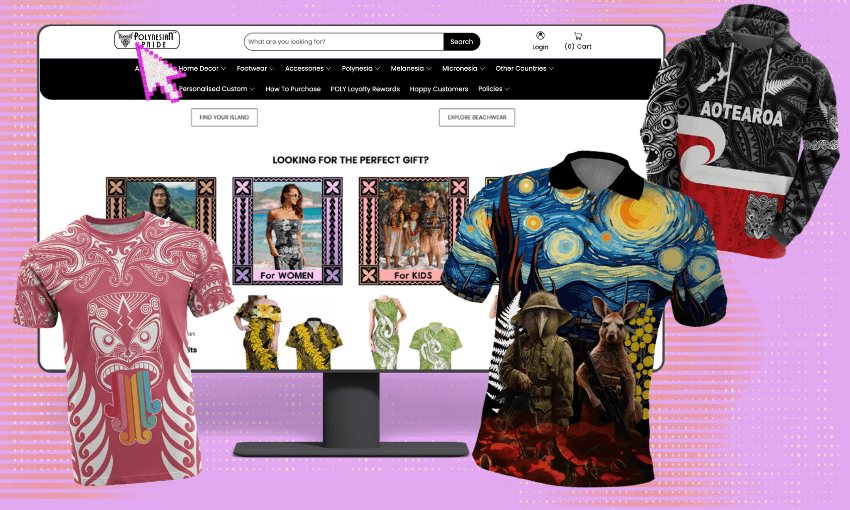
At first glance, Polynesian Pride appears to be proudly Polynesian. A number of Māori designers – including one who has accused the site of copying her design – suspect otherwise.
As Matariki approaches, a New Zealand fashion designer is warning shoppers wanting to rep Māori design to be careful about what they’re buying and where it’s coming from.
Kat Tua, who runs the menswear brand Manaaki and takes inspiration from Māori art, weaving and storytelling in her designs, recently stumbled across a webstore called Polynesian Pride. Selling a vast range of clothes, accessories and homeware items covered in the patterns, flags and motifs of the Pacific Islands, it invites shoppers to “wear your heritage” and “express your pride in your Polynesian roots”.
Polynesian Pride targets an underserved market (you can’t buy this stuff at Farmers or AS Colour). Among the 32 countries and cultures the site caters to are New Zealand, Tonga, Samoa, Niue, Vanuatu and Kiribati. Even residents of Pitcairn Island, population 35, have hundreds of items to choose from. Among the endless array of items on the site are Matariki dresses, hoodies with the Kanak flag and T-shirts marking 50 years of Papua New Guinea independence, plus a polo shirt featuring a kiwi and kangaroo holding rifles in front of Van Gogh’s The Starry Night, because of course. But look closer and you’ll notice they’re not real clothes. Instead, clear-cut garments and faceless models are overlaid with (very obvious) computer-rendered graphics. This method allows for endless iterations of each category or theme. The range is unreal and so are the people; many models appear to be AI-generated.
At first Tua (Ngāti Kahu Ki Whangaroa, Ngāti Raukawa) was surprised by Polynesian Pride’s low prices: a pair of “Toitu Te Tiriti Leggings” will set you back $39.99 and a Matariki-themed laundry basket is $45.76. “Then I realised that it was this whole massive conglomerate of Polynesian brands all merged together in this gross AI thing.” Alarm bells started to ring when she looked at the use of Māori motifs like kōwhaiwhai and tāniko, elements that traditionally carry pūrākau (storytelling). Most used by Polynesian Pride aren’t technically accurate, explains Tua. “They’ve been stylised, put through AI, and then generated and formed in a different way, and it’s actually no longer Māori.” She sees it as another form of cultural and economic extraction. “It’s just money making.”
Tua isn’t the first to call out Polynesian Pride: people have been raising concerns online since at least 2023. In 2025, designer and artist Rae Nordstrom (Ngāti Hine Waikato-Tainui and Ngāti Whakaue), AKA Native Disruptor, contacted the website after seeing one of her own patterns, a geometric design inspired by weaving that she first used on a range of skirts 20 years ago, on its products. “They’re making pillow cases, duvet covers, all sorts of things, with my design on it.” She didn’t receive a response to her email, sent to a support address listed on the site, and the products remain for sale.
But it’s not the first time Polynesian Pride has been warned about inappropriate use of Māori cultural elements. Lynell Tuffery Huria (Ngāti Ruanui, Ngāruahinerangi, Ngaa Rauru Kiitahi), managing partner of Kāhui Legal and an expert in Māori intellectual property rights, says the site has been contacted in the past about culturally inappropriate designs and has removed items from sale in response. “I would definitely encourage any artists to reach out to them, point out that they’re infringing their copyright and get them to take it down,” she says.
Polynesian Pride LLC is registered in Wyoming in the US. The business address – 30 N. Gould Street, Sheridan – is one used by thousands of other companies, according to local news outlets, where its registered agents can act on behalf of “foreign entities” under state law. The local chamber of commerce receives weekly calls from customers trying to track down companies registered to the address. According to the Polynesian Pride website, orders are “meticulously” produced and dispatched from a fulfilment centre located in Shangrao, China. Products are likely made on demand, with each design printed on generic base items. This way the business, or its contracting manufacturers, can offer a huge range while holding minimal inventory. In online comment threads, customers have complained that the products, when they do arrive, don’t look like the pictures.
It’s one of the few options available to creatives. Beyond sending the email to which she hasn’t received a response, Nordstrom doesn’t see how challenging them is an option. “It’s too costly to fight anything like that with the law.”
Tuffery Huria agrees that it’s “a real unjust situation… There’s not a lot that artists can really do about it, unless they have the financial means.” But there’s no question that using these designs is bad practice from both an intellectual property perspective and a cultural perspective. “These designs have whakapapa and they have embedded mātauranga.” She says that taking Nordstrom’s design and chucking it on a blanket is “culturally inappropriate and offensive” as well as a breach of the Copyright Act.
The law offers some fundamental protections; copyright exists as soon as someone creates a piece of work and “so long as their work is an original work, then they will own copyright in that work”, says Tuffery Huria. But challenging a breach of copyright is difficult. Although the Copyright Act grants ownership rights to an individual and their intellectual property, that means the onus sits with them to enforce those rights. Legal avenues are expensive.
Intellectual property frameworks are applied country by country, so if both nations are members of the Berne Convention for the Protection of Literary and Artistic Works, you can enforce your copyright in another member country. (Polynesian Pride is registered as an LLC in the US, where it’s “much more expensive” to take legal action.)
International moves have been made to improve design protection, like the World Intellectual Property Organization’s Riyadh Design Law Treaty, introduced in 2024 and signed by 28 countries. New Zealand was not one of them. Without domestic and international protection, Tuffery Huria thinks taonga will continue to be undermined.
Our Copyright Act is also “significantly” out of date, she says, believing it needs to be updated to address the digital era and AI, as well as the Wai 262 claim around Māori intellectual and cultural property rights.
While seeing someone repping their culture and identity through fashion is heartening, instead of shopping on online stores based abroad – or Temu – Nordstrom hopes to see more people supporting local designers. “The Māori economy is bigger than people think.” Many of them sell their work on the Facebook group Buy Māori Made, where she first posted about Polynesian Pride copying her work.
With technology making it so easy to create and distribute unoriginal work, Nordstrom is concerned about the wider impacts of digital harm on creatives, small businesses and Māori – including generative AI. “I think it will discourage people.” The online slop swamp has only continued to grow, with each week bringing more maybe-probably-definitely AI-generated models and hideous false death announcements from sports pages on Facebook. They’re murky in origin, like the clothing sellers, and exactly who is behind them isn’t always clear.
So, who’s behind Polynesian Pride? When run through an AI image detector, a picture of the supposed founder, John William, shows a 95% likelihood of being AI generated. His 73-word bio doesn’t say where he lives, what his professional background is or give any indication of his whakapapa. It does, however, describe Polynesian Pride’s products as “powerful canvas of ancestry”. But what he’s wearing doesn’t look real either.
The Spinoff emailed a number of questions to Polynesian Pride, including whether Rae Nordstrom’s complaint had been received and whether John Williams was real, but did not receive a response.
Tua believes that if John William – if he indeed exists – was passionate about his culture, he’d have consulted or collaborated with Māori. “There would be that sense of awareness or responsibility, if he was actually genuinely proudly Polynesian. The whole thing contradicts itself.” You can’t just chuck a kōwhaiwhai on a shirt and call it Māori, she says. “Kōwhaiwhai exist because usually they represent whānau and family and lineage,” Tua explains. “Don’t call it Polynesian Pride and have Māori written all over it, because it’s actually no longer Māori.”
She says it’s not about gatekeeping: “Anyone can do Maori-inspired clothing if you’re willing to learn and do it in a responsible way that’s respectful.”
There’s a market for it. And for Pacific fashion. “I think that people are tapping into that,” Tua says. “They’ve sniffed out that there’s money to be made.