A new, free festival puts marginalised writers on the main stage
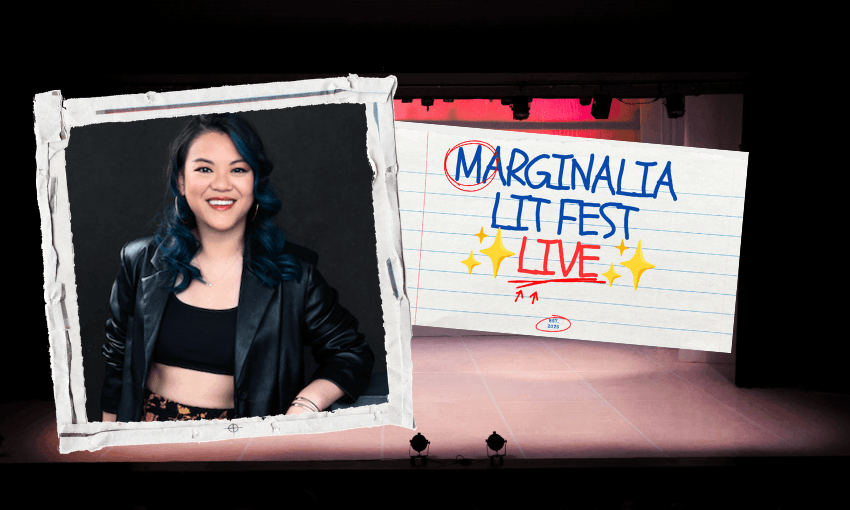
The founder of a new, free, online literature festival explains why she’s tackling ‘side-room syndrome’.
Marginalia Lit Fest Live is the freshest offering in Aotearoa’s suite of literature festivals. It’s free, online and has a very clear kaupapa: to feature marginalised authors and publishing professionals. Books editor Claire Mabey spoke to the founder, curator, technical manager, producer, host and everything else, Jackie Lee Morrison.
Claire Mabey: Hello Jackie! You must be very busy right now. Thanks so much for talking with me. Why did you start Marginalia?
Jackie Lee Morrison: I started it because my book had gone out on submission and I didn’t have anything else to do. I’d been given live permissions on TikTok and wanted to chat to people. So I set up one session and then thought, “Why don’t I just make this into a festival and set up a bunch of other other conversations as well?” So I did, and ended up with panels with people from New Zealand, Australia, the UK and the US.
CM: It was called Amplify in the first year. Why is it now called Marginalia?
JLM: When I came to this year’s festival I wanted to focus in and make it specifically for marginalised, queer, neurodiverse, POC authors and publishing professionals because at big festivals we always end up in the side rooms. We never get put on the main stage. I am always so interested to hear from those voices, but the rooms are so small and the conversation always centres around the same sorts of ideas. I felt like this was an opportunity to hear from writers I really admire and put them on the main stage.
CM: Love that. So what’s different about this second edition of the fest?
JLM: The first year I was doing panels at like three in the morning to accommodate people all over the world and I did it over a whole month. I promised myself I would not do that again, I was so tired! It’s so much smarter to do everything in one go and have an intense few days of events. It’s a lot easier for me this way, because I’m doing everything.
CM: You’re extremely good at running events. Have you worked in events before?
JLM: No! I used to joke when I planned my wedding that I should just go be an event planner. Like, I love this.
CM: So what was your life before Marginalia, and writing?
JLM: I spent most of my adult life as a professional chef, a pastry chef, and moved to New Zealand in 2016 with my husband. I opened a small baking business called Lashings, which I had for five years. Towards the end of Lashings I rediscovered my love for writing when I did Elizabeth Knox’s world building class [at Te Herenga Waka Victoria University Wellington]. I think everyone who falls back in love with writing got their second wind through Elizabeth’s class.
CM: I did!
JLM: So from there, I ended up doing the master’s at the IIML. These days I only cook for the love of it and work as a full-time freelance writer and editor. I’m re-working my novel, too.
CM: So why did you go online, instead of in-person, for Marginalia?
JLM: I think streaming live is great. I always thought that the best thing about doing a festival online would be that you can watch it at home and be comfortable. I think this probably also comes from me being neurodivergent. I know that when I have to go somewhere and sit in a room and listen to people talk my ADHD means that I’m a bit uncomfortable. I can’t really sit in the way that I want to sit because it’s not socially acceptable. So online takes the barriers away: you can watch in bed, or on the sofa covered in cats! That goes for the participants, too.
CM: And what should first-timers to Marginalia expect in terms of the chat?
JLM: Amazing conversations with authors and publishing professionals who you probably don’t know but you should definitely get to know. The topics are wide-ranging but one of the topics we’ll definitely be hitting on is how tricky it is to be a marginalised author in an industry that often promotes a particular kind of person. I also think we’ll be hitting on the idea of “pretty privilege”. I think there’s a lot of pressure on people to look a certain way, behave a certain way and be a sort of role model, which I have feelings about.
CM: Tell me more about that? For those who maybe aren’t aware that publishing is not a diverse industry, could you perhaps explain a bit more what it means to be marginalised within it?
JLM: The thing about publishing is we don’t know a lot about how publishers decide what not to put money into. What they do put money into is very often middle-aged white men and women who often already have a comparatively huge following. As a result, up-and-coming authors, especially POC, queer and neurodivergent writers, are treated like an anomaly and then just pushed into a corner. We’re always in the side rooms, and it’s only if you tick boxes like “young”, “pretty”, “overcame challenges” that you get put on a big stage because you’ve become a shining beacon of a marginalised writer.
CM: It comes back to the problems with the industry being orchestrated to support certain kinds of voices for certain kinds of audiences, eh.
JLM: Yes. I also have issues with competition aimed at marginalised voices: like imprints that publish specifically marginalised writers. It’s a little like, well why do we have to have a specific category? Why can’t we be considered part of the whole?
CM: Such a good point.
JLM: While at the same time we need those opportunities, they do help people. But it does create more separation.
CM: Which Marginalia events would you encourage people to see if they’re new to the idea of a lit fest?
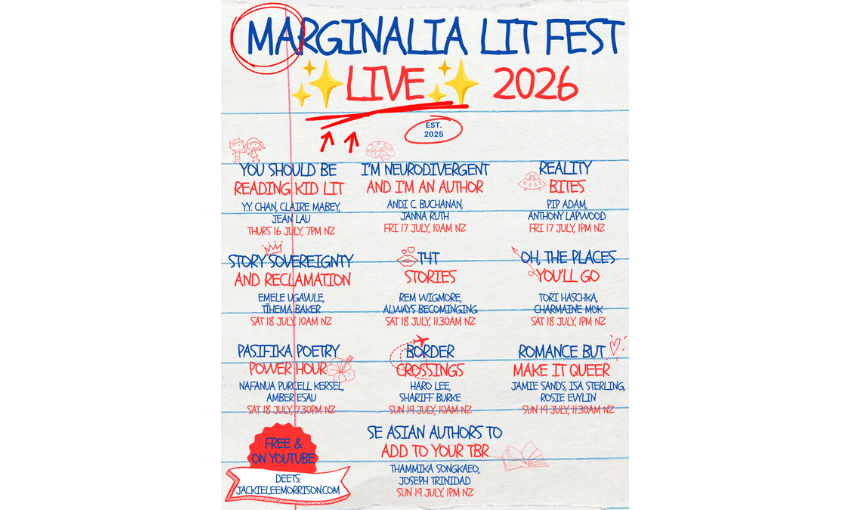
JLM: Oh, that’s really hard. But the three that I think a newbie would really enjoy are ‘You Should Be Reading Kid Lit’ with Y.Y. Chan and Jean Lau and yourself, because I think adults can get so much out of children’s literature which is very often undermined as just for kids and therefore not as serious or worthy as adult lit. ‘Reality Bites’ with Anthony Lapwood and Pip Adam which is about speculative fiction. And ‘Oh, the Places You’ll Go’, with Tori Haschka and Charmaine Mok, which is going to be about all the places writing has taken Tori and Charmaine, so a great one as an intro to lit festivals because it’s not necessarily about books but about the life of a writer.
CM: Brilliant. Do you have hopes and dreams for Marginalia? Or are you taking it more organically, year by year?
JLM: I do have a little dream, which is that I would really love to do some of it in-person and some of it online, but still have everything streamed online and still free. I would love some sponsors so I can pay contributors. A lot of the time marginalised creators are expected to offer their time for free, and I don’t agree with that.
CM: How was it getting writers to join the festival?
JLM: Everyone I asked said “yes”, which was wonderful.
CM: That’s really cool. It’s hard to start things up and then keep it going.
JLM: I also want to extend Marginalia into the year and do a podcast, maybe once a month, with a food element.
CM: Great idea to keep people fed year-round.
JLM: It gives me an opportunity to get more in depth with individuals because Marginalia is more about panels. I try to have at least two people because I think conversation is richer, and also they get a chance to talk with peers. I think that’s an enriching experience.
CM: That’s what I’m loving about Marginalia – the connections being made across time and space!
JLM: It’s really all very selfish of me. This festival is everything I want to see with people I want to hear from. So I’m just glad and excited that other people are excited about it as well. It’s a little project from my heart, and I hope people connect with it and that they want to see more.
Marginalia Lit Fest Live steams between Thursday 16 – Sunday 19 July. Full details online, here.