‘There really is no book like it’: Sam Brooks’ most memorable reading experience
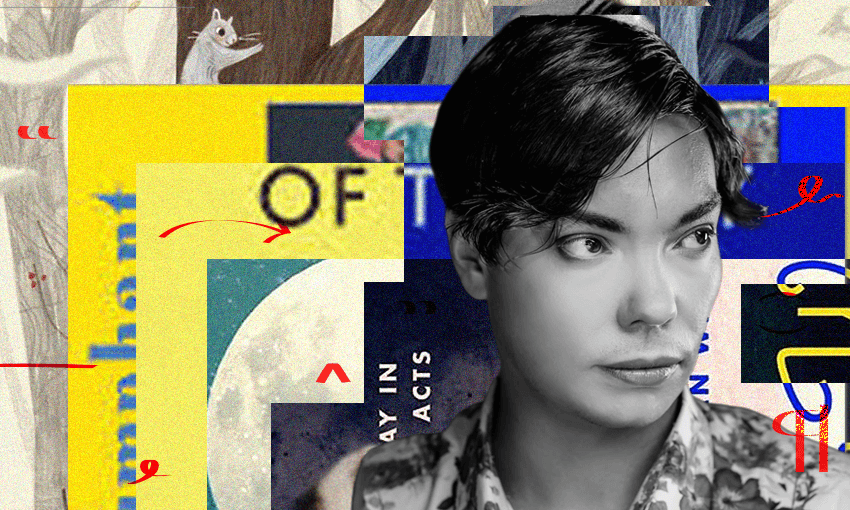
Welcome to The Spinoff Books Confessional, in which we get to know the reading habits of Aotearoa writers, and guests. This week: playwright Sam Brooks, curator and producer of Firing the Canon, a free play reading series.
The book I wish I’d written
The Hours by Michael Cunningham. I read it once a year, every year, usually as the first book of the year. I first read it in high school where I absolutely understood it without really understanding it, and as I age, the beauty, the sadness, and the dark undercurrent of it feels even stronger. It takes the adage “life is for the living”, which is about as trite as can be, and turns it into something profound, and affirming.
The book everyone should read
The Remains of the Day by Kazuo Ishiguro. It’s another one I try to read every year, and it gets more prescient every year, not just due to the unrequited love story at the centre, but about the cost of silence.
The book I want to be buried with
I have a rare copy of a book by someone I personally and professionally loathe that I would appreciate being buried with so nobody else has to read it.
The first book I remember reading by myself
I didn’t read a lot of books for children, and didn’t read much until I was 10 but for some reason Farthing Wood is sticking out. I’ve never gone back to it because of how much it traumatised me.
I wish I’d never read
When I worked at The Spinoff I was assigned to write a “best revelations of” a book about WhaleOil. It improved nobody’s life.
Utopia or dystopia
I have kinetomorphobia (fear of zombies, and yes I learned the name of the fear so it sounds more legit) so definitely utopia. The undead pop up less there than in dystopia.
Fiction or non-fiction
A cocktail of the two! I make a meticulous list of everything I read and when I read it, so if I’m reading too much fiction, I’ll throw some non-fiction in there and vice-versa. There’s so much craft that goes into both, and so much to learn about storytelling from both of them.
It’s a crime against language to…
I am notoriously bad with grammar (hello editors past, present and future) and so I think it is a crime against language to be a stickler about craft and form so much that it stifles storytelling rather than aids it. The word “gatekeeping” is so overused now, but some people’s requirements for perfect grammar over meaningful storytelling comes pretty damn close to that for me.
The book that haunts me
Our Town by Thornton Wilder. Most millennials are probably familiar with it from that one episode of My So-Called Life, but it’s one of the most profound and beautiful works of theatre about being in community. It hasn’t aged a single day in almost a century. Emily Webb is one of the great creations of the 20th century.
The book that made me cry
Joyful and Triumphant by Robert Lord, which we’re reading as part of Firing the Canon. It’s New Zealand’s greatest family drama, following one family through Christmas dinners across 40 years. I’ve read the play so many times, but there’s still one moment that hits me like a gut punch.
The book that made me laugh
When I was looking at plays to do for this second season of Firing the Canon, James Wenley recommended I check out Setting the Table by Renée, which I hadn’t read since university. This comedy, about a flat of women in Ponsonby rehearsing a satirical review, has lost absolutely none of its bite. Comedy generally ages like mud, and it’s perhaps an indictment on our society that Setting the Table has lost none of its relevance.
The book I never admit I’ve read
The Bible, front to back. I was trying to adapt a story from it into a gay play but couldn’t crack it. I’m not an expert on whether The Bible lends itself to interpretation, but it sure doesn’t lend itself to adaptation.
The book character I identify with most
Emma, from Austen’s Emma. Not necessarily for the matchmaking thing, but because Emma is absolutely the biggest problem, and undoubtedly, the villain, in the book Emma. When I say I understand her, I do not mean that as a brag because she’s kind of terrible. (You’ll notice that all Austen novels are named after the problem at the centre of them.)
Most overrated book
Tomorrow, and Tomorrow, and Tomorrow by Gabrielle Zevin. I gave it a scathing review at the time, but it genuinely bewilders me when I see how many readers are won over by this microwaved Before Sunrise nonsense which has about as much insight on games, gamers and gaming as the average fandom sub-reddit.
Most underrated book
Hoods Landing by Laura Vincent. It might feel weird to say that given it was shortlisted for the Ockhams, but my appreciation of Vincent’s ability to capture the complexities of the family at the centre of the novel only increases over time. It’s become my go-to recommendation for anybody looking for a book to read, and if you’re not a reader but want a gateway into it, Hoods Landing is it.
Encounter with an author
Does Jacinda Ardern count as an author? I wrote a play in 2018 named after her: a ridiculously overblown attempt to do Angels in America set in the three weeks between the 2017 election and Ardern becoming prime minister (I cannot in all good conscience call it a success). She signed the title page, which feels surreal now because of basically everything that happened after 2018, and also because her handwriting is borderline illegible so it really could be anybody’s signature.
Greatest New Zealand book
I have no idea where general consensus currently stands on it but The Luminaries is such a feat of ambition, craft and audacity. I read it in a day with a couple of wines, and it’s one of my most memorable reading experiences. There really is no book like it.
Greatest New Zealand writer
Playwright Maraea Rakuraku is my stake in the ground here. Te Papakāinga, about a village struggling to cope with the death of a child, is one of the great works of New Zealand theatre, and it’s an indictment on whoever makes programming choices that it’s never been put on.
Best thing about reading
It makes your brain, your world, your sense of what’s possible better. There’s no greater feeling than reading the right words in order.
What I’m reading right now
Your Name Here by Helen DeWitt and Illya Gridneff. It’s well overdue to be returned to the library and I generally find DeWitt’s stuff quite daunting, so after I file this it’s going to be my goal to get it done.
Firing the Canon, a play reading series revisiting the theatre canon of Aotearoa, plays at Basement from June 25-27.