The top tidbits and takeaways from New Zealand’s first Michelin ceremony
It’s taken the Michelin Guide 125 years to reach NZ. Was it worth the wait?
The anticipation has been at a rolling boil. After months of headlines, speculation, fervour and criticism, nearly 500 people were gathered in a room to find out who made the grade. Among them, household-name chefs like Peter Gordon, Michael Meredith and Sid Sahrawat; minister for tourism and hospitality Louise Upston and Auckland deputy mayor Desley Simpson; and local media, which has been feverishly covering the French tyre brand’s interest in Aotearoa.
We weren’t in a restaurant, but rather the New Zealand International Convention Centre in Auckland. An ambitious multimillion-dollar endeavour befitting another ambitious multimillion-dollar endeavour: bringing the internationally renowned Michelin Guide to our humble southern isles. Guests were greeted by a red carpet but no bubbles – that was for after the ceremony. It was a brave decision and did nothing to take the edge off pre-show nerves. On stage MC Sonia Gray, Michelin Guide’s international director Gwendal Poullennec and the Michelin Man himself…
… dished out a shitload of stars
Most people expected one or two. René de Monchy, head of Tourism New Zealand, said he’d hoped for “one in each region”. (The guide is focused on Auckland, Wellington, Christchurch and Queenstown.) What Aotearoa got was 14 single stars and one two-star restaurant. Awarded one star were Auckland’s Ahi, Mudbrick, Paris Butter, Tala, The Estate; Wellington’s Jano Bistro, Logan Brown and Ortega Fish Shack; Christchurch’s Inati and Tussock Hill; and Queenstown’s Amisfield, Kika, Rātā and Sherwood.
Chefs aren’t usually a loquacious bunch and the thank you speeches were more amuse-bouche than main course. Mudbrick’s Mrinal Ghosal accepted theirs with a classic “chur New Zealand” as well as a “yeah, nah”. Zennon Wijlens, collecting Paris Butter’s star alongside co-chef Nick Honeyman, revealed he had “the drys” and that this wasn’t on their bingo card this year.
‘Dedication, talent and the pursuit of excellence’
That’s what we were there to celebrate, said Poullennec, explaining this was the furthest that Michelin had ever travelled and their inspectors were impressed by the quality of our produce and restaurants’ “connection to land and sea”. He explained that all the decisions were made collectively and his inspectors, who spent a month here, “always pay their own bill”.
The tension ramped up for the two-star winner. “The chef is with us in the room,” said Poullennec. Cameras began stalking the crowd alongside roving (and very hot) spotlights. They found Paul Froggatt, head chef of Essence, an ultra-high-end restaurant located in a luxury hotel on the shores of Lake Wakatipu that you probably haven’t been to. He punched the air and got the second standing ovation of the night.
Before all the stars, the 60 restaurants included in the Michelin Guide (but not receiving stars) were announced. Auckland counts 1947 Eatery, Ada, Advieh, Alma, Baduzzi, Bar Magda, Bossi, Cassia, East, Esther, Gilt, Hello Beasty, Jervois Steak House, Ki Māha, Kingi, Kol, Lillius, Metita, Morell, Mr Morris, One Tree Grill, Onslow, Origine, Otto, Ragtag, The Lodge, Sails and The French Café. Wellington has 50-50, Boulcott Street Bistro, Charley Noble, Damascus, Floriditas, Graze, Highwater, Kisa, Koji, Margot, Napoli, Ombra, Rita, Rosella and Shed 5. Bessie, Cellar Door, Hugo and Miro from Christchurch made the cut too. So did Queenstown’s Arc, Bianca by Giovi, Billy’s, Botswana Butchery, Jervois Steak House, Millhouse, Nest, The Lodge, Soda, The Dining Room, The Woolshed, Toast & Oak and True South Dining Room. (If you’re counting, that’s two each for Michael Meredith, Sid Sahrawat… and menswear retailer Rodd & Gunn.)
Another 35 restaurants were awarded the Bib Gourmand, which denotes “great value” (though none of these places are cheap). There’s Apéro Food & Wine, Atelier, Bianca, Bistro Saine, Boda, Cazador, Gemmayze Street, Goat, Milenta, Osteria Uno, Parro, Pasta & Cuore and Tempero from Auckland. The capital’s 1154 Pastaria, Cicio Cacio, Hummingbird and Indian Alley. Christchurch restaurants A’mano, Earl, Fire And Slice, Gatherings, Londo, Odeon, Roca, Soul Quarter, The Athens Yacht Club and The Monday Room. And Aosta, Bombay Palace, Francesca, Muttonbird, Paloma Taqueria, Sundays, The Cow, and Treehouse from the Queenstown-Wānaka region.
And Michelin didn’t stop there. Special awards were given out to three “outstanding individuals”: Stina Persen from Graze (service), Robert Fairs from Londo (young chef) and The French Café’s Matthew Aitchison (sommelier).
Henry Onesemo made history
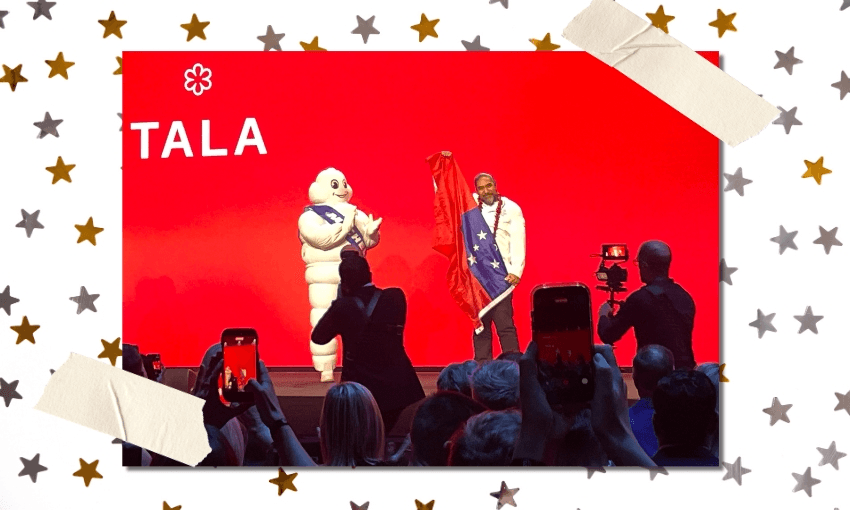
The first star of the night went to Tala, the first and only Samoan restaurant in the world to receive the honour. Chef Henry Onesemo looked shocked and on the verge of tears as he mounted the stage and unfurled a Samoan flag, helpfully held by the Michelin Man (whose official name is Bibendum), who finally had more to do than give a thumbs up. I caught up with him (Onesemo, not Mr Michelin) before the ceremony.
Standing by the wall (he’s shy), Onesemo said he’d nearly thrown up three times. “I’m just nervous to be around a lot of people.” Tala, the innovative restaurant he runs alongside wife Debbie, seats only 24 guests at a time. They opened it in 2023 but Onesemo had been working towards the dream for years. He started staging (culinary speak for interning) 12 years ago in one of Michael Meredith’s restaurants. “I went there to try and learn something, and here we are in the same room,” he said. “Just being here, with Michael, is mind boggling.”
Everyone was emotional
Sonia Gray, MCing the event, kept saying so. She was moved to the point of distraction, forgetting to give one winner their microphone and another’s introductory blurb. The laidback, personable ceremony felt very “Kiwi”. Although chefs are generally considered a stoic bunch, some were moved to tears and there wasn’t an onion in sight.
We all got to eat some Michelin-starred food
Amid much more sedate music and some long-awaited booze, attendees explored a “tasting pavilion” that dished out food from Michelin-starred chefs. The menu delivered inventive hors d’oeuvres with a Kiwi twist; palusami and “lau moli” from the Tala kitchen, L&P reimagined by Taiwanese chef Nobu Lee, abalone chawanmushi by US chef Michael Cimarusti, feijoa mallow puffs by Logan Brown, and Ahi doing interesting things with beef, caviar and pikopiko.
Everywhere people were popping canapés in their mouth and saying “wow” with a camera in their face. A small army of tiny microphones captured more nuanced takes, including what this means for New Zealand food. There was a lot of content being captured; Patrick Chew, who produces editorial for Michelin in Asia and the Middle East, and his crew were talking to chefs about their work. He reckons New Zealand food is “fantastic”. Circling around the crowd was a migrating food activation that involved cutting your own poppy-esque ice blocks.
It was a bit like a UFC match or a megachurch service
Between the bright sweeping lights and pounding dramatic soundtrack, it felt like being at a UFC match or a megachurch. I guess competitive physical sacrifices and the expense of being an acolyte are things you’ll find in the restaurant industry too. The ceremony began with a countdown soundtracked with a heartbeat and ended with all the star-awarded chefs lined up, like prize fighters, across the stage for photo ops with assorted stakeholders and the Michelin man himself.
Some people were missing
There were 500 people expected to attend but not all the chairs were filled. There were some surprising omissions from the invite list, too: Auckland’s Japanese degustation restaurant Cocoro and its chef Makoto Tokuyama, which has three Cuisine hats, was missing from the guide; as was Plabita Florence and Forest, Metro’s 2024 restaurant of the year; and Lyttelton’s Mapu, run by awards regular Giulio Sturla.
Chefs don’t get out much
They’re usually tethered to their kitchens and work ungodly hours, so this was a rare chance for New Zealand chefs to a) leave them and b) see their peers. Most were wearing their whites, which was charming and also helpful for knowing which restaurants were there. Everyone kept saying how nice it was to be with each other, especially after a challenging few years. “Every other day we hear about a restaurant closing,” Henry Onesemo told me. “I just want to forget about the bad news.” It looked far from everyone’s minds; convened in the cocktail area after the ceremony, a murmuration of chefs talked shop and had fun.
The pressure’s not over
Keeping a Michelin star is a challenge in itself. Losing one can be devastating.
It’s still a man’s world
Of all the chefs that came on to the stage only one, Ortega Fish Shack’s Teresa Pert, was a woman.
Tourism New Zealand is going long on food
This is all part of Tourism New Zealand’s strategy; it wants New Zealand to be a food destination. The Michelin Guide is about selling Kiwi cuisine and they think it could entice 36,000 more international visitors here.
Talking after the ceremony, amid the cocktail swilling and finger food, René de Monchy explained that although “some people are Michelin travellers” it’s a “pretty niche” group. However, everyone eats and most tourists are interested in food; “80% of people say trying local cuisine is something they want to do, but they don’t always know what’s on offer.” He thinks that the guide will help them find it and have a flow-on effect to the wider hospitality industry. “It goes beyond just Michelin… there’s great food and beverage all across the country.”
The partnership, which has cost New Zealand $6.3 million over three years (some of it from the International Visitor Levy) promises to deliver another two guides. The spend covers elements like assessment and promotion. The goal of bringing it here was to increase food-related tourism to New Zealand, which has a ripple effect for other hospitality businesses. (Australia turned down a similar, though much more costly, opportunity last year.)
New Zealand is already a powerhouse when it comes to food. Louise Upston used her welcome speech to remind us that New Zealand feeds 40 million people around the world and hospitality is vital to our economy, contributing $9 billion to GDP. The sector employs 193,000 people.
There are hopes that Michelin will expand its scope
Poullennec said this was “the beginning… a first step”.
When it came to awarding stars, Michelin’s inspectors largely blessed high-end restaurants with menus based on kitchen gardens and foraging. “Many of the restaurants are the same ilk,” noted food writer Johanna Thornton, former judge of Viva’s restaurant awards. “It celebrates a certain type of restaurant.” She hopes to see a wider variety of restaurants recognised next year. (Yes, there’s a next year; the partnership spans two more years at least.)
There’s been plenty of criticism levelled at the cost, supposed benefits and the guide’s four-city focus. Two of the country’s best restaurants, Blue Duck Station and Craggy Range, were out of contention due to their location. Restaurateurs outside of the main centres have criticised the guide’s largely urban scope, including Liz Buttimore, co-owner of Arbour in Marlborough, and Karl Martin-Boulton from The Green in Hamilton.
At the moment Tourism New Zealand says it’s focused on the four regions, confirms de Monchy, where two-thirds of the country’s restaurants are located. “But we’ll certainly assess it.”
It’s not just about the chefs
Several chefs were at pains to point out that there are a whole lot of people who make a great restaurant Michelin worthy. “Stars do not happen without everyone – front of house, back of house,” said Paris Butter chef and co-owner Nick Honeyman of what he (politely) told the crowd were “chef-centric awards”. Talking to The Spinoff after the ceremony, an “overjoyed” Paul Froggatt said that Essence’s two stars weren’t his alone. “This is teamwork,” he explained, from the front of house to the back, the dishwasher and the people who deal with the rubbish. “I’d like to thank the team, my wife, my children… everyone who made this happen. It’s not just me.” He had a glass of bubbles in hand. Finally.