What’s the greatest HBO show of all time?
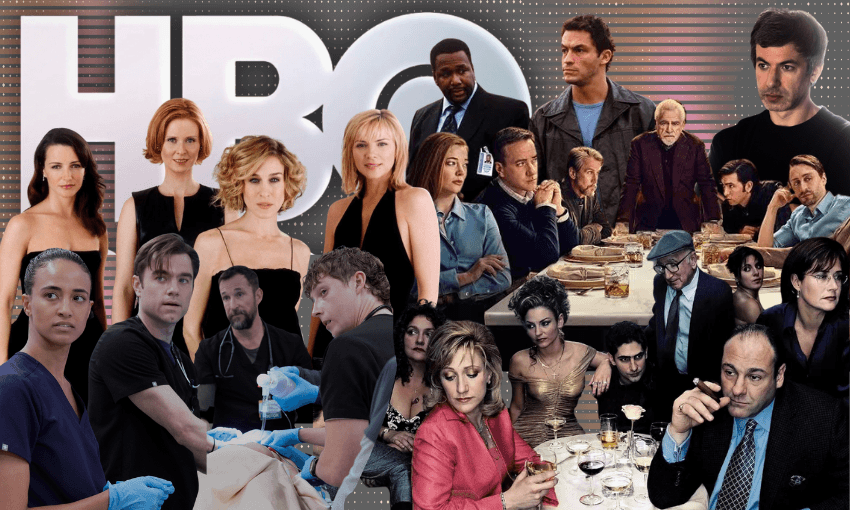
There are so many classics but only one can come out on top. Ten Spinoff writers make their cases for the greatest Home Box Office (HBO) Original of all time + vote for your winner.
There’s nothing more reassuring when you start a new show than hearing that low tone and seeing the HBO static logo appear. An early marker of prestige television, HBO has become synonymous with shows that stand the test of time, and continues to pump them out – including shows currently mid-run that will likely appear in future lists of HBO greats (The White Lotus and Industry, to name just two).
There are far too many to choose from, but 10 Spinoff writers have each selected their ultimate show and argue for the crown of Greatest HBO Show of All Time.
Vote for your winner at the end.
The Sopranos (1999-2007)
I can’t speak to the cultural phenomenon of The Sopranos as I wasn’t even in utero when this first landed on HBO. But it’s a testament to its brilliance that, even when you watch it more than 20 years on, you see clearly why so many people say no series since produced could hold a candle to it.
The Sopranos is a tragicomedy about the modern-day mobster, a show which supports the HBO hypothesis that the worst characters make the best characters. You get up close and personal in the lives of criminals who deal with so much blood, sweat and shit that Tony Soprano’s pretend job in the “waste management business” actually rings true. It’s dialogue-heavy, but it’s also genuinely television of Shakespearean levels. It’s also likely not what you think: underneath all the violence, it’s really just the story of a man conflicted by everything about himself, told through his eyes to his therapist.
Oh, and they mentioned New Zealand one time. / Lyric Waiwiri-Smith
Game of Thrones (2011-2019)
Whether you were watching on your laptop at home alone or with a bunch of colleagues at The Spinoff HQ – as we did for one season finale or another – every episode of Game of Thrones was a television event. God, what a show. It wasn’t just the battles – though they were edge-of-seat, heart-in-mouth gripping television – it was the scheming, the plotting, the twists and turns. And the dialogue! Tyrion’s quips, Cersei’s takedowns, Bronn’s insults, Stannis Baratheon’s endearing grammar pedantry… many a meme was born from this show. Don’t get me started on the characters, either. Most programmes have a couple of good ones and a host of forgettables, but GOT had depth. Remember Lord Varys? Littlefinger? It wasn’t just the despicable ones who were endlessly watchable either. Brienne of Tarth, anyone? The Hound? Olenna Tyrell? Tell Cersei. I want her to know it was me.
OK, some of them did some quite despicable things, but you couldn’t help rooting for them. That was the power of this show. Luckily the Westeros universe continues to scratch the ‘Thrones itch with Knight of the Seven Kingdoms and House of the Dragon (season three streaming now). / Alice Neville
The Pitt (2025-)
If you ever feel like you’ve had a hard day at the office, fire up The Pitt (either season) and rejoice in the fact that your office is not the emergency department of the Pittsburgh Trauma Medical Center with Dr Michael ”Robby” Robinavitch as your boss.
Some shows are comforts, others are high drama and comedy. Then there’s The Pitt, an in-real-time medical drama that will have you sweating and crying simultaneously. Never before has a show felt so immersive, filled with deeply flawed characters who you just want to be OK. After only two seasons, it’s already cemented itself as one of HBO’s greats, winning more awards for a single season than any other show on this list (five Emmys this year alone for its first season). The question isn’t whether or not this is one of the best shows on TV, it’s how many years will we get to bask in its glory? / Madeleine Chapman
Curb Your Enthusiasm (2000-2024)
I don’t think there’ll ever be a show with a wider gap between how dreadful it sounds on paper and how good it is in reality. Larry David’s post-Seinfeld comedy in which a loosely fictionalised version of himself argues and complains his way through a life of wealth and luxury in LA ran for 12 seasons from 2000-2024, and instead of falling off in quality like most comedies, some of its best episodes came right toward the end of that run. Now, David has turned his curmudgeonly eye to history, with the upcoming Life, Larry and the Pursuit of Unhappiness (out June 27), which will surely continue his undefeated television run.
In the meantime, Curb Your Enthusiasm remains quotable and meme-able while still offering plenty of forgotten gem moments on repeat viewing – pretty, pretty, pretty good indeed. / Calum Henderson
Veep (2012-2019)
Morals? Never heard of them. Lobbying? Totally fine. Walk and talks? High heels only. Egos? Unimpeachable. The genius of Veep is that it plays things straight. The best political series ever to air on television, this Emmy-winning show about bureaucratic ineptitude and capricious policy makers has only become more relevant since its debut in 2012. (I rewatch it annually.)
Showrunner Armando Iannucci is a high master of political satire, and Veep shows how brutally politics works, or rather, doesn’t; achievements and progress are scant and everyone is selfish, hapless, or both.
The acting is first class. Julia Louis-Dreyfus won six consecutive Emmys for her performance as vice president Selina Meyer. As good as she is – so, so good – it’s the many players in her orbit who make the show what it is. They carry around their ambitions and sacrifices with the diligence of Selina’s devoted bag-man Gary (an award-winning performance from Tony Hale). Their jobs are destroying them; physically, emotionally, morally. The point of it all is to win, not improve the lives of Americans.
Offscreen, here in the real world, the more absurd politics becomes the more I turn to Veep. Not for answers. Not for explanations. But because it feels savagely accurate. And you can laugh about it. / Emma Gleason
The Wire (2002-2008)
As addictive as the narcotics its corner boys sling, The Wire, set in Baltimore, initially looks like classic police vs drug dealers schtick, and then quickly expands to become a layered exploration of the failure of the US War on Drugs, the country’s inequities and systemic failures, and like all decent art, the human condition. Created by former journalist David Simon and former detective Edward Burns, it’s full of superb acting (it launched Idris Elba and Dominic West into the big time), and dialogue so memorable, it’s still frequently thrown around close to two decades after the show wrapped (“sheeeeet!” “re-up”). / Veronica Schmidt
Succession (2018-2023)
Succession is so good and I am so embarrassing that those first piano chords of Nicholas Britell’s theme send a shiver of thrill down my spine every time. A blisteringly funny, unapologetic, sometimes unhinged saga of excess, ambition and unwarranted wealth, this is that rare kind of television that is brilliant on the first watch and somehow gets better with every repeat viewing.
The characters! Contemptibly magnetic, profoundly shallow, and electric in pairs: Gerri and Roman, Tom and Greg, Logan and anyone.
The scenes! Roman rapping for his dad in Scotland. Boar on the Floor. Logan and Kendall going before the Senate in perfect rhyme with Robert and James Murdoch.
And Shakespeare could only dream of such dialogue. “I love you, but you are not serious people,” for example. Or, “If it is to be said, so it be, so it is.” Or, “Buckle up, fucklehead.”
Creator Jesse Armstrong resisted the powerful temptation to fire up a spinoff or just keep going forever, getting out of there after four seasons, blazing still, not with a whimper but a bang. / Toby Manhire
Sex and the City (1998-2004)
The pink singlet. The white tutu. The New York skyline and that city bus, hooning past Carrie Bradshaw and drenching her in a filthy New York puddle. No other show changed the landscape for female storytelling in the late 1990s like Sex and the City, which followed four single, independent women and their unapologetic sex lives. But rather than focusing just on the men that Carrie, Miranda, Charlotte and Samantha encountered on the New York dating scene, Sex and the City was a celebration of female friendship and those vital, vibrant platonic relationships that define our lives. And it was funny, too. Basically, Carrie Bradshaw walked (in Milano Blahniks) so Hannah Horvath could run. / Tara Ward
The Rehearsal (2022- )
The HBO canon is rich with jaw-dropping memorable final episodes from the hot mic mutterings of The Jinx to those breathless last moments of The Sopranos, but in my opinion nothing comes even remotely close to the final episode of The Rehearsal season two.
It is very hard to write about something as bizarre, genre-bending and galaxy-brained as The Rehearsal without it sounding like the most pretentious university art project ever made. Creator Nathan Fielder first rose to fame with Nathan For You, in which he saved small businesses in outlandish and novel ways (Dumb Starbucks, viral goat rescue videos, poo-flavoured yoghurt). But even more resonant than his joke solutions was what he revealed in the participants: a culture still utterly desperate to be on television at any cost.
In The Rehearsal, Fielder’s fixation on fame, performance and television itself gets dialled up to 11. Season one saw Fielder obsessing over rehearsing moments of social life and domesticity, eventually simulating his own home life on an HBO sound stage. Although season two opens with a more narrow focus – the number of plane crashes caused by miscommunication between pilots – it soon throws the emergency exit wide open and leaves you tumbling in a freefall through all the horror, beauty, hilarity, tragedy and poetry that comes with being a person.
And believe me: you simply will not believe how he sticks the landing. / Alex Casey
Barry (2018-2023)
There’s a scene in Barry where the titular character is being interrogated by federal agents. “That guy’s here to kill me,” he says, pointing to one of the suits in front of him. The camera cuts to a man hyperventilating and sweating profusely. “No way,” say the interrogators, as the assassin steps forward and promptly blows his own fingers off with a malfunctioning doohickey.
It’s the collision of the serious and stupid that makes Barry so compelling. Plenty of shows are about the banality of evil. Barry leans more heavily into the mundanity of evil. Its lead is a psychopathic serial killer, for sure, but only as a humdrum day job that’s distracting him from his true passion, acting.
In episode seven of the first season, Barry commits a murder so gut-wrenching it paints every moment leading up to it in a different light. By the end of the episode he’s using it for material on-stage. Barry’s disdain for profundity is its most profound quality. If it didn’t make you laugh, you’d cry. / Hayden Donnell