‘Getting closer and closer’: on Beijing’s ballistic missile in the Pacific
The military message may be meant chiefly for others, but the reverberations for New Zealand are clear enough.
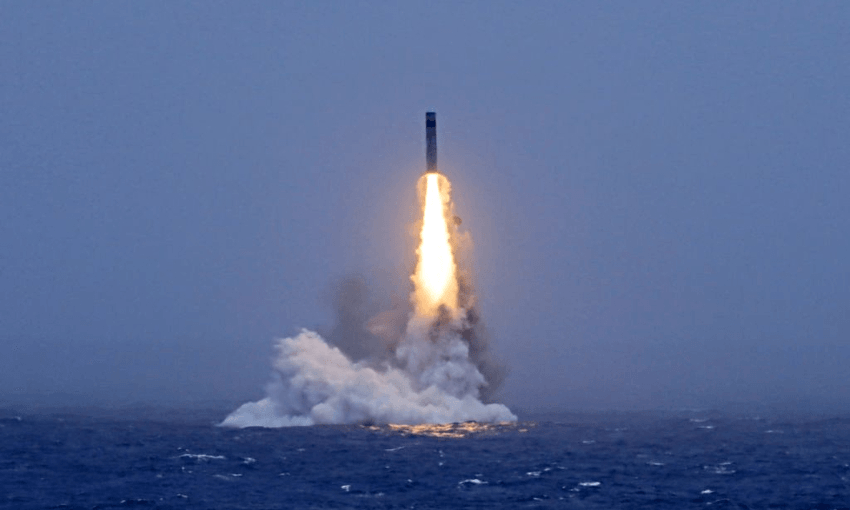
On Monday afternoon, an intercontinental ballistic missile was launched from a People’s Liberation Army submarine into the South Pacific. To the US, it formed part of a “rapid and opaque nuclear weapons buildup [that] is of great concern to the region and the world”.
Beijing insisted the test was “routine”, warning others not to “overinterpret it”. But at the same time, the state-controlled media ran numerous stories on the missile launch, with a Global Times editorial trumpeting, “the stronger China’s strategic nuclear forces are, the more regional peace is guaranteed”.
While China was “testing for their only technical reasons”, said Anna Fifield, speaking on the Spinoff podcast At Large with Toby Manhire, “they are also certainly sending a signal. They want everyone to see.” A heads-up was given a few hours ahead to Japan, Australia and New Zealand (foreign minister Winston Peters called the test “deeply concerning”), but that no warning had been offered to the US underscored the dynamic. “It’s all part of that great power competition,” said Fifield. “The two sides are flexing their muscles.”
Fifield, a former Beijing correspondent for the Washington Post who today writes the World Bulletin for Spinoff members and the Between Giants newsletter, said the launch was part of a wider pattern in which Beijing is asserting itself across the Asia-Pacific. That includes pursuing claims in the South China Sea and displays of military power and reach. “Last year we saw a PLA Navy taskforce go through the Tasman Sea and conduct livefire exercises. They did not let Australia or New Zealand know at the time … They’re wearing down people’s defences and building up people’s tolerance so that eventually, by stealth or increments, they can stake a claim to be the power in this part of the world.”
The missile, armed with a dummy warhead, reportedly hit the water about 1,000 kilometres north-east of Solomon Islands, and into a region where the US and China are engaged in an ongoing wrestle for influence. “It will be interesting to see how the Solomon Islands reacts to this, given the fact that they do have the security and policing deal with China,” said Fifield.
For New Zealand, “while we like to think that our isolation will protect us, that geography is our best insulation”, such demonstrations “increasingly show that it’s not, that the world, that China, is in many ways coming to us … China is showing more and more interest in our region, which, of course, is making the United States also wake up and pay attention again and realise that this is a sphere of influence up for grabs. Of course, neither of these sides is really giving that much agency to the people who live there in the first place and have sovereignty, but it does just show how this geopolitical game is getting closer and closer to us.”
Simultaneous pressures from China and the US just ratcheted up the pressure on New Zealand’s position in balancing its interests between the two powers, said Fifield. “We have traditionally had our security relationships with the United States and our economic relationships with China. Increasingly, security and economics are intertwined, and it’s really hard to unravel the two. So we are, as with many other countries across the Pacific and across Southeast Asia, trying to hedge more and more, to keep in between both sides. That is going to become more and more difficult in situations like these.”
To get every episode of At Large with Toby Manhire in your podcast feed, follow here for Spotify, or here for Apple. If you’re YouTube-minded, you can subscribe to the Spinoff here and find all the episodes here.