A battle over the bare minimum at Auckland Council
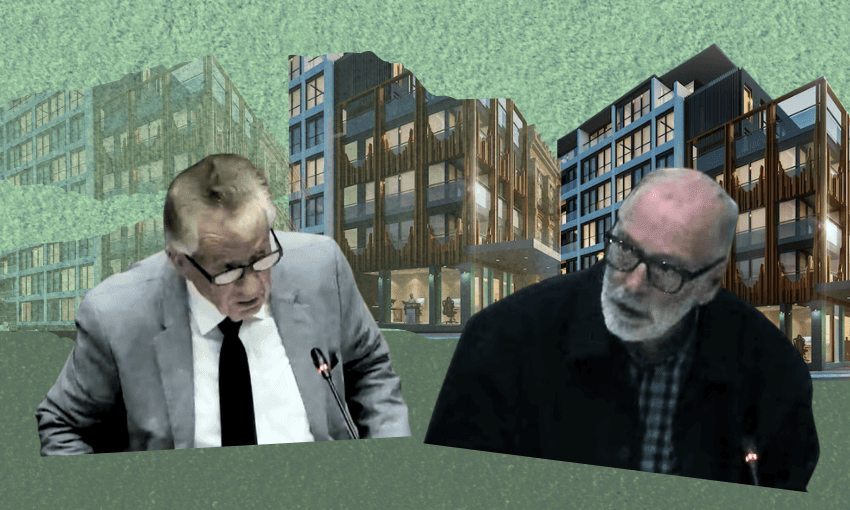
One councillor said tall buildings contribute to global warming. Another said Auckland doesn’t have a housing crisis.
Wayne Brown was already grumpy by the time the council’s latest housing debate rolled around. Auckland’s mayor had sat through a pair of lengthy, at-times fractious discussions to kick off his council’s policy and planning committee meeting on Tuesday. The first focused on the council’s submission on the government’s move on orders legislation, and he got into two separate fights. One was with the Auckland Ratepayers’ Alliance. “One of the worst offenders for begging is the Auckland Ratepayers’ Alliance, who are out there begging online all day long,” he said. The second was with one of his regular combatants, Waitematā councillor Mike Lee. “You escape to an island mate, I live in this,” he shot back at some loud heckling from the Waiheke resident.
Things didn’t get much more harmonious when the topic got around to apartments. Councillors were there to talk over four options for the city’s housing future, or to use the memorable parlance of the council’s planning team, Scenarios A, B, C and D. Through door A, minimal change awaited. It was doing what the government commanded, no more, no less. That meant zoning for a capacity of just over 1.4 million homes, mainly by allowing apartments around five western City Rail Link stations, town centres and the city centre. It left 87% of the city untouched. Scenario B was doing a little more: putting more apartments near frequent bus routes and local centres like Sunnynook. It left 85% of the city untouched. C and D both meant comprehensive upzoning that spread intensification across Auckland.
Of course those two never stood a chance. The entire debate was between A and B, or more accurately A or A plus B. Conservative councillors wanted to only put out the least ambitious plan to local boards and mana whenua for consultation. The more progressive bloc wanted to send both options out, at least preserving the faint whiff of a more apartment-filled future.
Brown sided with the latter group, mainly because scenario A would have meant allowing people to build apartments around train stations out west but not east. He didn’t know why Mt Albert should get housing but not Remuera. “How are we going to explain that? he asked. ”It looks completely irrational and I don’t like doing things which are embarrassingly irrational.”
It didn’t hurt that his political nemesis lives in the east. Brown has had a hankering to put apartment buildings near David Seymour for months now, and the urge has only got stronger each time the Act leader has willed his colleagues into watering down the government’s housing plans. “Just next door to where Mr Seymour lives would be a really good one. I’m thinking of a 10-storey building there,” he said. “It would be assessed on its merits through the resource consent process,” cautioned senior council planner John Duguid in response.
The case for the bare minimum
The group campaigning for scenario A made a host of arguments, but they mostly boiled down to “this is what the people want”. A majority of submitters wrote in opposition the last time the council consulted on extra housing, two government backdowns ago. “We do live in a democracy,” said Lee, to explain his vote. “We have to take seriously what the public’s view is.”
There’s debate over whether the people who make submissions to local government are really representative of the broader public. But Lee was at least basing his argument in fact. That tether to reality frayed as things went on. He argued that because tall buildings can give off warmth, they actually worsen global warming. “If we’re worried about emissions and greenhouse gas emissions, well, a high-rise city actually generates more heat,” he said. Lee went on to argue that the idea building houses helps lower property prices is economic “gobbledegook”.
Albert-Eden-Puketāpapa councillor Christine Fletcher added that she didn’t get why there was such a need to put downward pressure on house prices anyway. “Right now, at this very moment in time, we don’t have a housing crisis,” she said. “Go and talk to any real estate agent in Auckland right now, and find out whether there are a glut of properties that are available.”
Fletcher’s fellow Albert-Eden-Puketāpapa councillor Julie Fairey wasn’t impressed. She spent her entire speech rebutting her colleagues, starting with Fletcher. “I was astonished we just had a claim that we don’t have a housing crisis when earlier today we were talking about homelessness, which is at record levels,” she said. Lee was next. Fairey pointed out that while urban heat islands have nothing to do with climate change, vehicle emissions do, and you can cut those significantly by building densely close to jobs, shops and public transport. As for prices, Auckland houses used to cost more than 10 times the median household income. Studies show the Unitary Plan has helped bring that median multiple down to around seven. “Still severely unaffordable, but less unaffordable than it was, and heading in the right direction.”
Waitākere’s Shane Henderson pointed out, with some frustration, that the more ambitious housing plans – scenario C and D – were projected to generate $3.3bn and $3.9bn in economic benefits compared to $700m for scenario A. “I didn’t know that our economic shape as a city was so good that we can leave all this potential economic benefit and this GDP on the table,” he said, sarcastically. “This is people’s jobs, people’s businesses, people’s livelihoods.”
By this time the meeting was in its eighth hour and people were starting to question their own livelihoods. “That laptop might be reflective of where I’m at because it’s gone offline,” said Houkura board member Karen Wilson as the clock ticked toward 6pm. Things started to go off the rails. Wilson’s Houkura colleague Ngarimu Blair accidentally voted with the scenario A crowd. “I voted against these fullas,” he said, plaintively, to committee chair Richard Hills. After his position was correctly noted, the scenario A alone option was defeated, 12 votes to 10. The committee sent both Scenario A and B for consultation, in a compromise that left few happy.