Should your council merge with the council next door?
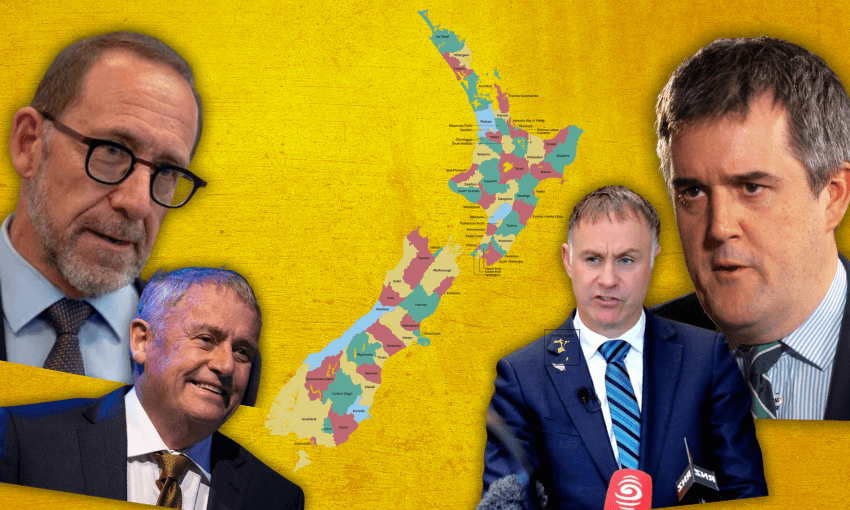
The government wants to squish councils together into a few super-councils. Is it a good idea?
The first western-style local government meeting in New Zealand happened halfway along Wellington’s Pito-one beach on March 2, 1840. The Council of Colonists, as it was called, led the fledgling settlement for three months, digging roads, starting plans on a town hall and maintaining mostly positive relations with the local Te Ati Awa people. Then, the Crown found out. Governor William Hobson, fearing it was a challenge to his authority, sent troops from Auckland to disband the “illegal and treasonable body”.
It was the start of a long and rocky relationship between central and local government. The people of Wellington formed a new council in 1842, which held New Zealand’s first democratic election. It lasted less than a year before the Crown abolished it because of an argument about who should be in charge of lighthouses. Then, there was the provincial council which lasted 23 years until it was, once again, shut down by the central government.
This is kind of a theme in New Zealand political history. Central government kicks local governments around, overrules them, and tells them what to do without giving them the money to do it, all under the constant threat that it can simply shut the councils down. One time the central government promised to loan councils lots of money if they built low-income housing but then Ruth Richardson just stopped the scheme. Now the councils are deemed stretched, inefficient and unpopular so the government has decided to abolish some more of them.
The government has given New Zealand’s councils until August to produce amalgamation plans, or it will impose them. Every community is different, the deadline is tight, and the conversations are only just beginning. Here are some of the key arguments.
Bigger is better… or is it?
A big selling point for amalgamation is that it allows councils to combine services and consolidate management, leading to fewer double-ups and, hopefully, cheaper and more efficient services. However, mergers tend to be disruptive and expensive, so any improvements in cost or service are likely to be a long-term thing.
Auckland Council claims to have saved $2.4bn since amalgamating in 2010, though the total cost of operations has still increased and a 2022 Infrastructure Commission report found there was little evidence of cost improvements in core services such as road maintenance and building consent processing.
The biggest opportunities for cost-saving comes from combining transport and water services – though this doesn’t necessarily require council amalgamation. It’s already happening with the creation of new regional water entities.
If there’s any benefit it’s probably at the governance level: there are 1,639 councillors and mayors across New Zealand. Amalgamation would help to trim the fat and hopefully voters would keep only the most competent ones.
The art of the deal
From the perspective of the central government – and some councils – the pot of gold at the end of the amalgamation rainbow is the prospect of a city or regional deal. The details of these can vary wildly but they’re usually some sort of income-sharing and development-enabling arrangement.
The government has dipped its toe in the water with a handful of mini- or proto-deals but seems wary of diving in too far. In general, it’s much easier for the government to deal with one large regional entity than a bunch of smaller councils and mayors who disagree with each other.
The benefits of mergers apply at a business level too: having consistent rules region-wide for things like zoning, property requirements, inspections and signage makes it easier for businesses to operate in and expand across a region. Again, that doesn’t necessarily require amalgamation either; the government is already heading down that path with its RMA reforms. But if you’re going to combine water, transport and planning then perhaps you may as well go all in.
Who subsidises who?
Every morning, thousands of people travel from Waimakariri into Christchurch or from the Hutt Valley into Wellington to go to work. While there, they use the water, roads, sewerage, and might visit a park or a library. Centre city areas generally have greater service needs with busier streets, larger pipes and bigger facilities. But at the end of the day, the commuter population leaves and goes back to their home districts, without contributing a cent of rates to the city. They are essentially freeloading off the people who live in central districts. On the other hand, many people living in outer suburbs or satellite towns don’t visit the centre city very often. In fact, they may have chosen their neighbourhood specifically because it’s far away. They aren’t too keen to suddenly be saddled with paying for a bunch of old, mismanaged infrastructure from another district.
The urban/suburban divide also applies to politics: where you live makes a huge difference to different lifestyles, priorities, and preferences. Amalgamation can change the balance of the electorate, which may be good or bad depending which way you lean.
Regional voice vs local accountability
Beyond all the economic arguments, the most significant change from amalgamation is one of negotiating power. Part of the reason the central government has been able to boss local governments around since 1840 is because it has much stronger legal authority, financial resources and electoral mandate.
The mayor of an amalgamated council represents more people and controls a larger organisation. Auckland mayor Wayne Brown is particularly fond of pointing out that more people voted for him than for any MP in the country, technically giving him the largest mandate of any politician in New Zealand. This gives Auckland Council an improved ability to stand up for itself and demand things from the central government, while smaller local councils are forced to grovel.
The tradeoff is that larger government entities are typically slower to respond to the small stuff. Elected councillors go from representing a single neighbourhood to a wider area, making it harder to maintain on-the-ground relationships. Poorer or more far-flung districts may worry about their local neighbourhood being forgotten in a merged super-entity. But at the same time, some wealthy neighbourhoods who are used to getting what they want might find themselves with slightly less sway.
Good or bad? It depends
At this point we still don’t actually know what any of these amalgamations might look like. We could embrace Super Rugby-based boundaries or return to the 19th-century provincial council maps.
More important than the maps is how the organisations are structured. What assets will they control, what powers will they have, how will their balance sheets be structured? At the end of the day all of these specifications make much more of a difference to people’s daily lives than the size of their council boundaries. Until we have more information about the proposals, the jury’s out.