Memo to Labour: Wasteful spending is for roads, not public transport subsidies
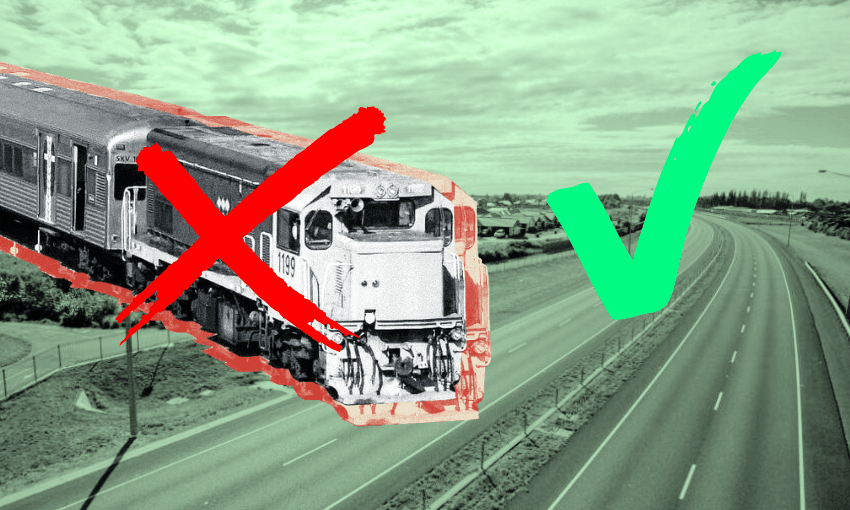
Labour made a big mistake saying it would spend $65m making public transport cheaper. We need that money for roughly five metres of highway.
National switched from government to opposition within minutes of Labour ending its monastic silence and announcing a policy earlier this week. Its response to the news that its opponent would introduce a $10, for towns, and $20, for bigger cities, weekly fare cap on public transport was swift and sour, with campaign manager Simeon Brown lambasting the party for planning to use the “already oversubscribed” National Land Transport Fund (NLTF) to pay for its scheme.
Labour has costed its fare cap at $65m a year, which represents less than 1% of the NLTF budget. But Brown clearly thought all of that and more should go toward the impossibly expensive roading programme he committed us to during his eventful year as transport minister. “Labour is once again trying to bribe New Zealanders with their own money,” he said. “This is yet another spending promise from the Labour party with no plan for how they’ll pay for it.”
It’s easy to see why Brown was so annoyed at Labour for proposing to spend a small percentage of the NLTF helping people onto trains, buses and ferries during a fuel crisis. Everyone knows that’s not what the fund is for. It’s for roads with business cases so terrifying you have to keep them secret for fear their release will stop anything getting built. Spending promises you have no idea how to pay for should be reserved for those same roads, many of which experienced predictable multi-billion dollar blowouts within months of being announced.
Prime minister Chris Luxon shared his minister’s concerns about potentially spending roughly 0.3% of the budget of just one of the new motorways on public transport subsidies. “Classic Labour really, isn’t it,” he told reporters. “You’re going to take money out of the NLTF, which is already oversubscribed. So that means you’ve got to cut something, so what are they cutting?”
The answer might be one of these:
Labour hasn’t said what it would cut, preferring to point to a future reprioritisation process. But imagine if it opted for “less than 10% of one new road in Nelson”. The Hope Bypass costs an estimated $1bn. Once built, it may help free up a single road that gets congested at peak times. Or what if the party ends up getting rid of roughly 103 metres worth of the East-West Link in Auckland, which is expected to set us back $3.8bn-$4.1bn for just 5.5kms of new tarseal? Nothing says wasteful spending like paring back the most costly per-kilometre road in the world.
The rest of National’s critique is harder to decipher. In staking out a position against bribing people with their own money, Brown seemed to be saying Labour shouldn’t be looking to pay for its promises out of an existing tax-funded reserve. But the day after he made that statement, Chris Bishop, who replaced Brown as transport minister, told reporters he might use an unallocated $450m “emergency fund” to improve public transport, though he would use the money on service improvements rather than fare subsidies.
The emergency fund is a finite pot of money that can be divided between competing projects. It’s paid for, just like almost everything the government does, by taxes. In some senses, it might remind you of the NLTF.
If the government did use an emergency fund to improve public transport soon after its opponent promised public transport improvements, it might look a bit like “bribing people with their own money”, to use Brown’s terminology. It could seem like National’s issue with Labour is less the so-called bribe than that it didn’t make it through the official channels. Next time Labour wants to announce a policy, maybe it should point to an opaque contingency fund rather than a set budget. That way there shouldn’t be any issues.
This article has been updated to reflect that rather than making an announcement that he was looking at using a $450m emergency fund for public transport, Chris Bishop was responding to questions about where investment should be directed.