The madness and mania behind Narendra Modi’s landmark New Zealand visit
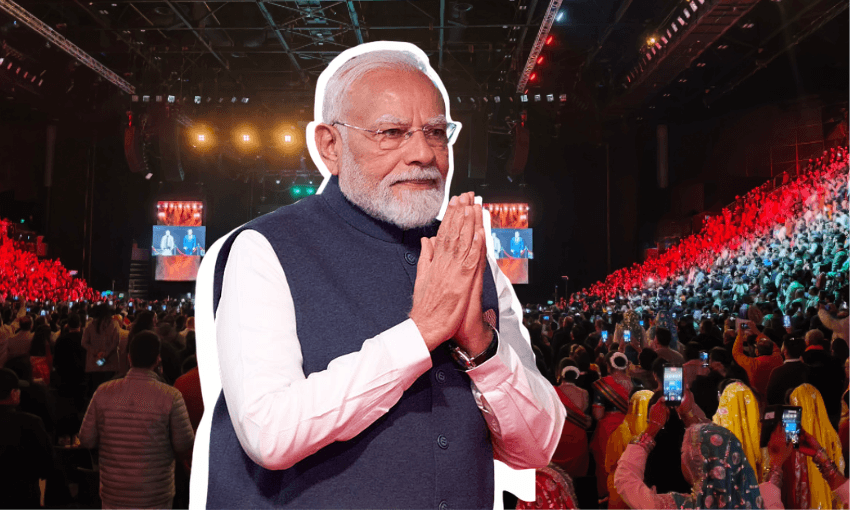
Inside the Indian prime minister’s extraordinary whirlwind trip to Auckland.
The leader of the most populous nation on earth stood on the lawn at Auckland’s government house as a tattooed, bare-buttocked warrior approached him, grunting, stamping and swinging a heavy weapon at his face. He laid a carved wooden token on the ground.
Joe Harawira, kaumatua to the governor-general, spoke in Indian prime minister Narendra Modi’s ear, explaining the ritual challenge. Modi faced the warrior, picked up the token and clutched it to his chest. He asked Harawira what he should do with it. “Just hold onto that,” Harawira replied. Almost immediately, Modi handed it off to an assistant.
Approaching New Zealand prime minister Christopher Luxon, Modi reached out for a handshake. Luxon went in for a hug. Modi accepted. As the pair inspected the lineup of soldiers, Modi marched with a rigid upright posture. Luxon strolled with relaxed shoulders while swinging his arm. It was a perfect juxtaposition of New Zealand’s casual matesy-ness against India’s hierarchical formality. These are two leaders, from two very different nations, earnestly trying to work together but still inevitably separated by the subtleties of culture and language.
Modi’s trip to Auckland, which lasted about 24 hours from Friday evening to Saturday evening, was New Zealand’s most significant state visit in a generation. It comes three months after the two countries signed a landmark free trade agreement, which represented the most significant political accomplishment of Luxon’s career. However, the agreement also caused uncomfortable ruptures within the governing coalition – New Zealand First opposed some of the immigration provisions, meaning Luxon had to rely on support from Labour to pass it.
For Modi it’s the culmination of a tour that confirmed his status as a global political rockstar. In Indonesia and Australia he was met with stadiums of screaming fans – and secured key strategic partnerships in the quest to establish India as a true global power. The 75-year-old has been prime minister since 2014 and has overseen a period of rapid economic growth. He maintains an approval rating of 70% in the largest democracy on earth, though is controversial for stoking Hindu nationalism, jailing critics and journalists, and the treatment of Muslims and other minorities under his government.
For New Zealand’s Indian community it was a celebration and a reminder of the significant political force they’ve become. For the anti-immigration protestors outside, it was a challenge to their ideas of what it means to be a New Zealander.
And for the hundreds – if not thousands – of public servants, caterers, artists, lighting and sound technicians, security guards, police officers, soldiers, drivers, translators, cleaners, and community organisers who made it happen, it was a stressful symphony of near-chaos. Everything ran late, nothing went exactly to plan, and yet somehow it came off without a hitch.
After the official welcome Modi and Luxon walked up the hill to government house, where senior ministers from both governments waited at a long table covered with flowers in the colours of the Indian flag. Notably, only ministers from the National Party were present for New Zealand. Conveniantly, foreign minister and NZ First leader Winston Peters was out of the country that weekend.
The ministers took their seats opposite their counterparts and donned translation headsets. As Luxon delivered his opening platitudes, the opposing side fiddled with their earpieces. The sound kept cutting out. “Is that a tech issue or a prime minister issue?” asked Luxon. “It’s never the prime minister’s fault,” he joked.
The big announcement from the bilateral meeting was a new strategic partnership: a step up from the FTA towards active collaboration in specific government and business sectors, everything from counterterrorism to “traditional medicines” and “animal husbandry”. The documents were vague on what that would actually mean. The two countries will “endeavour to schedule meetings”, “continue to enhance dialogue” and “exchange mutual support where possible”. It left a lot up to interpretation.
With the formalities complete, the absurdly long motorcade made its way to Viaduct Events Centre to talk business with some businesspeople. First up, an ultra-VIP meeting of the official business delegations. Some of the most powerful business leaders in both countries lined up on stage for the photo op, then stayed standing in position for 29 minutes as they waited for the prime ministers to arrive. Luxon and Modi entered, walked down the red carpet, took the photo, and left the room again. Once everyone was seated they did a second red-carpet entrance, to more applause.
Therese Walsh, CEO of Air New Zealand, described the assembled VIPs as “rangatira”. Jayden Mehta, CEO of dairy giant Amul, called them “captains of industry”, according to the translation device. It was all very nice mutual admiration until Mehta dropped a line that raised eyebrows on the New Zealand side: “New Zealand has promised an investment of $20b in India over the next 15 years”.
This is one of the awkward sore points underlying the entire FTA. New Zealand seems to think it vaguely agreed to promote and encourage investment in India. India seems to think we’re really gonna invest $20 billion US ($33b NZD) in their economy. Modi, speaking after Mehta, was equally as clear: “New Zealand has committed to invest $20b in India over next 15 years.” Later, he described it as a “firm commitment of a $20b investment by New Zealand in India”.
Next up was a flashy sports-themed gala lunch titled “A winning partnership”, celebrating 100 years since India and New Zealand’s first sporting interaction, a hockey tour by the Indian army team. Luxon spoke of memories of playing street cricket in Delhi while on a foundation trip, namedropping Kapel Dev, Ajaz Patel and Ross Taylor. Modi repeatedly referenced rugby: “Just as rugby is built on teamwork and trust we too will move forward together with mutual trust. We are on the same team. So the only thing we will be tackling are challenges,” he said.
Dame Valerie Adams showed the prime ministers some sort of high-spec shot put. Dame Lisa Carrington demonstrated an erg machine adapted for kayaking. Paralympic medalist Nicole Murray presented a space age track bike. ‘Tua’ by Stan Walker played over a montage of some of New Zealand and India’s greatest athletes: Edmund Hillary, Tenzing Norgay, Kane Williamson, Virat Kohli… and a picture of Sport New Zealand CEO Raelene Castle playing lawn bowls.
The media was ushered out of the room before the food arrived. Afterwards, when asked how his lunch was, defence minister Mark Mitchell said; “it was vegetarian”. He stomped away, presumably in search of an animal to kill.
More than 10,000 members of the Kiwi-Indian community packed Spark Arena to see Modi and Luxon speak. They screamed with more manic excitement than the venue had seen since One Direction rolled through in 2013.
Outside, hundreds of fans who couldn’t get seats chanted “Modi, Modi, Modi” and shook the barricades while a volunteer stood on a wheelie bin and begged them to stop. Further down the road, there was more chanting: Indian progressives protested against Modi’s Hindu nationalism, while a group associated with Brian Tamaki protested against increased immigration.
Inside, the crowd cheered and whistled for dance performances representing each Indian state. Occasionally, a photo of Modi’s face would flash on screen for a few seconds and the room would erupt. “India is a country of beautiful chaos,” the woman sitting next to me said.
When Luxon said “Kia ora”, the crowd boomed it back to him in response. It was by far the friendliest and most enthusiastic audience he’d ever spoken to, and he clearly relished it. He got waves of cheers as he listed some of the jobs Indian-New Zealanders have: nurse, dairy owner, IT support worker. The crowd murmured excitedly when he mentioned he’d lived in India in his 20s while working for Hindustan Unilever. He heaped praise on Modi, saying he “has helped to lift hundreds of millions of people out of poverty” and was “one of the most important leaders of our time.”
Luxon ended by asking the crowd to “make some noise for…” but he never reached the words “Narendra Modi”. The arena was already too loud to hear himself speak.
Modi held a brown scarf above his head. It was a gift he received on a visit to New Zealand in 2001 and he’d kept it ever since. The crowd roared in approval. What followed was 45 minutes of oratory brilliance. Modi conducted the crowd like an orchestra, moving them through applause, cheers, laughter and awe, the intensity building higher and higher until it broke into a deafening call-and-response chant.
Judging by the crowd’s reaction alone, it may have been the greatest political speech ever given on New Zealand soil. Unfortunately for this linguistically challenged journalist, the speech was entirely in Hindi and there was no translation service available.
For a more thorough analysis, I recommend Ravi Bajpai’s report for Awaaz. But if you want to know what the speech was like for someone who doesn’t speak Hindi, this is a list of all the words I understood: “Kia ora, New Zealand, prime minister Christopher Luxon, Kiwi-Indian community, Rachin Ravindra, Ajaz Patel, Bombay Hills, Coromandel, Calcutta Street, Labour Party, bipartisan support, farming technology, mānuka honey, honey production. All Blacks, rugby, sports technology, space sector, the moon, success, key technology, Māori, culture, haka, manaakitanga, family, institution, kaitiakitanga, fastest growing major economy on earth, vaccine producer, mobile manufacturer, milk producer, automobile market, startup ecosystem, energy, digital identity, public, drone technology, Sikh community, New Zealand economy, guarantee, thank you.”
Luxon and Modi held hands as they waved to the crowd, then turned and raised their arms for a photo, triumphant. It’s a shot that may end up defining the prime minister’s political legacy. In the background, people waved flags and screamed the last of the air out of their lungs. Beautiful chaos, indeed.