Echo Chamber: The scores, scrapes and sparks of scrutiny week
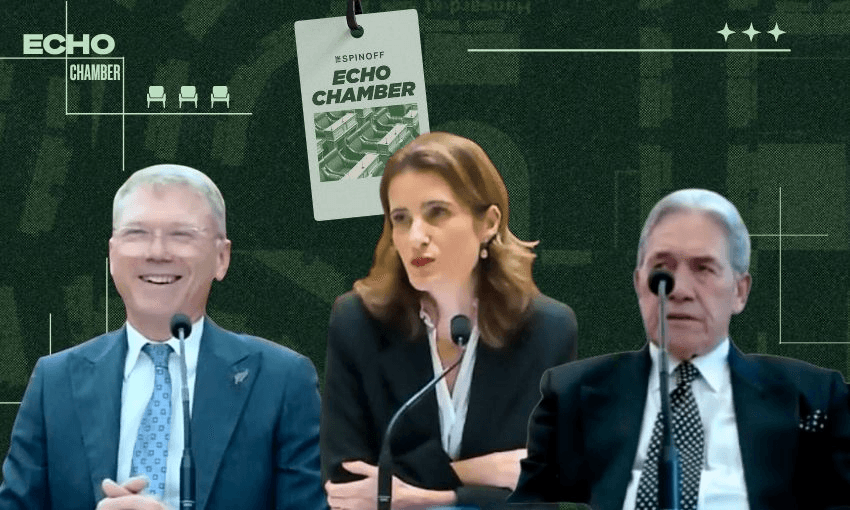
The highlights and lowlights of a long week at parliament.
While you were watching the FIFA World Cup, parliament was busy hosting a tournament of its own. Theoretically, the scrutiny week game is all about accountability. In action, it’s more like an endurance sport where goals are not scored by kicking balls, but by busting them. Ministers were on defence, opposition on attack, Winston Peters gave a protester a red card, Paul Goldsmith played often enough to qualify as a one-man team, and Te Pāti Māori struggled to get off the bench at all.
It all kicked off on Monday with a triple header. Goldsmith fronted the social services and community committee wearing the hats which usually gather dust on his coat stand: arts, media and Pacific peoples. There was a very light “ooh” at the small list of arts-related achievements Goldsmith provided, but for the most part, the minister did what he does best: going “uhhh, well, I, uhhh, ahhh” intermittently for two hours.
The cards were already coming out by Tuesday morning. Labour’s Deborah Russell told regulations minister David Seymour he was “taking the mickey”, Labour’s Willie Jackson challenged treaty negotiations minister Goldsmith to “name one Māori” who supported him, and immigration minister Erica Stanford revealed that her biggest opponent was her own ministry.
Across the road in the Māori affairs committee room, Māori development minister Tama Potaka channelled his inner life coach. When Willie Jackson argued it was “racist” for Māori services to constantly “prove” themselves worthy of funding, the minister tried to claim the moral high ground. “I come from a background where I don’t kill people with kindness,” he said, sagely. “I torture them with success.”
Later, Goldsmith (this time with his communications minister hat on) was back, discussing satellites with officials from the Ministry of Business, Science and Innovation. It was largely a boring affair, but sparks briefly flew between the minister and Labour MP Cushla Tangaere-Manuel, after she questioned the efforts made to connect the last 2% of marae which are still off-grid.
“Is 98% [connectivity] not good enough for you?” asked Goldsmith. The reason why some marae had been slow to join the government’s digital connectivity scheme was due to “something about Big Brother,” said one of the ministerial officials. “Which is unfounded, of course, but there was some of that stuff going on.”
“I think they didn’t want to be connected to the podium of truth,” Goldsmith offered, referring, perjoratively, to Jacinda Ardern’s Labour government.
Wednesday’s first bout was between finance minister Nicola Willis and Greens co-leader Chlöe Swarbrick. There was plenty of sighs from the Green MP, who shook her head and stated “that’s not true” whenever Willis tried to assure her that Aotearoa was still on track to meet its climate obligations under the Paris Agreement. They spent several minutes disagreeing over that, before moving onto another disagreement over whether they were disagreeing with each other’s “implications” correctly.
“I would like to out my own words in my own mouth,” Swarbrick told her. “Sure,” Willis replied, coolly. “You do that, and I’ll do the same.”
In room four, associate education minister David Seymour showed up to discuss charter schools, attendance and school lunches. There was a convoluted metaphor about pizzas and class sizes, which ended with Seymour stressing the need to improve numeracy rates, especially for “young people who could grow up to become opposition MPs”. There was another dig he wanted to get in at Green MP Lawrence Xu-Nan, but “I’m trying to be good for the rest of the week”. A good idea, given how Seymour started it.
Thursday morning saw minister Simon Watts make a rare admission of a misstep with his environment portfolio. Questioning from Te Pāti Māori co-leader Debbie Ngarewa-Packer led Watts to admit that he wanted to revive the recently slashed Māori Climate Platform fund. It was a clear example of a project in which “intervention by government has had some success”, Watts told Ngarewa-Packer. He’ll be lobbying the finance minister to bring it back.
Goldsmith resurfaced again to speak on justice-related spending. Asked by Green MP Tamatha Paul about the cost of implementing the controversial treaty clause review legislation, Goldsmith confirmed that the bill likely won’t pass the select committee stage before the election. And on the response he’s received about the bill from iwi leaders? “I think, probably, I could generalise and say that the feedback from that quarter has been, ‘don’t do it, and leave things as they are’.”
Paul vs Paul provided a nail-biting finale to Goldsmith’s long week in the select committee. There was a bit of tension when the minister identified Te Pāti Māori’s proposal to abolish prisons as a Green Party policy, and corrected himself with another imagined policy: that the Greens wants to defund the police.
“That was your words that you put on a billboard,” Paul shot back. “Words that didn’t come out of my mouth but, you know how the spin machine works.”
Goal to Paul, Goldsmith nil.
“Oh, OK,” replied Goldsmith, smiling ear to ear. He tried to “Anyway…” the situation, but Paul wasn’t giving up. “I’d love a reference of when it came out of my mouth,” she told the minister, who uhhh-ed and ahhh-ed as he does. “It’s disinformation.”
Two to Paul, Goldsmith still nil. Committee chair Andrew Bayly’s cry of “order!” was the whistle that finally broke it up.
On Thursday afternoon, more excitement. Foreign affairs minister Winston Peters is a man rarely overshadowed, but a handful of protesters – some of whom were detained by Israeli forces for their involvement in the Global Sumud Flotilla last year – managed to bring his hearing to a standstill. Following questioning from Labour MP Damien O’Connor over the minister’s decision not to recognise a Palestinian state, protester Hāhona Ormsby stood up and took the scrutiny into his own hands. “Are we going to investigate Israel for the people on the flotilla that were brutally beaten and tortured?”
After committee chair Tim Van de Molen requested that cameras cut, Peters slow-motion rolled around in his chair. There was “no evidence” that Ormsby and others had been the victims of brutality – “that’s bull dust,” Peters told him, gruffly. “Now, get out of here.” Parliamentary security and Act MP Laura McClure saw him out of the room, followed by a few stragglers who cried, “Free Palestine”.
“How was that allowed to happen?” Peters asked, cold eyes scanning the room, as if a parliamentary staffer was planning to pop a hand up and say, “Sorry mate, it was all me”. One of the few protesters who remained took a silent approach, turning her back to the minister and scrutinising the sunny day outside.
Another week of vaguely successful scrutinising of the government done and dusted. As for the scoreboard? Well, does anybody ever really win at scrutiny week? But after four days of point scoring, own goals and the occasional admission, these players are at least worthy of a participation prize.