The problem with treating science like a startup
Few New Zealanders spend much time thinking about volcanic monitoring but when a volcano erupts, we expect expertise to exist immediately.
When governments talk about science, they increasingly sound as though they are talking about startups. Research should be agile, innovative and capable of producing outcomes that can be measured within political cycles. It should attract investment, create intellectual property, support industry and ultimately contribute to economic growth.
The government’s recently released Science Investment Plan broadly reflects this direction. At one level, it is difficult to argue with. New Zealand is not a wealthy country. We face well-known challenges around low productivity, brain drain, environmental pressures and an economy still heavily reliant on agriculture and tourism. It makes sense to ask what return we are getting from public investment in research.
But I wonder whether we are beginning to talk about science in a way that misses something fundamental about how it works. These ambitions sit more comfortably alongside engineering and product development than they do alongside much of science itself.
Because science often moves slowly.
Some discoveries are made quickly, but many are not. Some projects fail. Others appear unremarkable for years before becoming indispensable. The people doing the work rarely know at the outset which category their research will fall into.
The technologies that have transformed modern life often emerged from questions that had no obvious commercial application at the time they were asked.
Magnetic resonance imaging exists because physicists spent decades investigating the behaviour of atomic nuclei. The development of mRNA vaccines relied on years of research that struggled to attract funding and was considered by some to be a scientific dead end. GPS depends on an understanding of relativity that emerged from theoretical work carried out by Einstein more than a century ago.
Closer to home, some of New Zealand’s most valuable scientific contributions have come from long-term investments in knowledge.
The Christchurch Health and Development Study has followed more than 1,200 people born in Christchurch in 1977. Nearly fifty years later, it continues to provide insights into child development, mental health, education, addiction and criminal offending. It is difficult to imagine a venture capitalist waiting half a century for a return on investment. Yet few would now argue that the study was not worth undertaking.
When I started in forensic science, I inherited methods, expertise and ways of thinking developed by scientists who had retired long before I arrived. Some were formal procedures; others were practical insights that had been refined over decades and passed from one person to another. The people who developed those systems would never personally benefit from my using them 20 years later. They simply assumed that someone would come along after them, and that it was worthwhile leaving things in a better state than they found them.
Science also accumulates in less visible ways.
A research group is not simply a collection of individuals working on separate problems. Over time it develops habits, judgement, memory and ways of recognising when something does not quite fit. Senior scientists teach younger ones not only techniques, but how to think about uncertainty, how to identify a dead end, how to communicate doubt and how to know when they might be wrong. These communities of practice are difficult to measure and almost impossible to rebuild quickly once they disappear.
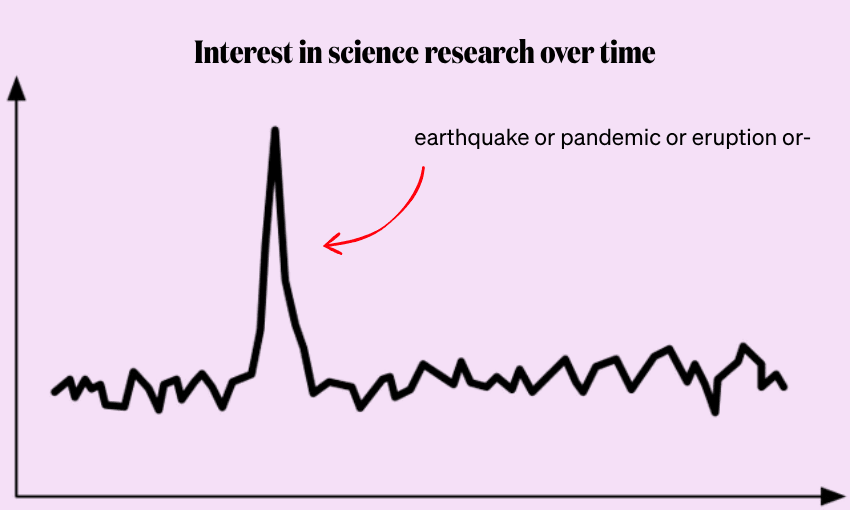
Few New Zealanders spend much time thinking about volcanic monitoring, marine ecology, earthquake engineering or forensic science. Yet when a volcano erupts, a fishery collapses, a building fails or a homicide occurs, we expect expertise to exist immediately, to be available locally and to function well under pressure.
That expectation rests on an assumption: that someone has been paying people to become experts in subjects that may not seem particularly important until suddenly they are. And that assumption feels less certain today. We have become remarkably comfortable harvesting fruit from trees planted by previous generations, while becoming increasingly reluctant to plant any ourselves.
Part of this is understandable. Public money is limited, and science competes with housing, healthcare, education and infrastructure. Governments are entitled to ask difficult questions about priorities. In fairness, politicians operate under constraints that scientists largely do not. Elections occur every three years. Voters expect visible improvements within their own lifetimes. Ministers are judged on what they can point to, not what may become possible in 30 years’ time.
Science asks for something more difficult. It asks society to accept uncertainty, to tolerate failure and to invest in work whose value may only become apparent long after everyone involved has retired. That is not an easy proposition to sell, particularly when many households are struggling with the immediate pressures of rent, mortgages and groceries.
But some activities only make sense if they are viewed across generations. Science does not simply generate answers. It creates the conditions that allow future generations to answer questions that have not yet been asked. That makes it difficult to evaluate using the same metrics we apply to businesses.
Businesses are expected to succeed or fail. Research programmes can spend years producing results that appear incremental or obscure, only for their significance to become obvious much later. Other projects never even reach that point. That is frustrating, but it is also part of the process.
Perhaps the real question is not whether science should contribute to economic growth. Of course it should. The question is whether we still have enough confidence in one another to invest in knowledge whose benefits we may never personally see.
The scientists who built the foundations of many of the systems we rely upon today worked for a future that belonged to other people. They trusted that society would value curiosity, patience and expertise enough to continue the work. It would be a shame if we became the generation that decided those things were luxuries we could no longer afford.