Vera Ellen on what it feels like when AI takes your music
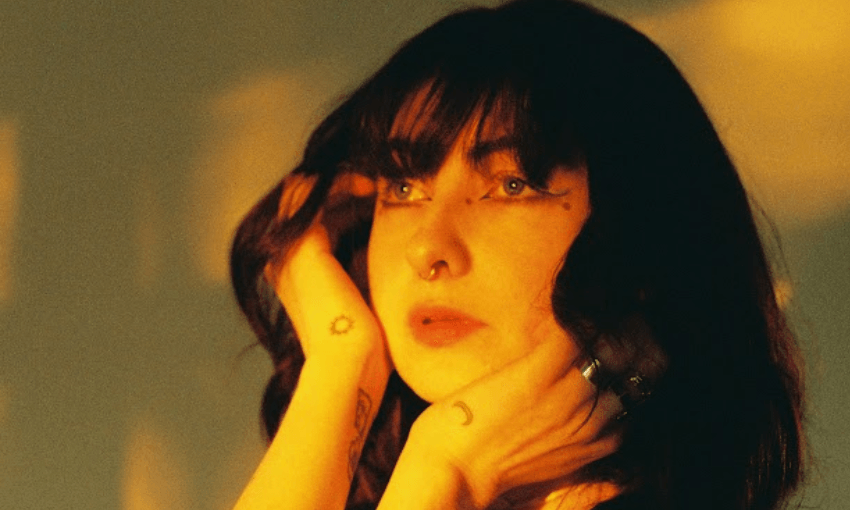
What can you do when your deeply personal music about painful experiences is scraped for parts? Fight, says Vera Ellen.
This story mentions suicide. Please take care.
On her recent European tour dates, Vera Ellen saved one special song to play near the end of each set. “I’ve been performing ‘Broadway Junction’ a lot on this tour,” Ellen says. Taken from her Taite Prize-winning 2024 album Ideal Home Noise, that song is about giving up. “I wanted to jump in Broadway Junction / Feel the tracks against my back,” sings Ellen. “To be super blunt, I was suicidal,” she told RNZ about that song’s inspiration. On this tour, Ellen finds ‘Broadway Junction’ carries a different vibe. “I’m revisiting those feelings in this healing space with an audience,” she says. “It’s been very emotional seeing how that song connects to other people – and who has been in that space.”
That song, and others from Ideal Home Noise, have been taken by AI, says Ellen. Many other Aotearoa artists recently found out their songs had been taken too. That’s thanks to The Atlantic’s AI Watchdog tool, launched to reveal “the books, videos and other media used by the world’s most powerful tech companies to train their AI models”. Search that database and you’ll find dozens of Aotearoa artists and hundreds of songs: 43 by Aldous Harding, 47 by Che Fu, 60 by Lorde, 90 by Marlon Williams, 111 by Bic Runga and 127 by Shihad. “No permission. No licence. No payment. These are not bargaining chips, they are the life’s work of… New Zealand songwriters,” says APRA AMCOS chief executive Dean Ormston in a statement titled “Proof of Theft”.
Ellen found out earlier on her tour when she woke up in Budapest to an email telling her that her songs may have been taken. She took to Instagram from her hotel room, posting a fiery video. “I am so exhausted,” she says in that clip. “Billion dollar companies quite happily take our creativity, take our life experience, put that in their pocket and give us a little crumb… We can’t keep rolling over and being exploited like this. We need to protect ourselves.”
Ellen told me use of her most intimate songs was especially troubling. “The idea of someone extracting this very personal [and] deep human experience and using it for its parts… there’s a responsibility that isn’t there. It’s a very sensitive subject and not necessarily something I trust a machine to handle.”
She isn’t the only one speaking out. In a recent TVNZ interview, Bic Runga railed against AI datasets taking “waiata, reo Māori and haka” then spitting them back out in deformed ways. “I do worry that if we outsource all our creative disciplines to a machine, our brains will just get a little bit dim,” Runga said. Kane Strang is also appalled, finding 24 of his solo songs and another 12 from his band Office Dog in The Atlantic’s search engine. “We’re climbing a broken ladder,” Strang writes in a recent Substack post. “How was AI ever going to benefit working songwriters in the long term? How can you feed music to an AI developer and it not take something away from the artist?… We need to tear this whole thing down.”
This article was originally published on Chris Schulz’ Substack, Boiler Room.
Helplines and support Suicide Crisis Helpline – 0508 828 865 (0508 TAUTOKO). If you, or someone you know, may be thinking about suicide, call for support from a trained counsellor. Youthline – free text 234, call 0800 376 633, webchat at youthline.co.nz, DM on Instagram @youthlinenz, message on Whats App 09 886 56 96. For young people and their parents, whānau and friends. Helpline available 24/7, webchat 10am – 10pm. Lifeline – 0800 543 354 (0800 LIFELINE) or free text 4357 (HELP) Here to listen and help. Samaritans – Free call 0800 726 666 for support for anyone who is lonely or in distress (24/7).