‘You thought he would always be there, like the Southern Alps’: Memories of Sam Neill
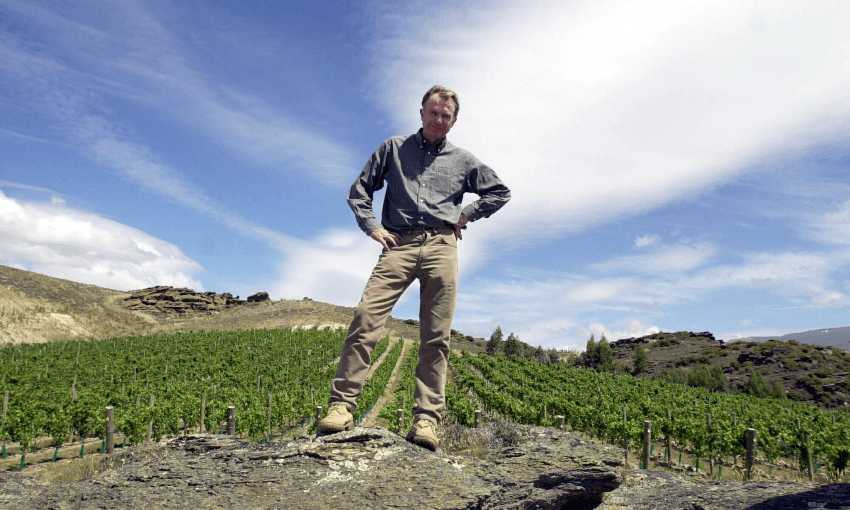
A giant of the pictures, paddocks (two) and protest, Sir Sam Neill has died at 78. Friends and colleagues share their memories of an extraordinary New Zealander.
For a special episode of At Large with Toby Manhire, we invited many who have worked and played with the mighty Sam Neill to share their memories.
Below, transcribed audio from film and television luminaries including Robyn Malcolm, Oscar Kightley, Dame Gaylene Preston, Kate Rodger, Rachel House, Lucy Lawless, Peter Mullan and Jennifer Ward-Lealand, entrepreneur and Otago champion Sir Ian Taylor, artist-poet-curator-activist Gregory O’Brien and arts minister Paul Goldsmith.
Robyn Malcolm
I’m sitting here in my hotel room in Munich, just thinking about Sam, having heard the news a few hours ago, and it’s just occurred to me that there’s about four or five people on this film set who all have a connection to Sam. I don’t think I’ve been in a piece of theatre, film, TV, or at an event involving the arts, where there hasn’t been someone who’s had a connection with Sam in some way. He’s worked everywhere and has made friends with everyone he’s worked with. I think that defines Sam more than anything else. The minute you meet and work with Sam, you adore him.
We became pals in the early 2000s when I asked him for some advice, and we had lunch, and then we’ve just stayed in touch ever since. Some of the advice that Sam gave me is the sort of advice that you just want to chuck on your fridge and look at regularly. He tells the best jokes. He is so naughty, so funny, so charming, and he only takes seriously the things that really need to be taken seriously, like the politics in New Zealand, in particular what’s going on now. I hope his fights are continued by others.
He seemed to me to be one of those artists that was able to keep everything in quiet perspective. The last time I saw Sam, I saw him physically, was in a vineyard in southwest Australia because he was working on one job and I was working on another and we had lunch at a vineyard and I think he called me a silly moo for some reason, probably because I was being a silly moo. For the Auckland Writers Festival in 2024 I had about an hour-and-a-half with him on stage, and getting him to talk about himself or his career was like getting blood out of a stone because he just sees it all as skiting. He wanted to talk more about Fonterra and New Zealand butter and the arts sector as a whole in New Zealand. And every time I paid him a compliment, you could see he just wanted to walk offstage. It was a glorious hour, just making Sam Neill squirm while I told him how brilliant he was.
I don’t think he would ever accept how how profoundly important he has been to the screen industry in New Zealand and to actors in New Zealand as a whole, not by the advice, but just by the example of how to exist in a very unstable industry and become very successful, and remain kind and lovely to everybody, and to always put that ahead of any of the work. He just valued people more than anything else. You know, there are some people that you just think are going to go on and on and on? I’m sure many of us felt that way about Sam. You knew that he was always going to be there, like the Southern Alps.
Oscar Kightley
When I think of Sam Neill, my mind first goes to Sleeping Dogs because that’s when I first saw him on screen, and then it goes to Reilly, Ace of Spies because, you know, that was on the BBC, and I just remember being a little kid, and and I’m sure many young New Zealanders had this experience of just looking at this dashing, handsome leading man and going, ‘Wow, he’s from our country.’ You know, he’s from our place. And so, just by him existing, it created a line between our dreams here and what was possible. He cared so much and wasn’t afraid to use that to fight for things that he cared and believed about. But, you know, he was just possibility manifested in in this very gentle, quite reserved guy from the south of New Zealand.
There’s so many facets to this guy, and it’s hard to just pick one. In the end, all you do is just think of that incredibly handsome face, the perfect hair and the twinkle in his eyes and his shy smiles. You know, he could go from playing a a Russian submarine captain to a grizzled Irish cop for the BBC to Satan, and what actor could possibly do that? But I guess for me and my people that I work with, he’s probably the only person who’s appeared in bro’Town and The Simpsons, and bro’Town isn’t happening any more. So, you know, unless King Charles gets on an episode of The Simpsons, Sam will probably be the only person who’ll have that honour and that distinction.
[Update from Oscar: Flight of the Conchords have also done both bro’Town and The Simpsons. What a lovely group!]
Sir Ian Taylor
There is so much that one could say about Sam, but at this moment I have a vision of him standing alongside Sean Connery in the film The Hunt for Red October and what I see is a proud Scotsman and a proud Kiwi. Sam managed to take a little piece of New Zealand with him in every role he played.
He showed us that he could become a citizen of the world without ever stopping being a New Zealander, and in that context, I’m reminded of the Māori story of the kuaka, the godwit: “He rite a Sam ki te kuaka. I rere ia ki te ao, engari i hoki mai anō ki te kāinga.” Sam was like the kuaka. He flew out into the world, but he always returned home.
Dame Gaylene Preston
Sam’s strong social conscience and generosity made him the man he was.
When I was collecting money for a fellow filmmaker who had cancer and needed expensive treatment, Sam went down to my local branch to deposit his contribution into my bank account. I went down there the next day, and all the tellers were still swooning. I reckon I could have got a loan that day.
Sam was an early supporter of women’s work. In 1979 while he was working at the National Film Unit, he made a great documentary, Red Mole on the Road. He gave my sister, Jan, her first film composing gig writing the soundtrack.
Sam needed some headshots to send to his agent in Sydney. Two women were making a feature film and he wanted to audition. I had a good camera, so we headed off to a park up the back of Aro Street and I started clicking away. Normally when you are taking portraits, there’s a moment you wait for. It’s a nano-second of energy between the lens and the sitter. That’s when you click. Then you wait for the next click moment. But in this case, I had a strange experience. I could click at any time. Now or now. Any time, fine. It threw me. A bit. I asked him to come for a second sitting. He obliged. Same thing. Always beautiful. Always connected.
I refused to charge him for my photos because I had mucked him about. After he came round and collected the prints, I found a $10 note on the mantlepiece.
He got the part. My Brilliant Career. And what a brilliant career it was.
That generosity continued of course. It was ingrained.
We went to Punakaiki to shoot Perfect Strangers. Down the Coast, if you are going to a party they say: ladies a plate, men a crate. At crew get-togethers, Sam would turn up with a crate – of Two Paddocks. Our taste for good wine spiked. He loved a singalong. A woman would come down to the pub and bring her karaoke gear. She never recognised him in his Swanndri. After he did a particularly heartfelt rendition of John Lennon’s ‘I’m only Sleeping’, she patted him on the back and yelled, “Better keep your day job, love!” I said to her, “I’m pretty sure that’s what he’ll do.”
Painting. People. Music. Acting. And leaving the world a better place for goodness’ sake!
That was Sam.
He will be greatly missed.
Moe mai rā e te rangatira.
Kate Rodger
It is a weird thing listening to all of the old clips and interviews that have been going up in the hours since the news broke, getting so many messages from people around New Zealand, in fact around the world, that never met Sam, didn’t know Sam, that feel like they’ve almost lost a family member. It’s when you take someone that has the kind of kindness, really, that he infuses in most of his characters. Perhaps not when he’s playing Damien in The Omen, but he just has that kind of special feel about him that just draws people into his characters, draws people to him when he’s interviewed. You get that same kind of vibe from him.
He was so beloved, and if we think how long he’s been around, and go way back to when we saw him in Roger Donaldson’s Sleeping Dogs, and then of course Event Horizon, one of the most scary films I ever saw in my life. Then you have Jurassic Park or Hunt for Red October, and then all the way through to Wilderpeople. He just – he’s the man. Do you know what I mean? And he makes you feel proud to be essentially kind of Kiwi because he embodies the gentleman aspect of being a top Kiwi bloke, it’s hard to explain.
I’ve been so bloody lucky to have so many little sideline chats with him, proper on-camera chats with him, weird little rooftops at the Toronto Film Festival, a little aside when he just wants some peace and quiet away from all the drama of cameras and things, and he just wants to hang out with a Kiwi and pretend none of that’s going on, and just, you know, chat, natter.
He was a storyteller in just every kind of way and I’ve just always loved interviewing him. One of my fondest memories was with a very young Julian Dennison when Wilderpeople came out and we went for a wander under the Harbour Bridge of all things, and Julian was such an inherently funny kid, and what a dynamic between Sam and Julian, as they sat there, kind of giving each other just so much gip. It was just such a beautiful thing to bear witness to, and I felt really lucky to be there.
And even more recently, just a couple of months ago, for Seven Sharp, we got Sam and Taika in for the 10th anniversary. He was looking frailer, but still the same Sam. Just still the same guy sitting there and just quietly letting Taika be Taika, and giving him a few elbows in the side as well. It was awesome. I feel like so many of us, it’s just – we lost a really good one. Like so many of us, I’m feeling really sad.
Rachel House
I have been on rooftops in London remembering Sam with Aussie friends. It’s too painful to remember specific stories and the ones we talked about may be inappropriate. He loved a room full of friends and good wine.
We argued a lot. Mostly over gender politics. He always listened. And laughed gently when I told him off.
He did not care for bullies.
He was, in actual fact, one of the best humans I’ve ever met. He cared deeply about the arts. In all forms. He cared deeply about the conservation of land for the future generations. He cared deeply about decency, kindness and fairness. He cared deeply about people.
He was generous to a fault – and happened to be a superstar, proving that both things can be true.
He was constant in his curiosity. He was openly gentle and vulnerable. He would tear up if his friends were having a tough time.
He was one of my great loves and I know that I’m not alone. And that was Sam. When he loved you, you knew it and he wrapped around you and you had no choice but to let go and love him back.
The world is not as good without him in it.
Sign the petition to stop the mining!
Lucy Lawless
Sam Neill was my first on-screen crush after seeing My Brilliant Career. I was lucky enough to work with him on The Sinking of the Rainbow Warrior and found him unfailingly generous and funny in an unusual way; sort of elegantly droll, inclusive and very, very sweet. My fave Sam picture: ‘Possession. He was a graceful man. Lucky us for having had him.
Jennifer Ward-Lealand
We remember Sam with love. Many years ago, I asked him if he’d be willing to be the patron for the New Zealand Actors Benevolent Fund, and he immediately agreed, as he was keenly aware of how few protections there were for performers, and he also agreed to be patron of our drama school, the actors’ program, and was a long-time supporter of the school. Whenever he was in town, he’d call me up and pop into the school for an hour and just sit and chat with students. I think he knew that his international fame gave him immense leverage, and he used every ounce of that leverage to look out for the generations coming up behind him.
When we honoured him with the Equity New Zealand Lifetime Achievement Award in 2019, it wasn’t just a salute to his brilliant career. It was a deeply heartfelt thank you from his peers for standing with us and for us. And he told me afterwards that it was one of the most important awards he’d ever received because it came directly from his people, his peers, and I distinctly remember him saying that actors were his absolute favourite people. That he loved the unique humour and humanity they possessed. I think he also set the gold standard for professionalism on set. It didn’t matter if you were a Hollywood director, a local crew member, or a background extra, Sam treated you with the exact same respect. And there was a deep devotion to our collective community that was woven into everything he did.
When he accepted the invitation to use the title “Sir” rather than KMZM, he explicitly wanted the press release to come directly from Equity, and I could see exactly why he did it. But he felt that this investiture wasn’t just a personal win, but good news for all of us. You know, he wanted to bring gravitas to our entire profession. So for us, for all of us actors in New Zealand, he was a giant of our industry. But to those of us who knew him, he was also our greatest defender, our friend, and a true champion for actors.
Gregory O’Brien
When I think about Sam, I think of his huge commitment to to Aotearoa, but particularly to the south of the South Island, to Dunedin, Central Otago, Southland, for the simple reason that, I guess, he loved the place. There was such a sense of him being in the place and the place being in him, and you can see that in all sorts of things. The wine growing, his presence there, and the cultural life of the area. He was the patron of the Henderson House, a residency for artists in Alexandra. He was hugely involved in the Eastern Southland Art Gallery. I was there recently, and basically Sam Neill has given them a huge amount of his collection. I mean, if you go there at the moment, there are works by Ralph Hotere, by Jeffrey Harris, by Dennis O’Connor, by Michael Smither – all first-rate works that Sam has gifted to the gallery because he really wanted to celebrate that part of New Zealand and its culture and its people and its history.
When I think about him I just sort of think: what a lightning bolt, what a great gift he was on all sorts of levels. There was a sense of the kind of joy of wonder of being alive, because Sam certainly liked having a good time. He loved pinot noir. He was incredibly social, but also loved being in the natural world and loved place and people. But he also realised that you had to fight for that, as Ralph Hotere did back in the days of the Aramoana smelter.
He got involved in Wellington 18 months ago with the fight to save the City to Sea Bridge. He was very vocal about presenting New Zealand art in Te Papa. He wasn’t ever afraid of going in and having a bit of a stoush on behalf of culture and art.
And then, more recently, in the last months of his life, he was hugely involved in the opposition to the gold mining proposal in Thomson Gorge in the Dunstan Ranges, probably 20 or 30 kilometres from where he lives at Earnscleugh, just near Clyde. So even in ill health, he got hugely involved in events and and basically in a protest movement to stop that area being desecrated.
This is another thing he would have got from Ralph Hotere: the sense that the land is us. You know that people creating that sort of aberration on the Central Otago landscape was like something that was happening to him as a person. He took it personally. He got really angry. He got obstinate. He got very militant about it in the best possible sense, and I do think that’s an amazing part of his character too. I mean, he’s a great actor, a great man, but he also had that fire in his belly. He certainly got upset about things, and he acted upon that.
Paul Goldsmith
We throw around words like legendary and iconic very easily, but with Sam Neill, they genuinely were the case. He was obviously hugely internationally regarded as an actor, but also a man of great passions – and humble. I had a long conversation with him only a month or two ago in an airport lounge, and he was so interested, so friendly. Even though we came from very different perspectives, he was a real gentle man and an incredible leader of the creative sector in New Zealand.
Peter Mullan
I’ve quite a few memories of beautiful Sam.
We were in a film together about golf [Tommy’s Honour, 2016] and I was playing Old Tom Morris – Tom Morris was a founding father of golf, who designed all these amazing golf courses in St Andrews. But the big star of the family was his son, who they called Young Tom Morris, who in the film was played by the beautiful Jack Lowden. There was a scene when Sam came in and he was playing the aristocrat who kind of owned Old Tom Morris, and ipso facto kind of owned Young Tom Morris.
And Young Tom’s got a game playing against a very famous Scottish golfer called Willie Park. And Sam’s opening line was, “I’m a bit concerned about the upcoming match against Willie Park, how’s young Tom looking?” And I had to say, “Oh, he’s fine. He’ll beat Park.” And he had to come back saying, “I’ve got money on this.” That kind of thing.
Anyway, so we come to do it, and Sam comes in very beautifully aristocratic, and he says, “I’m slightly concerned about the match with Willie Field.” And off he goes. So he finishes. Somehow I held it together. And he looks around. And Jason Connery, who was directing the film, came up and said, “That great, wonderful, brilliant Sam, we’ll go again. And, ah, it’s Willie Park.
And Sam says, “what did I say?”
“You were saying Willie Field, it’s Willie Park.”
“All right.”
So we do the second take, and Sam, you know, “I’m concerned about this match against Willie Field.” And I am really struggling now, really struggling. And we finish, and Jason points out, “It’s Willie Park. You’re saying Willie Field.” So we do takes three, take four, take five. I think I’m not exaggerating. I think it was five takes, and by this time I’m gone, and Jack was in behind Sam during the scene, and a couple of times Jack turned and if our eyes met we were gone, just gone every time. Beautiful Sam said, “Willie Field.” It just dissolved.
So they eventually wrote the name Willie Park on a piece of polystyrene, a big. white piece of polystyrene, and they put it just behind my head. And Sam, on about take six or whatever the hell it was, Sam comes in: “I’m a bit concerned about this Willie White match.” I’m afraid that myself and Mr Lowden absolutely disintegrated at that point.
Ah, beautiful Sam. I met him, fortunately many times after that with Robyn, my girl, who’s a great friend of his, and I consider myself really, really lucky. We shall all meet one day, somewhere.
To get every episode of At Large with Toby Manhire in your podcast feed, follow here for Spotify, or here for Apple. On YouTube, you can subscribe to the Spinoff here and find all the episodes here.