The past haunts Wellington’s Mount Victoria tunnel, but it also stalks the urban motorway
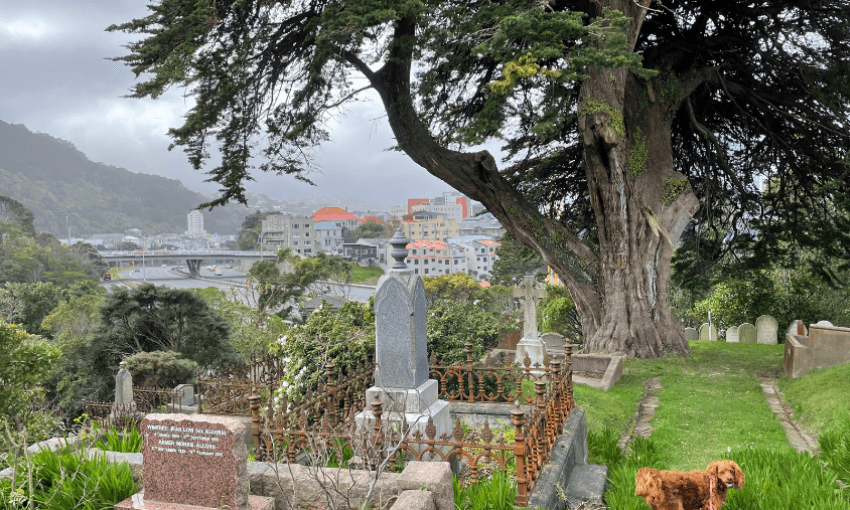
Progress, in the 1960s, meant digging up 3,700 bodies to make space for a motorway.
If you’ve ever driven through the Mount Victoria tunnel in the capital, you might have heard horns blaring. It’s a tradition that started to scare away the rogue spirit of a teenager killed and buried during its construction. She must be the most tooted-at ghost in the world, but it’s the motorway on the other side of the city that is far less talked about but could be the most haunted. The one that passes through a space once occupied by thousands of graves.
Wellington’s urban motorway was first proposed as a solution to the city’s traffic problems in 1961. The city was growing, and the old motorway into town was becoming too small for the number of cars. Fancy engineers were called in from America and after a period of surveying, a new motorway path was decided, one that would be a wider and more direct route to the city centre.
Bolton Street Cemetery is one of the earliest settler cemeteries in the country and by far the earliest in Wellington, dating from 1840 and remaining in service for 50 years until the 1890s. A walk through the cemetery takes you past the graves of sailors who fell from high masts, actors who died in mysterious circumstances, early politicians, tragic stories, long lives and everything in between. Headstones tell stories of the thousands of Pākehā buried there (and apparently, five Māori).
Unfortunately for the cemetery, it was in the way.
It took a while for the public to become aware of the proposed plans to push the new motorway directly through the cemetery, but once the news got out, there was significant backlash. Columns were published, letters sent to influential people, and a newly formed Bolton Street Cemetery Preservation Society took up the fight.
“The Bolton Street Cemetery is Our Westminster Abbey” read the headline of a long letter in the Dominion newspaper onNovember 7, 1964. “If it goes it is gone forever,” warned another in the Evening Post “and no documents or memorials can replace it”.
Mayor of Wellington Frank Kitts was unmoved. “The way I look at it, is that these men of great stature” (he means the people buried in the cemetery) “would not want to stand in the way of progress”. This was the prevailing attitude of the government, as other arrangements for the motorway were deemed too expensive and impractical.
These details are from a history of the cemetery called Unquiet Earth, written by historian Margaret H. Alington. Published in 1978, it was commissioned by the Ministry of Works as it managed the fallout from its decision to cut through the cemetery. Alington writes about what happened after the final paperwork was filed, once it became clear that the cemetery’s days were numbered.
“Descendants visited their family plots, numerous photographs were taken, artists sketched scenes that would soon vanish, gardeners removed century-old roses and other plants, residents took their last short cut to the city down the gully path… One elderly lady who lived on in her family home, its last survivor in Wellington, told Shirley Smith, ‘I don’t know what I’ll do when the cemetery is gone; I never visit anywhere else’.”
Construction of the motorway had begun years earlier, but didn’t reach the cemetery until the 1970s, when they began the stretch of road that would end at the Terrace Tunnel.
“From a physical angle, dismantling the cemetery was efficiently and effectively carried out by the sexton [cemetery caretaker] and the contracting firm, working in co-operation,” Alington writes. “When they had finished, a large expanse of smooth clay lay before them where previously there had been a harmony of graves and trees and a chapel marking 128 years of history.”
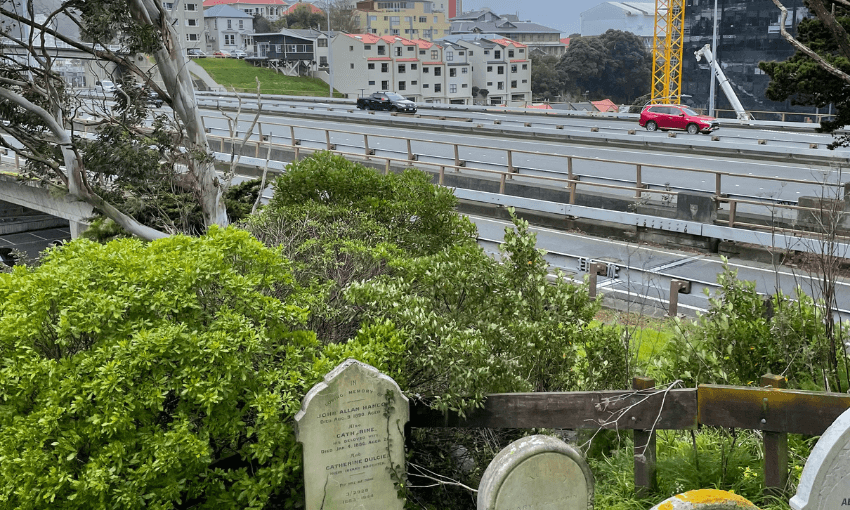
The decision had been made to reinter graves into a mass burial site below the motorway. Workers expected to encounter 900 bodies, but incomplete burial records from the cemetery’s early history meant they kept uncovering more. In the end, over 3,700 graves were reinterred. Some headstones were lost or destroyed in the process.
“Is this progress?” Alington recorded the Bolton Street sexton, Thomas Edmunds, saying. “He thought it odd that elsewhere in the country others were toiling to reconstruct historic sites and settlements, yet here was he, called upon in the course of his daily work to destroy a significant portion of one of those very sites,” she wrote. “In short, he felt that to dismantle a cemetery was to desecrate it.”
One glaring omission in articles of the time was that far worse had been and was being done to Māori cultural sites. The area below the cemetery that trails down the hill to the waterfront had been an important burial site for local iwi well before it was a Pākehā cemetery. Bolton Street Cemetery ki Paekākā is its name these days, to acknowledge that history.
The two remaining segments of the cemetery, with a big honking motorway through the middle, tell a story of the priorities of the time. The cultural or historic value wasn’t considered as necessary as this piece of city infrastructure. Around the same time in the early 1960s, similar decisions were being made in Auckland. The development of the Auckland southern motorway cut through the Symonds Street Cemetery, and 4,100 bodies there were shifted out of the way.
Fifty years on we have the legacy of pragmatic Pākehā decisionmaking. Motorways, yes, but also a cemetery divided, a mass grave, and ghosts in the tunnel.