What would happen if we all pooed into Auckland’s new poo pipe at the same time?
The question on everyone’s lips, answered.
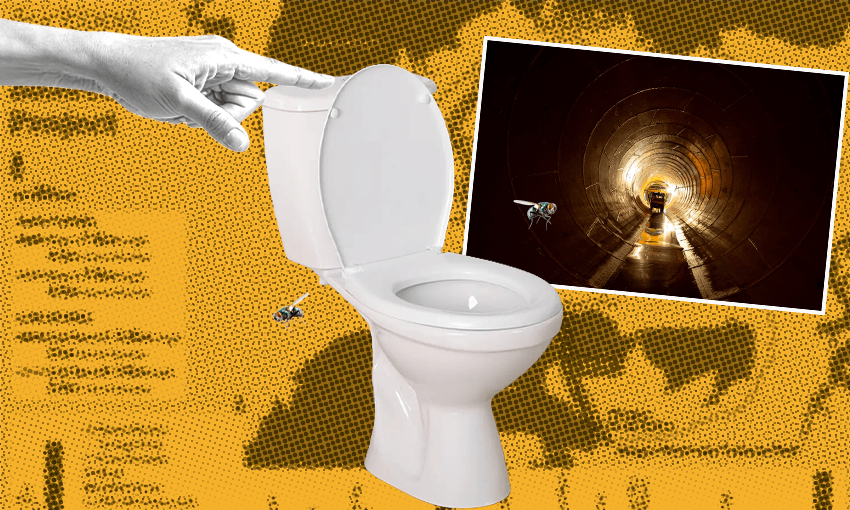
The atmosphere was exuberant by local government standards as Watercare opened its ginormous new poo pipe, the Central Interceptor. Auckland mayor Wayne Brown complimented the agency for getting the project done on time and almost on budget, allowing himself only a few dark mutterings about how that compares to the city’s other big project, the City Rail Link. Ngāti Whātua Ōrākei poutaki Taiaha Hawke spoke movingly about how the giraffe-sized passage would clean up the central beaches where his iwi’s tūpuna used to fish and swim. Watercare chief executive Jamie Sinclair whooped as he declared the thing officially open.
It was hard to fault the team for being in a celebratory mood. The Central Interceptor is set to reduce sewage overflows by 80% between Herne Bay and Manukau. It will pave the way for intensification in central areas, which will undoubtedly be a relief to the special character advocates who have long wrung their hands about infrastructure constraints in Auckland’s villa belt. But a key question was lost in the festivities: just how much poo can this bad boy take? More to the point, what would happen if everyone along its route went poos at the same time?
To answer that, The Spinoff went directly to the top. “What would happen if everyone around the Central Interceptor went poos at the same time?” it asked mayor Wayne Brown. “It would be a terrible smell,” he said. But then the mayor put on his engineering hat. He decided the interceptor could easily accommodate the turd tsunami propelled by the roughly 400,000 butts it’s set to serve. Our creaking sewer network is already handling a rush hour surge of sorts every day, he said. “We all do poo at once every morning,” he said. “We do a poo and a wee.”
It was compelling and visceral, but it was essentially guesswork. Before he took the stage to officially open the pipe on Watercare’s behalf, Jamie Sinclair met with The Spinoff to discuss the potential ramifications of a mass flushing event. “What would happen if everyone in the isthmus pooed at once?” The Spinoff asked Watercare’s chief executive. “I’m really sorry, I can’t tell you what would happen there,” he said. But he did try to address the substance of the question. “We’re planning for this to have capacity for the next 100 years. There’s plenty of capacity in the Central Interceptor. We’d be in much better shape in a mass flushing event than we are now.”
Perhaps an engineer would be more specific. Watercare’s Central Interceptor delivery manager Bojan Jovanovic has spent a third of his life working on the project, starting when it was still in its planning stages 11 years ago. Asked how it would hold up if it was subjected to an isthmus-spanning poo-off, he expressed cautious optimism. “Dry weather flows are a trickle. Seriously, when it’s not raining, it is ankle deep,” he said. Jovanovic said rainfall would be the bigger problem. It would fill up the pipe almost entirely on its own, leaving less room for poos.
Francesco Saibene agreed. The Ghella executive served as the Central Interceptor’s project manager and said on a good day, it could easily process every poo in Auckland. “It is certainly capable,” he said. That would change during rain. Even every gastrointestinal system in Auckland couldn’t compete with the sky, he said. “Dry conditions, yes, wet conditions, no.”
Together, the technical experts provided reason for hope. But they were still vague on the numbers. Jovanovic would only say the pipe could handle “heaps” of poo. Saibene couldn’t deliver a calculation on the hoof either, simply saying he was confident in the pipe’s capacity.
The question needed a mathematical mind. “What would happen if everyone in the parts of Auckland served by this pipe made a deposit at the same time?” The Spinoff asked Auckland University professor of biostatistics Thomas Lumley. It provided Lumley with some parameters. On the demand side, the interceptor’s max capacity is 250,000 cubic metres or 250 million litres. There are 140,000 houses in Auckland’s central isthmus, but the pipe will serve 400,000 people across the city. On the supply side, flushing the average modern toilet uses roughly six litres of water.
Using those figures, Lumley calculated that if everyone on the isthmus pooed at once, it would produce 850 cubic metres of waste. Even in a situation where all 400,000 people flushed either at once or in quick succession, it would send just 2,400 cubic metres of waste into the pipe; not even 1% of what it could ultimately handle. “There’s clearly lots of extra capacity,” Lumley said.
Taken together, these experts provide an answer to the central question posed by the Central Interceptor. Yes, it would easily be able to handle every single person in its catchment going poos at the same time in fine or even just moderate weather conditions. It wouldn’t be advisable to hold a mass flush-off during a cyclone, but at almost any other time it would now be A-OK.
At least, that is, according to theory. A practical test would still be welcome. Auckland’s driest month is February and judging by the science, that would be the best time to hold a flush-off.