Are football jerseys an unkillable fashion trend?
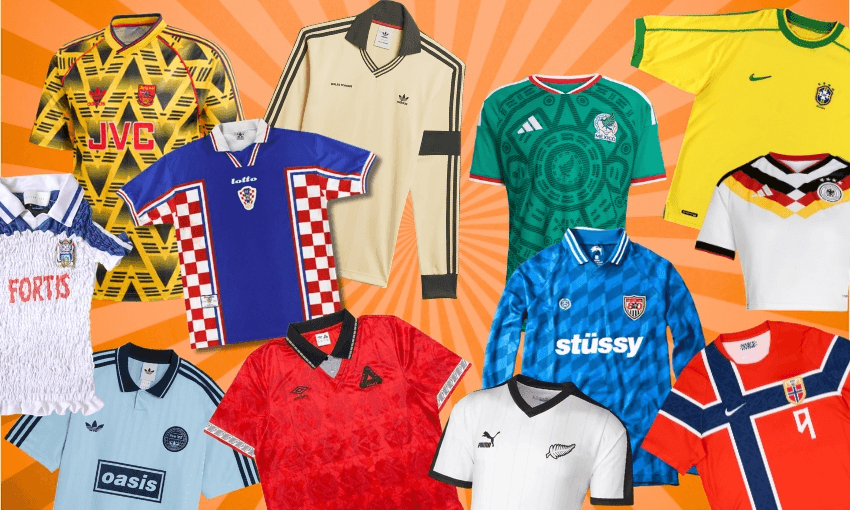
Forget France, Spain or Morocco. Maybe the World Cup’s biggest winners are the jerseys filling the stands and pitches.
Football jerseys are everywhere. Head to the supermarket or the pub, and you’re sure to spot “Mbappé” or “Messi” sprawled across a few sets of shoulders. Tune into the Fifa World Cup and the stands will be awash with national pride and pridefully worn polyester. Walk down the road and you’re likely to run into at least one Ronaldo.
The apparel is both ubiquitous and easily obtainable. You can buy World Cup replica jerseys from Adidas (Spain, Belgium, Argentina, Columbia), Nike (England, USA, Brasil) and Puma (Portugal, New Zealand) without leaving your couch. Those big three companies dominate the professional uniform and fan merch markets, but there’s extra street cred to be earned by wearing garb from historic outfitters like Umbro, Lotto and Kappa as well.
The garment’s popularity is getting as high as the nosebleeds in the World Cup stands. In 2026 the number of New Zealanders searching for “football shirt” have increased considerably from four years ago. A trend report released by Pinterest in May showed searches for “world cup shirts” were up 840% compared to last year. With audiences around the world watching the World Cup, the best kits are in demand; Google searches for Japan, USA, Mexico and South Korea jerseys have surged globally. Morocco and Norway are popular too.
But it’s not just about the latest kits. Queries for “vintage soccer jersey” are up 200% on last year as classic sportswear continues to dominate apparel trends. For some shoppers they’re collector’s items, but others are drawn to the older uniforms’ loose and swaggy designs.
The jerseys have become a popular merch format. Huffer made some for the Christchurch music festival Electric Avenue. Abbey Road Studios, Fontaines D.C. and Travis Scott have all sold them. So have beverage brands Jarritos, Hyoketsu and Guinness. Even New York mayor Zohran Mamdani got in on the action, releasing NYC-inspired, Brooklyn-made jerseys for the World Cup.
How did a garment once mainly contained to pubs and stadiums become a fashion favourite? Well, for starters, everyone looks good in them. Football shirts lend the wearer an air of health and vitality, suggesting a familiarity with shuttle runs and teamwork. Instead of a work-obsessed hyper-optimised psycho who’s chasing your bag, you’ll look like you a) have a life and b) share it with other people. Aesthetically, football shirts are antithetical to the boring styling of officewear and the tasteful minimalism that dominates a lot of contemporary design. They possess attributes lacking elsewhere in apparel right now: colour, pattern and joie de vivre.
But it’s not just the design; it’s the sense of community that comes with pulling one on. Whether it’s a precious old shirt or something box fresh, donning one delivers a feeling of belonging, granting the wearer instant entry into a society of fans, followers and fellow countrymen. They make you feel like you’re all in it together, even if you fan for free while the professional players whose names adorn their fabric earn eyewatering figures (Cristiano Ronaldo rakes in US$433.9 million a year and this year’s World Cup is the most lucrative in the history of sport, set to earn Fifa, a Swiss-registered non-profit, US$8.9 billion). A football shirt suggests you’re down-to-earth and happy to sink a pint with the bloke or blokesse next to you.
This all helps explain the shirts’ current explosion in popularity. But the fervour didn’t come out of nowhere, nor is it solely tied to 2026 World Cup fever. It’s been brewing for over a decade.
Legacy brand Umbro has collaborated with the streetwear label Palace since 2012, when it launched a fresh spin on old football shirts (currently going for US$635 on resale sites). Stüssy released football kits in 2015. Old jerseys from the Paris Saint-Germain club, reworked by French fashion brand Koché, appeared on the runway at Paris Fashion Week in 2017. In 2020, what would prove to be one of the most influential partnerships in fashion and sport launched when Adidas worked with English designer Grace Wales Bonner on a series of retro capsules which included football shirts. Bella Hadid wore one. So did GQ editors. So far, so cool.
It also helps that more women are watching football, and more people are watching women play the game. The Women’s World Cup, hosted by Australia and New Zealand in 2023, was the stage for Jamaica’s ultra-cool Wales Bonner-designed Adidas kits (I bought that shirt). Oh, and everyone finally remembered that Bend It Like Beckham is actually a brilliant movie. Will wearing a football shirt make you look as cool as Parminder Nagra, Keira Knightley and Shaznay Lewis? Many of us hope so. That’s why you see them worn with baggy jorts and miniskirts. This merger of sportswear with feminine fashion was dubbed “Blokette” by the podcast Nymphette Alumni in 2022 and it’s only grown since then.
Although it’s tempting to think this is a flash in the pan, nostalgia is one hell of a drug. Remember how cool Liam Gallagher, Damon Albarn, Robbie Williams and Jarvis Cocker looked playing that Oasis-vs-Blur charity match in 1996? (Fast-forward 30 years and ‘Wonderwall’ is the unofficial anthem of the English team and Oasis is selling football jerseys as reunion merch.)
Revisiting the past isn’t going away anytime soon. Why would it, when it gives us a break from the current hellscape? The teams know this. Germany’s current uniform reimagines the famous 1990 West Germany kit. Mexico’s reference 1998. Brands have cashed in by reissuing retro designs. Arsenal’s 1991-1993 “bruised banana” was brought back from the dead. Even the All Whites got the vintage treatment when Puma boldly released a design inspired by the (Adidas) shirts worn during their 1982 World Cup debut.
But how do hardcore fans feel about everyone and their dog donning a football shirt?
The Spinoff’s resident football expert Calum Henderson doesn’t see any problem. In fact, he thinks the trend has been a net positive for long-time football diehards. He has around a dozen jerseys, mostly lucky op-shop finds, but only used to wear them when he was doing some form of exercise. Now no-one turns a blind eye if he wears them with no reason. “In general, I think fashion people are doing good things for the football jersey and making it more socially and stylistically acceptable for real fans to wear them.”
Is Calum a gracious outlier? I asked a staunch Gunners supporter, my friend Nick, how he feels about people who aren’t die-hards donning football shirts. “I’m happy for anyone to wear whatever they like! But you won’t see me dead in anything but an Arsenal jersey.” Seeing a deep-cut throwback in the wild, like Arsenal’s 2000-2002 Dreamcast sponsored Nike jersey or the 1991-93 bruised banana jersey, gives him a “warm wave of nostalgia”. To merch wearers who don’t have a favourite team or even care much about the sport he says “go hard!”.
With welcoming fans, burgeoning support in the fashion industry and mass market advertisements every week in the form of the world’s most popular sports leagues, where will the football shirt fervor go? Is there a roof on this trend? Well, if there’s one thing we’ve learned from the World Cup, it’s being a fan is really, really fun. The event has smashed records for viewership and attendance. Between the swathe of new converts and the fact that football feels like the last mass-culture event in a fragmented world, I’d hazard a guess it’s only up from here.