There’s a reason Luke Jacobson is an All Black again
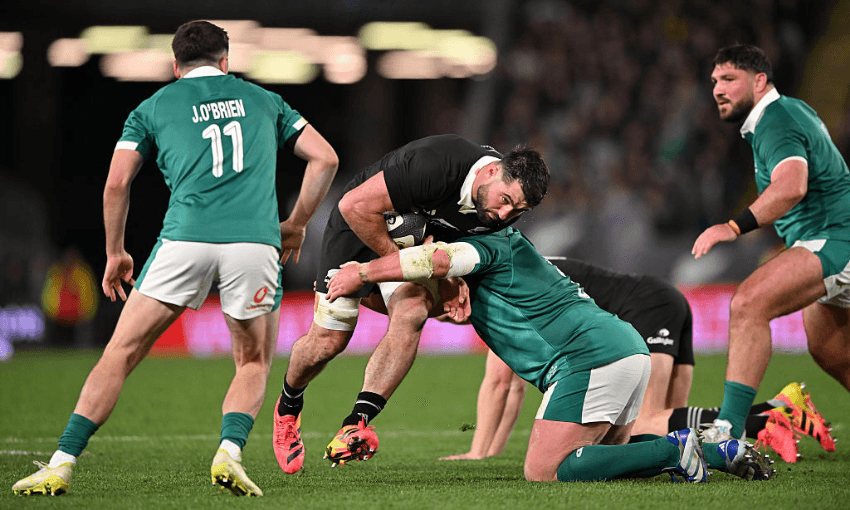
The All Blacks under Dave Rennie are confident and optimistic. Even the yellow-carded Luke Jacobson serves a considered purpose.
Déjà vu: Ireland come to Eden Park with high hopes of being the first visiting international team to win there since 1994; the All Blacks put 40 points on them; afterwards coach Andy Farrell suggests the scoreboard isn’t an accurate reflection of the contest.
In 2022 Farrell was vindicated before Tui could produce a “Yeah, right” billboard: Ireland beat the All Blacks in Dunedin and Wellington, becoming just the fifth team to win a series here, following South Africa in 1937, the British Lions in 1971, Australia in 1986 and France in 1994.
(The Wallabies also “won a series” here in 1949 but, seeing the All Blacks were touring South Africa at the time, it doesn’t count. The Lions didn’t become the British and Irish Lions until 2001; given that not being British is fairly central to Ireland’s existence and identity, Irish patience has to be admired.)
This time around, Farrell’s claim felt more like putting on a brave face than coming to a hard-headed conclusion: if anything the scoreboard flattered Ireland. A more pertinent takeaway was rival coach Dave Rennie’s insistence that the All Blacks can be a lot better.
They’ll need to be. Their next assignment involves four tests in successive weeks against the Springboks – three in South Africa and a missionary expedition (AKA money-spinner) to Baltimore, USA. Given the Springboks’ power, talent, experience, monumental self-belief and home advantage and the teams’ respective points in their development cycles, a drawn series indicating the Boks have peaked while the All Blacks have upside would be an excellent outcome.
“Optimism” has been the Rennie regime’s buzzword and, three games in, one feels guardedly optimistic that the All Blacks will give a good account of themselves.
The atmospherics around the team have changed; there’s now a palpable sense that the grown-ups are in charge. Rennie’s coherent, straight to the point media manner is in stark contrast to the verbal spaghetti served up by his predecessor Scott Robertson. Rennie comes across as a worldly individual who thinks talk is cheap, doesn’t believe in fairy tales and treats Rudyard Kipling’s impostors triumph and disaster the same. It’s nigh on impossible to imagine him succumbing to the hubris that led Robertson to blurt out that he wanted to win World Cups with the All Blacks and another national team.
While “optimism” is shorthand for the mindset needed for the bold, ball in hand, high tempo game Rennie wants the All Blacks to play, “brutality” is another term that gets a fair workout. While brutality in everyday usage evokes gratuitous violence and inhumanity, Rennie is calling for relentless and targeted application of physical force to create time, space and momentum for Will Jordan and co to exploit.
The essence of test rugby is the war for the gain line. At its most attritional it brings to mind Captain Edmund Blackadder’s crisp summation of Britain’s strategic objective in the trench warfare of World War One: moving Field Marshal Haig’s drinks trolley six inches closer to Berlin. The need for players who are mentally and physically equipped to survive and thrive in this hand-to-hand combat explains the Rennie selection that has confounded many fans and pundits: that of Luke Jacobson at openside flanker.
Jacobson, 29, first made the All Blacks as a 22-year-old. Since 2019, however, he has been absent from All Blacks squads for two stretches of almost two years. He has come off the bench more often than he has started and most of his starts have been in romps against second tier teams. He has played second or third fiddle to a host of players, many of whom, having fallen out of favour, have headed offshore or are en route to the departure lounge: Samepeni Finau, Cullen Grace, Akira Ioane, Dalton Papali‘i, Hoskins Sotutu, Pita Gus Sowakula.
As was reflected in much of the commentary, amateur and professional, surrounding his selection, Jacobson is widely regarded as a journeyman, a nearly man, a time to move on from man, too limited to prance in the wide open spaces and get his name on the score sheet.
Rennie’s typically laconic explanation was that Jacobson is “tough” – tough on defence, hence the sobriquet “Concrete Shoulders”, and tough at the breakdown. According to former All Blacks halfback Brad Weber (one of the few who foresaw Jacobson’s elevation), the Chiefs loosie is the best ruck cleaner in New Zealand rugby. As James Parsons, another ex All Black, put it: “He folds dudes.”
Folding dudes cleans rucks but is its own occupational hazard, as Jacobson rediscovered on Saturday when he was yellow carded for a dangerous cleanout in the first half.
So why is he underrated? Among basketball great Charles Barkley’s various explanations for anointing Michael Jordan, rather than LeBron James, as the NBA’s true GOAT, he tartly observed that those who believe otherwise must only watch the highlights reels.
You don’t watch the highlights to see heavy lifting in the dark places.