Attention armchair selectors: these are the mistakes you’re making
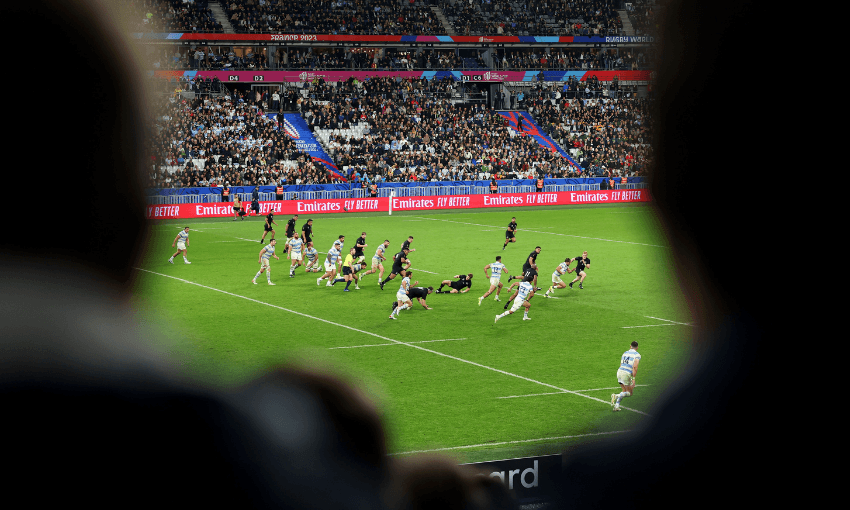
Think you could pick a better All Blacks squad than Dave Rennie and co? You’re not alone… but you’re also probably wrong.
The build-up and reaction to the All Blacks squad announcement reassuringly confirmed that we remain a nation of armchair selectors.
The selection process involves whittling the 200-plus Super Rugby players down to 34. Beforehand, so many contenders were floated that the comparative handful who weren’t name-checked must be contemplating a career change.
And afterwards there was the inevitable focus on the supposedly shock omissions (“What more could he have done?” etc). In 2024, the non-selection of Blues number 8 Hoskins Sotutu caused outrage north of the Bombay Hills and incredulity elsewhere; two years on his departure to an English club will barely register.
While many Kiwis are convinced, quietly or tiresomely, that they could do as good a job, if not better, than Dave Rennie and co, the reality is that most armchair selectors make some or all of the following mistakes.
They have preconceptions shaped by parochialism, prejudice or idiosyncrasy. The dreadlocks sported by Tana Umaga and Ma’a Nonu, two of our greatest midfielders, were regarded by some south of Wellington as disqualifying. (Nonu boldly upped the ante by applying eyeliner before taking the field.) I have a friend who couldn’t be persuaded that Black Cap Kane Williamson was an all-time great because he didn’t like his voice.
They make knee-jerk judgements pro and con, wanting to promote fresh faces on the basis of a handful of eye-catching performances, before they’ve demonstrated they have the attributes to succeed at the higher level, and to dump proven performers who may be keeping some powder dry for the big battles later in the year.
They attach too much importance to one-off performances and not enough to consistency. Ditto pyrotechnics and work rate, especially off the ball. Ditto attack and defence. “Defence wins championships” is a mantra in all football codes for a reason.
They pick a collection of individuals rather than a team, thus players are shoe-horned into combinations, in the midfield and loose forwards for instance, that wouldn’t gel because their skill-sets are redundant rather than complementary. After seizing rugby writers by their love handles and hoisting them off their feet, former All Black coach Alex ‘Grizz’ Wyllie would tell them it was just as well their teams never had to take the field.
Rugby has always prided itself on being a game for all shapes and sizes, reflecting the very different physical demands and technical requirements of the various positions. The Timaru-born, Wesley College educated French tighthead prop Uini Atonio is 1.96m tall and weighs 150kg. The French left wing Louis Bielle-Biarrey, arguably the best player in the world, is 1.84m and 84kg. Sadly, neither will take the field against the All Blacks in Christchurch next Saturday: Bielle-Biarrey is being rested; Atonio retired after suffering a heart attack in January.
Fittingly, it was a Frenchman who coined the saying that rugby is a game “for piano players and piano shifters.” Pierre Danos, a halfback blessed with movie star looks whose career spanned the 1950s and 1960s, was quick to add, “Fortunately I’m one of those who can play a tune.”
In fairness to armchair selectors they are engaging in a pastime, albeit often with a passion, rather than doing a well-paid job and don’t have access to the mountains of data the selectors sift through and tend to fall back on. Information technology and statistical analysis has made selection more of a science than an art. As former All Blacks captain and New Zealand Rugby board member Graham Mourie put it, “There’s nowhere to hide now.”
I can’t think of a rugby equivalent of Raymond Domenech, the French coach at the 2010 Fifa World Cup, whose selections were influenced by astrology. He distrusted Scorpios generally and Leos in a defensive role because “I know he’s going to want to show off.” Not surprisingly, there was a player revolt – after receiving a halftime spray, striker Nicholas ‘Le Sulk’ Anelka reportedly told Domenech “Go fuck yourself, you dirty son of a whore” – and France didn’t make it to the second round.
Despite their combined experience and expertise, the data and the endless hours devoted to the exercise, the pros still make howlers.
In 1992, All Black captain Sean Fitzpatrick had to talk new coach Laurie Mains into picking the extravagantly talented Zinzan Brooke. Graham Henry, Steve Hansen and Wayne Smith, all of whom were later knighted, didn’t take GOAT candidate Nonu to the 2007 World Cup.
And Umaga had to talk the three knights-to-be into picking the late Jerry Collins. Their reluctance is intriguing given a fearsome blindside flanker has become the All Blacks’ great white whale. “In their eyes he was a one-dimensional player,” said Umaga. “I argued that, based on my experience of playing with and without him, the dimension he certainly possessed was the one every team needs: intimidation.”