Eleven moments that defined the Black Caps’ series win over England
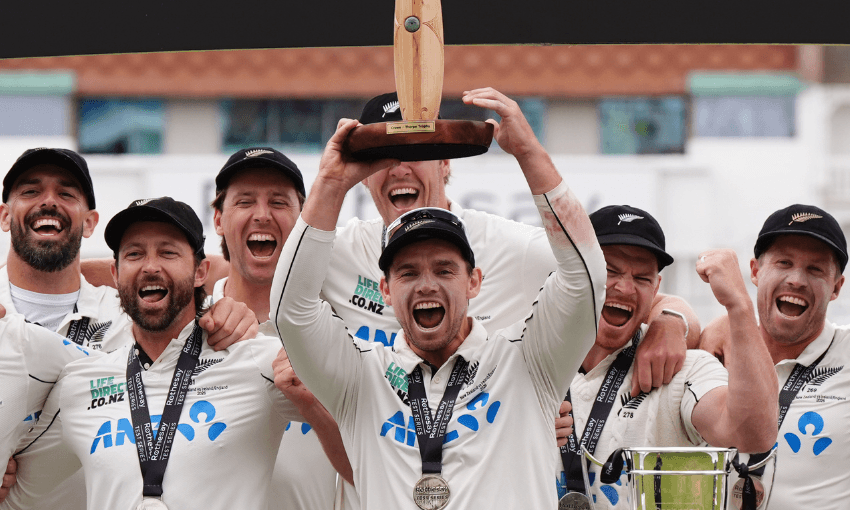
Dylan Cleaver casts his sleep-deprived mind back over New Zealand’s successful test match tour of England.
This story was originally published on Dylan Cleaver’s Substack, The Bounce.
NZ 438 & 288 for 9d England 354 & 212 NZ win by 160 runs; NZ win series 2-1
There was a scene, a small one, barely a vignette, at the conclusion of this magnificent third-test performance that summed up the past fortnight. There was Matt Henry, who would have dearly loved to take his place in the side but couldn’t, chatting to Daryl Mitchell, lagers at hand. Both waited a long time to establish themselves in this Black Caps side. Both have made up for lost time since. There were no microphones and probably only a vague awareness there might be cameras zoomed into their rooms. As they prepared to make their way to the presentations, Henry looked at his mate, fresh off one of the grittier centuries you’ll see, and said, “that was awesome”.
It didn’t matter if he was talking about Mitchell’s performance, which you suspect he was, or the performance of the squad across the series. Either way he was on point. New Zealand were awesome. Often imperfect, frustratingly so at Lord’s, but awesome nonetheless.
This was never a series dominated by a superstar who took control and bent it to their will. It was a series of big moments, not big players. New Zealand grabbed more of them than England. Most satisfyingly, the moments were grabbed by a whole host of different players.
Some players, on balance, had a statistically average series, but their big moments were oversized — think, for example, Tom Latham failing in five out of six innings, yet really cashing in the one time he got a start, and captaining superbly on the frenetic fourth evening at Trent Bridge.
Even the bit-part contributors found a way to influence games. Ben Sears, the travelling reserve, struggled mightily in the first innings at Trent Bridge, then scored vital lower-order runs to guide Mitchell to his ton, mangled his finger in the process but got patched up enough to bowl a snorter to Ben Duckett to remove England’s most dangerous batter on stumps on the fourth day.
Moments.
This is not exhaustive, it can’t be, but here are my 1st XI of New Zealand-centric moments that have, in my sleep-deprived state, defined this series for me.
1. The ball hits the turf… rinse and repeat
Lord’s was a lottery. From ball one the pitch squatted and spat. It provided excessive lateral movement and, to compound matters, the test was played under leaden skies and often with the lights on, which assisted swing. Very good players looked like they were batting in blindfolds. In short, runs were like gold, and New Zealand let England get far too many of them by grassing simple chances. Harry Brook and Duckett were both dropped early on the way to useful scores as Devon Conway and Rachin Ravindra had fielding matches to forget.
2. Nate announces himself
Among the wreckage at Lord’s, Nathan Smith announced himself as a critical component of New Zealand’s medium-term future (never pays to look too far ahead with fast bowlers). During the bulk of his five previous tests he had looked bustling but limited, but the helpful conditions and a six-wicket bag seemed to put a little extra puff in that chest. He needs more runs if he is going to bat at 8, but player-of-the-series Smith is a wonderful fielder and has that uncoachable quality of being a cricketer where things tend to “happen” around him. It seemed fitting that the last act of the series ended with the ball in his hands, having laid out at long-on to dismiss Jamie Smith (60), off Mitchell Santner (2-54).
3. The Big Night Out
One of the defining moments of New Zealand’s series occurred at a private club they’d quite probably never heard of. When Ben Stokes and Gus Atkinson decided to kick their first test celebrations up a notch by heading to Chelsea’s Rex Rooms, it set off a chain reaction that saw three England debutants appear at The Oval, and another two with just one test each. Mind you, New Zealand were missing someone themselves…
4. Goodbye to the Steadier of Ships
“I stand here to announce my retirement from international cricket and am happy to take questions from you all.” So said Kane Williamson, New Zealand’s greatest batter and a towering figure in New Zealand cricket history. Whatever the motivations for Williamson deciding to call it a day mid-series, it left a 9,500 runs-sized-hole in the New Zealand batting line-up. It also left an opportunity for Latham’s captaincy mana to grow without his most reliable sounding board. In one of those weird anomalies that is almost certainly coincidence, some of the Black Caps’ greatest test moments in recent history have come with Williamson absent, including the 2021 series-winning victory at Edgbaston and, of course, the 3-0 series win in India.
5. GP’s big flex
Having lost the toss and been inserted, New Zealand found themselves at a tenuous 188 for 5 when Glenn Phillips walked to the crease. That he was last man out for an even 100 with the total a match-high 391 only tells a fraction of the story. New Zealand’s best batter at Lord’s counterpunched brilliantly, first with Tom Blundell (51) and then with Kyle Jamieson (41) on a chaotic second morning.
The real theatre came at the fall of Blundell’s wicket on the first night, when a rampant Jofra Archer entered the scene and unleashed hell. At one point Phillips went to the sunglasses to try to see the ball better in London’s crepuscular light. It was an unscripted scene from a coming-of-age sports movie, as he ducked and swayed and found a way to keep New Zealand in the game. The maker of cameos went feature-length.
6. Nicholls finds a wholesome three-way
Henry Nicholls started the tour as the back-up squad batter, something that was both entirely warranted (he scored prolifically in the Plunket Shield and notched an unbeaten 150 in his previous test against Zimbabwe), and not universally popular (he is closing in on 35 and, let’s be honest, there’s been a lot of frustrating moments in those 60 tests across 10 years). As uncharitable as it might be to mention it at this moment, the two leaden-footed prods at Trent Bridge might have even reminded you of some of that frustration. Yet Nicholls’ contribution to this series victory was immense, moving from his previous position of comfort batting at five to take the three spot vacated by Williamson. His second-innings century at The Oval was critical, coming in at 8 for 1 and leaving at 261 for 4 with New Zealand in a position of total control it would not relinquish. He made useful but not defining contributions at Trent Bridge, yet it was his sensational run out of Joe Root on the fifth morning that extinguished all hope for England. When he was dropped following a hapless tour to Bangladesh in 2023, in his heart of hearts Nicholls would have struggled to drum up this scenario. There was something quite wholesome about his role in this series.
7. Matt Henry marks his territory (ft. Tom Blundell)
New Zealand’s best bowler was a passenger at Lord’s in conditions that should have had him drooling. He missed Trent Bridge completely. In between, with a back threatening to spasm at any moment and nursing a strained calf, Henry took 11 wickets and bowled his country back into the series. It was a wonderful display of control and brains — it was late-career Hadlee-esque, of which no higher honour could be bestowed. He ran through the tail in both innings but it was his dismissals of Joe Root and Harry Brook in both innings that did the heavy lifting in this win.
To that end, the Black Caps owe a lot to Blundell. He made a couple of decent contributions with the bat in the series, not quite enough for a No 6, but it was more than made up for by his work with the gauntlets, which was world-class. It was 18 months ago in Wellington that Blundell discovered that Harry Brook’s kryptonite was a keeper standing up to the stumps to the seamers and Bazbatting has never really recovered. That Blundell managed to pull it off while keeping to a Dukes ball on uneven surfaces was remarkable. He effected a modest nine dismissals, scored just 123 runs and conceded 58 byes, yet he must have been in the running for player of the series, that’s how influential he was. Ian Smith described being a keeper as akin to being the drummer in the band, implying that their job was to keep the beat of the side going and, for the most part, to be unobtrusive. If Blundell was the drummer in the band, he was Keith Moon.
8. Latham and Conway set their stall out
For reasons explained in #4, Latham is a sneaky good captain, understated and underrated. It’s hard to think of a time when New Zealand appears to be drift badly under his leadership¹, and he is undoubtedly a more judicious utiliser of reviews than any of his predecessors. Even though I included him as 13th man in Modern New Zealand Cricket Greats, there are too many holes in his résumé for him to be considered a truly great test opener. He struggled across the four tests of this tour, as did his partner at the top Conway, but when they got in, they really made it count, putting on 317 for the first wicket after winning the toss and batting at Trent Bridge. That laid the table for everything to follow.
9. Foulkes crashes the party
In an era of tall, hit-the-deck-hard, shape-it-away fast bowlers, Zak Foulkes offers a point of difference (POD). The only problem is, the conditions window for his POD to actually, erm, make a difference, remains quite small. His limitations were laid bare in last summer’s series against the West Indies, and even against Ireland on a relatively docile Stormont wicket. It was certainly no shock when Blair Tickner and Sears were preferred ahead of him for the decider in Nottingham, but when the former went down, felled by an Archer bouncer, New Zealand got a massive slice of fortune.
Foulkes’ double of 3-35 and 3-52, plus a ballsy hourlong 6 with the bat in the second innings, was a critical component of the win. His POD made a difference. It was classic next-man-up stuff.
10. ‘Brahms’ and ‘Rammstein’
I’ve had a couple of notes from newsletter readers who enjoyed my analogy for the 129-run Ravindra (Brahms) and Mitchell (Rammstein) partnership that took the match and series away from England, so I’ll go to the well once more. Ravindra had an up-and-down series with the bat and a down-and-down series in the field, but his ups were really good. Mitchell never once appeared to be in form, yet in a bowler’s series he scored 235 runs at 47. Of all the players in this series who had fathers who coached and played oval-ball sports professionally, Mitchell was by far the most influential.
11. The Unmentioned
At last count, Brendon McCullum had been mentioned 642 times² during the previews, reviews and broadcasts of the three tests. The vast majority of cricket fans in England probably still have no idea who the head coach of the Black Caps is. One oversaw chaos on and off the field; one had his team ready to play hard-nosed, effective test cricket. At this point in time, I’ll take the one with no name.
This story was originally published on Dylan Cleaver’s Substack, The Bounce.