The LNG levy is dead – but who will pay remains a mystery
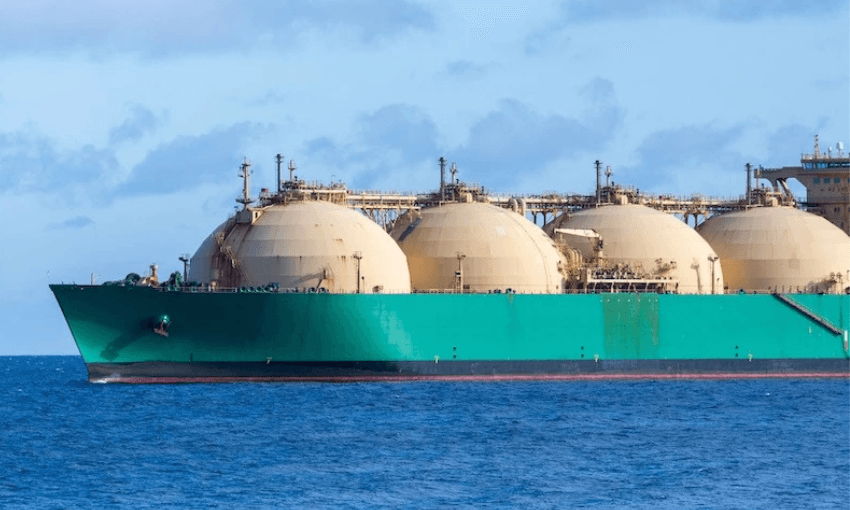
The government has scrapped its plan to fund New Zealand’s proposed LNG import terminal via a levy on power bills but gives no specifics on alternative funding sources, writes Henry Oliver in today’s excerpt from The Bulletin.
To receive The Bulletin in full each weekday, sign up here.
The government has scrapped its plan to fund New Zealand’s proposed LNG import terminal via a levy on the electricity sector. Energy minister Simeon Brown announced the shift in a speech to the Auckland Business Chamber, telling RNZ that MBIE and NIFFCO would work with the “gentailers” (power companies that both generate and sell power) on a “fair funding model”.
While Brown offered no specifics on possible funding sources, he was categorical that it would not be a levy on power bills: “Responsibility for keeping the lights on sits squarely with the electricity sector – that is the principle guiding our decisions on funding.”
From ‘gas tax’ to uncertainty
The original plan, announced in February by then-energy minister Simon Watts and the prime minister, was for the roughly $1 billion facility to be paid for through a levy of $2–$4/MWh on power. The opposition quickly labelled this a “gas tax”, warning the cost would flow through to consumers.
Labour’s energy spokesperson Megan Woods told 1News there was now “real uncertainty” about who would pay, saying the government was “rushing into a multi-billion-dollar commitment without explaining how relying on volatile international markets will lower costs for Kiwis, or ultimately how it will be paid for”.
The government has long framed the terminal as a backstop for a renewables-heavy grid vulnerable to dry years. Brown said the shortfall requiring cover in a dry year is around three terawatt-hours over three months – a gap that cannot be filled by batteries or a few days of stored water.
Pros and cons
Jonathan Milne of Newsroom reports that last month, in a “surprise reversal” of its previous support for LNG, Meridian Energy told a parliamentary committee that New Zealand does not need to import LNG to cover dry-year supply shortages. “From everything we can see, the analysis shows dry-year risk is being managed through the next 10 years,” said Meridian chief executive Mike Roan. “So when we look at LNG … it is not necessary from an electricity perspective.”
Some big industrial power users have welcomed the government’s confirmation of the terminal. Pan Pac Forest Products general manager Roger Jones told Newsroom the announcement would help keep the last major mechanical pulp mill in New Zealand operating. In 2024, wholesale prices hitting $800/MWh forced Pan Pac to shut its Whirinaki mill for a month and send 140 workers home.
Major Electricity Users Group chair John Harbord said LNG would introduce a limit on wholesale prices, acting as an effective fifth player in a market long dominated by four gentailers. “I’m not claiming this as a miracle cure,” he said, “but it does introduce a soft cap on how high wholesale prices go.”
No escaping the cost
But, according to Milne, scrapping the levy doesn’t mean consumers escape the billion-dollar cost – it is simply routed through the gentailers rather than a flat charge. “Although the Government may wish to stop the power companies passing the cost through to consumers, any attempt to do so might be seen by global markets as an assault on property rights,” he writes.
“It’s also worth remembering that ministers may be quietly happy for the power companies to maintain their profit margins, because the Government is a majority shareholder in Meridian, Genesis and Mercury. Last year the three paid a total $564 million in dividends to the Crown.”