Greens correct $800m tax policy error, Swarbrick calls it a 'typo'
The Greens have been forced to correct figures in their flagship tax policy, revising net revenue projections down by about $200 million annually due to a "typo".
An economist who helped analyse the costings for the party told 1News he was sorry to have missed the issue but maintained the revenue still stacked up — his review having found the costings reasonable, although conditional on the Greens' own assumptions.
The party's taxation plan, its first major policy of the election year, proposes a wealth tax on net assets above $10 million, an inheritance tax, and income tax changes the Greens say would deliver a tax cut to 96% of New Zealanders.
The Greens revised the plan following media enquiries this morning by RNZ and 1News.
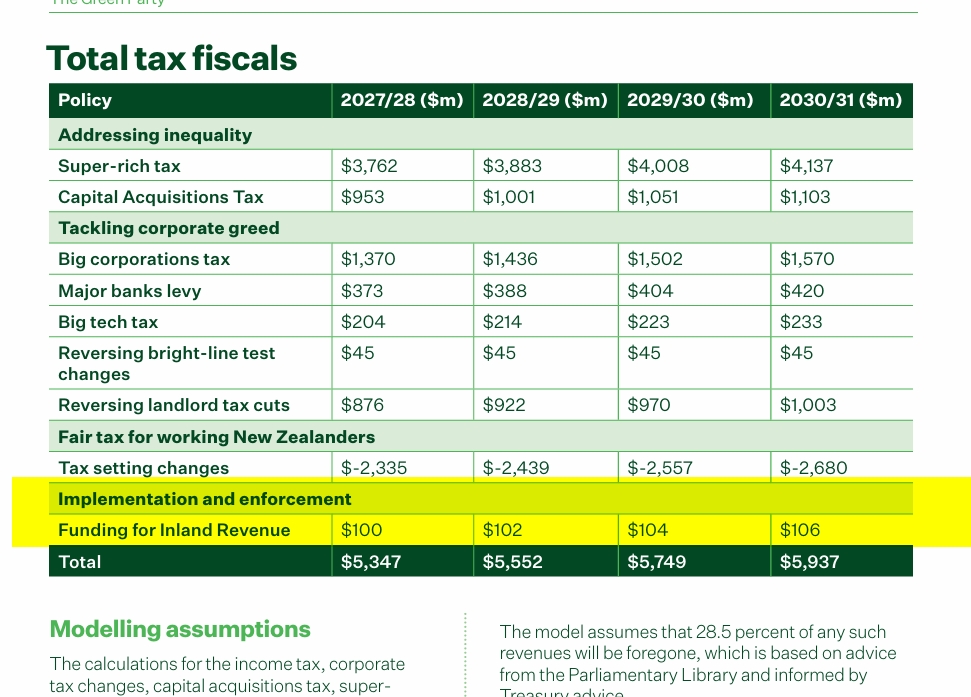
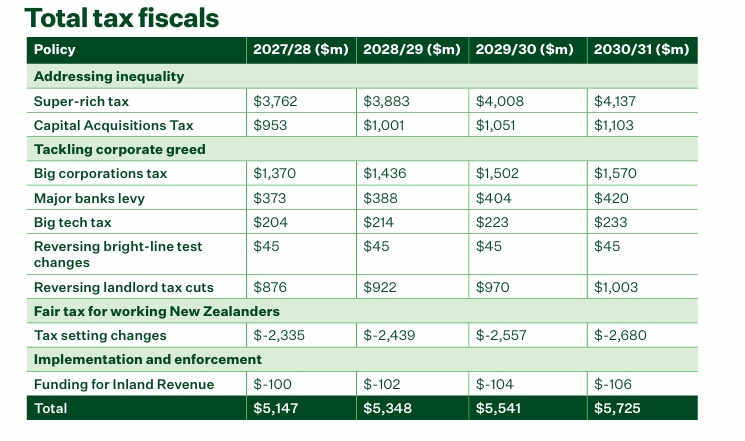
In its reissued form, the policy shows total net revenue of $5.15 billion in 2027/28, rising to $5.73 billion by 2030/31 — down from $5.35 billion and $5.94 billion in the version released a day earlier, a reduction of roughly $800 million over four years.
The roughly $200 million annual drop came after questions were raised about the policy's fiscal table, where $100 million a year set aside to administer and enforce the new taxes was incorrectly added to total revenue brought in, rather than subtracted as a cost.
Infometrics principal economist Brad Olsen, who reviewed the policy's costings for the Greens, told 1News the IRD administration cost had been recorded in the wrong place.
"During our analysis of the Green Party’s tax policy, the Green Party and Infometrics agreed that an explicit amount should be added in to account for the administrative work IRD would need to be funded to do to undertake the proposed tax policies.
"When incorporating this administration cost, the figure was inadvertently included in the summary total of revenue when it should’ve been recorded as a cost — in other words, negative revenue, recorded with a minus. I’m sorry to have missed this.
"However, all revenue from the Green’s tax changes do stack up. The error is regrettable but not material to the taxation elements of the Green’s Tax Policy."
Party co-leader Chlöe Swarbrick acknowledged the mistake when questioned on RNZ's Midday Report, describing it as a typo.
"Yes, we've issued a correction on this. So, there was a typo, which you've rightfully pointed out with net revenue," she said.
Put to her that the error amounted to nearly half a billion dollars over the forecast period, Swarbrick said the figures still held up.
"This is what happens when you have a large team moving at pace, and you've got designers who are producing collateral, which is going out.
"We've made an error, and we've issued a correction to correct exactly that, but our figures still stack up, and we're being transparent about that correction."
The revision does not alter the individual policy measures.
Today's correction marked the second hitch in the policy's launch.
The Greens had already been forced to bring forward Sunday's media event after the plan appeared early on the party's website, hours ahead of a scheduled announcement.
The party are proposing a 2.5% annual tax on net assets above $10 million, with the family home exempt, and a "capital acquisitions tax" charging 33% on inheritances and gifts received worth over $1 million, with family homes and farms exempt.
For earners, the plan creates a $10,000 tax-free threshold and a new 45% top tax rate on income over $160,000, replacing the current 39% top rate on income over $180,000.
Swarbrick said yesterday the party had narrowed its wealth tax in response to voters wanting certainty about who would be affected.
"We have heard loud and clear from people that they want clarity as to who this will apply to, so with that $10 million threshold, I think it's pretty clear," she said.
At Sunday's launch, Swarbrick was also questioned over how Inland Revenue would assess and collect the new taxes, and pointed to the funding the party had set aside.
She said modelling under the previous Labour government had estimated IRD would need about $3 million a year to evaluate and apply a wealth tax.
"We've resourced the IRD around $100 million in this proposal, so we think that is more than adequately accounted for," she said.
It is that same $100 million IRD funding line that the party later corrected, after it had been added to total revenue rather than subtracted as a cost.
Co-leader Marama Davidson said the policy was designed to benefit the majority, with the party stating 99.7% of people would not pay the wealth tax.
The Infometrics analysis, carried out by economist Brad Olsen, concluded the costings were reasonable but conditional on each policy's assumptions, and cautioned that the large number of overlapping changes were "difficult to fully assess".
The review did not independently cost the proposals.
National's campaign chairperson Simeon Brown said yesterday the Greens had handed Labour "a smorgasbord of new taxes" and called the proposals "economic lunacy".
Greens' tax plan net revenue estimates
New estimates on Monday
2027/28 - $5.147 billion
2028/29 - $5.348 billion
2029/30 - $5.541 billion
2030/31 - $5.725 billion
Original estimates on Sunday
2027/28 - $5.347 billion
2028/29 - $5.552 billion
2029/30 - $5.749 billion
2030/31 - $5.937 billion.
— additional reporting by Senior Political Reporter Benedict Collins