Icehouse Ventures’ $150m Growth Fund III hits first close as KiwiSaver provider Generate invests
Icehouse Ventures has revealed a $40 million first close for its Growth Fund III, with Generate KiwiSaver featuring heavily in the mix of early investors.
The final close is set for the year’s end, with a target to raise $150m to invest in 20 to 30 early stage companies – those beyond the seed stage and into Series A to D raises – over the next 10 years.
Venture capital advocates, including the Start Up Council, have lamented KiwiSaver funds’ lack of interest in the sector.
With an election looming, is it another chance to push our legislators toward changing that?
“There are plenty of reasons to lobby for more policy to lubricate investment from KiwiSaver funds into venture [capital],” Icehouse Ventures chief executive Robbie Paul said.
“But if I were to have a controversial take, I actually think the private market will sort itself out.
“KiwiSaver managers are looking to generate returns for their investors. That’s their first and their last thing. We can’t ask them to be patriotic. We have to prove to them that it’s worthwhile investing in the space.”
Generate already had $50m in other Icehouse funds, Paul said.
Overall, his firm has around $100m from KiwiSaver players, including $10m from Pie Funds (which has also backed Icehouse rival Altered Capital, which recently announced a $100m fund).
At the other end of the scale, individuals can invest from a minimum $50,000.
Golden visa cash pouring in – but not much of it to VCs
One area where the Government has been proactive is the revamped “golden visa” programme.
While its predecessor stalled at around $100m, the Active Investor Plus programme has reached $1.49 billion in its first year from 609 applicants (with a further $2.4b in the pipeline from those waiting final approval).
Of that, $1.2b has gone to “managed funds”. Within that subset, private credit ($899m) was the biggest winner, while $147m went to venture capital. 63% had been deployed as of April 22.

“Investor immigrants will be a reasonably strong source of capital. Most of the money so far has not gone into venture capital,” Paul said.
“One explanation for that, I would say, is that there were not many late-stage funds. The reality is, seed-stage investing is not for everyone.”
Growth Fund I performance
The late pandemic period was a heyday for venture capital. With interest rates near zero, a lot of money was lured away from more traditional investments.
“It was a very frothy couple of years,” Paul said.
Fund I money went into three firms that have become global names, including Crimson, Tracksuit and Halter, plus a number on a promising trajectory, like Hnry.
Growth Fund II performance
Getting investors on board for Growth Fund II was harder as interest rates climbed and a post-Covid hangover set in.
“Relative to Fund One, the cheque size was half and the time to get to a yes was twice as long, which meant basically we had to work eight times harder to achieve the same outcome,” Paul said.
The younger Growth Fund II has yet to see any hits or misses from exits from individual companies.
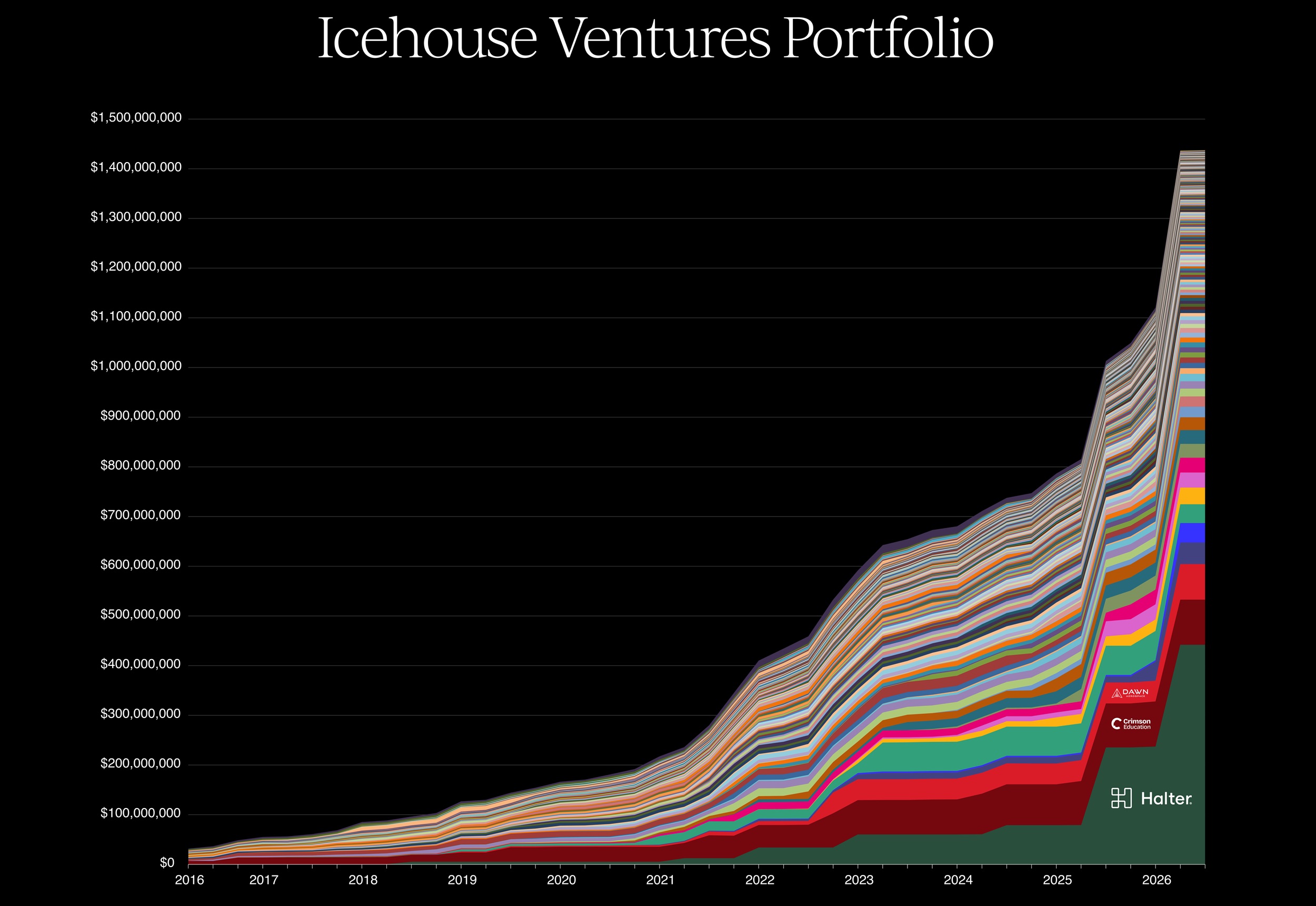
New companies were added, including electric boat maker Vessev, but a lot of Growth Fund II capital went toward Growth Fund I companies, including Halter, Crimson and Sharesies, who were making good progress.
Halter looms largest in this strategy.
“When we invested in Halter, it was two university students. They hadn’t graduated, they had no product,” Paul said.
“We invested $100,000 [from an Icehouse seed fund], said ‘Well, interesting hypothesis, high quality young entrepreneurs’ and we were willing to take them on at a valuation that reflected the long-term risk, the volatility, the chance of failure, future dilution and everything else.”
Across various seed and growth funds, Icehouse Ventures made progressively larger investments in Halter, including $500,000, $1m, $4m, $10m, $20m and larger punts.
Paul said Icehouse Ventures had invested $105m to date, with a current holding value of $409m.
The third-largest holding is more extreme on the risk-reward scale: Christchurch-based Dawn Aerospace, which recently made its first sale of its small uncrewed spaceplane. It also makes systems for satellites and is working on a prototype satellite refuelling system.
Backing ex-pats
Another major Growth Fund II trend was capital going to offshore firms run by Kiwis (all were 2025 rounds – bar Wayve in February this year – and all led by multinational investors). These included:
“We are limited to the amount of capital that can be invested in offshore companies, which is roughly 30%,” Paul said.
“What we discovered last year with Substack first, then Nuro then Wayve, then Foxglove, then Antioch and many more, is that there’s a very strong emotional pull by these Kiwis to stay connected and to have a little bit of investment from us.
“If we were Icehouse Canada, Substack would not have answered the phone. Instead, we got to participate, and many others did not.”

It’s been years since the NZX had a major tech IPO (initial public offering) – one of the main exits for venture capital.
Crimson and Halter have both reached $1b-plus valuations without listing. Neither have any immediate plans to do so and it’s possible both could list in the US if they go public.
Paul said start-ups are staying private for longer.
“It’s changing a lot,” he said.
“SpaceX, when it IPOs, will obviously be a very large moment. But it’s also a very telling story, which is that you used to have to IPO for liquidity or for a large cash raise, and now both of those things can be solved without going public, all the way up to a trillion-dollar valuation with SpaceX and Stripe.”
Elon Musk’s 24-year-old SpaceX is expected to list before year’s end. Online payments giant Stripe, started 16 years ago, has founders who still actively talk up staying private.
“I think the world’s evolving quickly because now institutional investors, including in New Zealand, are realising that if they want to be part of this sort of growth ecosystem, they need to invest in the private markets,” Paul said.
Chris Keall is an Auckland-based member of the Herald’s business team. He joined the Herald in 2018 and is the technology editor and a senior business writer.