Christian leaders speak out against Brian Tamaki’s incendiary online comments - ‘Jesus was a migrant’
Christian leaders across the country have condemned Brian Tamaki’s “potentially dangerous” comments, which have seen the Destiny Church leader have his gun licence revoked and firearms seized by police.
Tamaki was served a “temporary firearms licence suspension notice” by police and had several hunting weapons confiscated this morning, after incendiary comments made online.
The controversial Christian leader made a reference on a recent podcast to using a shotgun to protect his family.
He also said “let’s purge New Zealand of Hindus, Sikhs and Muslims” in reference to claims that Indian Prime Minister Narendra Modi was targeting Indian Christians with threats and violence.
“And, while we’re at it, if they’re burning churches down, why don’t we burn mosques and their temples down? Tit for tat,” Tamaki said on social media this month.
In response to Tamaki’s recent rhetoric, Wellington Anglican priest Scottie Reeve said Tamaki wants to “mandate a vision of a theocracy”.
“There are two very different visions of Christianity,” Reeve said.
“There’s what Jesus put forward, where he talked about us ‘salting or seasoning the world’ as Christians and being a positive influence.
“Then there is Brian’s perspective, which we’re seeing come from [Donald] Trump and lots of his acolytes and folks around the world, which is instead of Christians being a positive influence on the world, we’re meant to ‘dominate and control’ the world.
“Jesus steps into people’s lives with hope; Brian instead wants to mandate a vision of a theocracy.
“We are in a moment globally of fear and uncertainty – economically, politically, socially. And in those moments, as you saw in the 1930s and in other moments in history, we tend to look for someone to blame, and often migrants and foreigners, those who are different from us, are an easy place to scapegoat.”

Reeve said that Jesus himself “was a migrant and a refugee in his life”.
“If Brian doesn’t think there’s room for migrants, then he’s actually saying there’s no room for Jesus.”
Reverend Dave Whitaker, from the Wesleyan Methodist Church in Christchurch, said Tamaki’s “response is not in line with either the teachings of Jesus or the mainstream Christian church”.
“It’s potentially dangerous as well, in terms of radicalising people towards extremist activity.”
Whitaker, who has researched the risk of Christian radicalisation, said Tamaki’s “increasingly violent” comments are concerning.
“I do find his rhetoric is getting increasingly violent. My concern is that it only takes one person to misconstrue the teachings of Tamaki and have a major incident.
“While it is good to see Brian is concerned for the welfare of Christians around the world, I just think, on this issue, it is contrary to the gospel.”
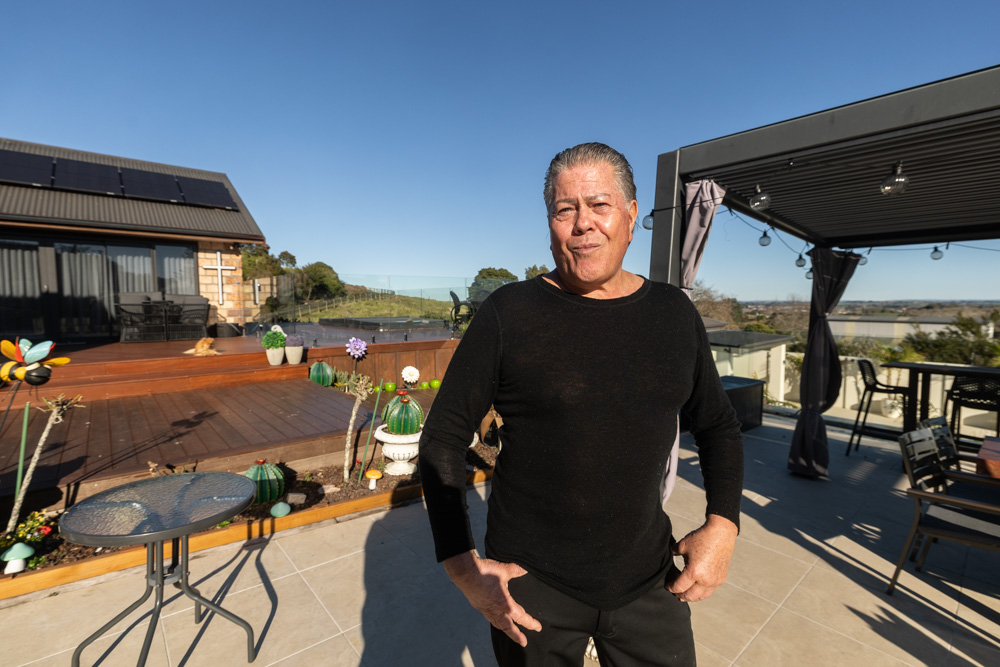
Anglican Bishop of Wellington Justin Duckworth said Tamaki’s rhetoric is “very sad”.
“I think it’s counter to the gospel as I understand it. I think it feels to me like it’s making a statement at the cost of people’s lives.
“Jesus himself, in his early life as a child, his family migrated to Egypt due to difficult situations in his birth context. You know, Jesus was a migrant in his early childhood.
“It’s such an unusual statement for a Christian leader to be making, and I think it feels to me that it’s generative in fear, not in love.
“And I think the gospel flows from love, not from fear. As Christian leaders, hopefully most of us disagree with the statements.”
Duckworth said “the gospel is really clear that we’re called to turn the other cheek”.
“We believe in Jesus who changed the world by non-violence, by laying his life down, not by resorting to violence.
“Jesus turned his back on violence. It is counter to the gospel to think that we would respond to violence against Christians around the world with violence.
“In this moment in history, it’s really easy to propagate one’s cause by building on fear.
“I think for all of us, whatever our beliefs, what history calls of us is not to propagate fear, but to propagate love, compassion and belonging.
“We’re starting to talk a lot about social cohesion. That’s what we’ve got to be about. We’ve got to be about not continuing to be seen as people who are peddling a narrative of fear.”