Auckland manslaughter defendant Kaixiao Liu suggests ‘cult’ leader insinuation is wrong
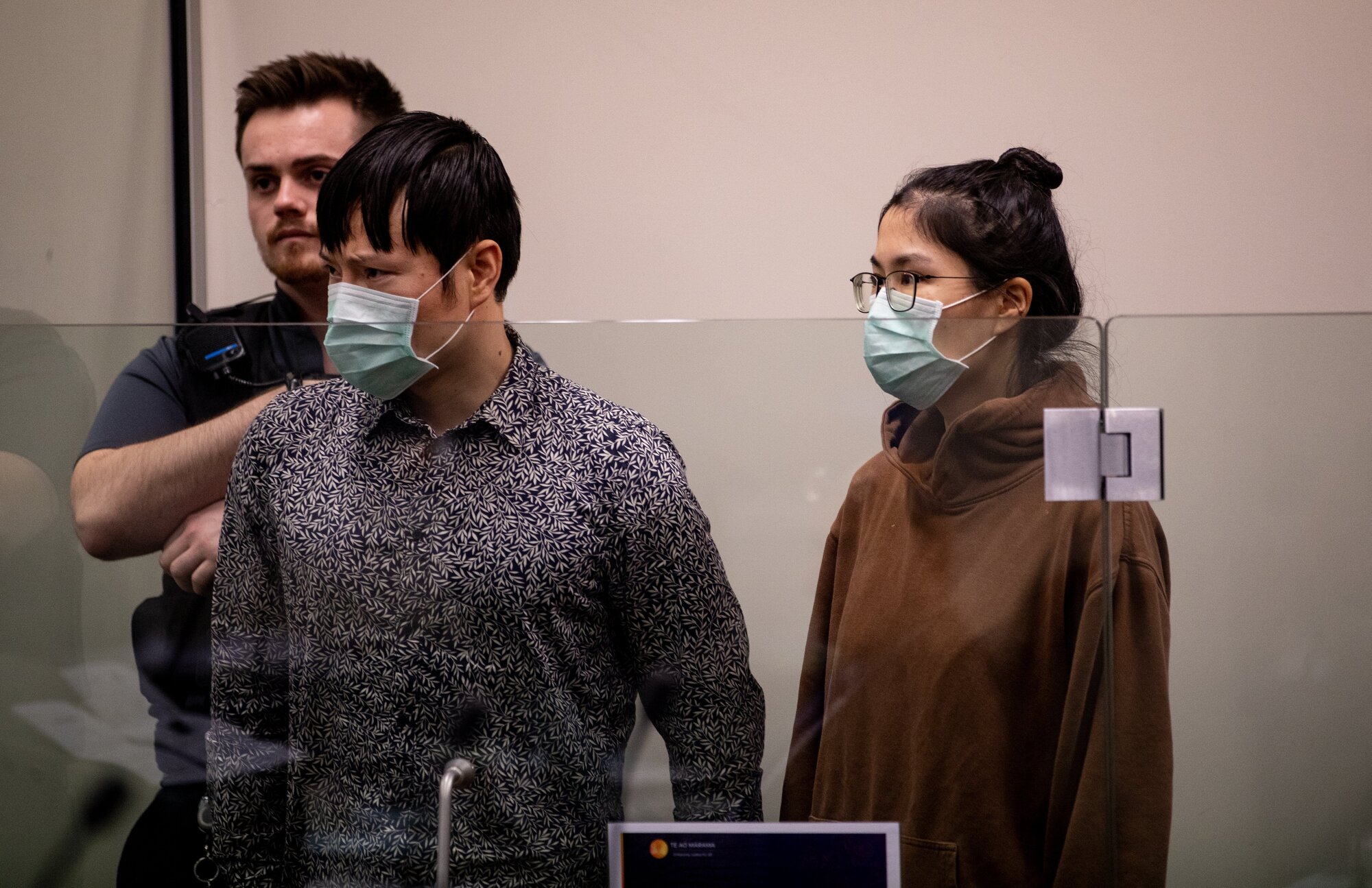
An Auckland resident accused of having helped kill and dump the body of a Chinese overstayer - one of six women who allegedly travelled to New Zealand for his religious instruction - suggested to jurors today that documents have been mistranslated to make his household sound like a cult.
Prosecutors have been careful not to use the word “cult” through the two weeks of evidence so far in the case of Kaixiao Liu, who is on trial in the High Court at Auckland for manslaughter and kidnapping alongside his wife and parents.
But they have described a “religious sect” known as The Ark that was headed by Liu out of the family’s Ōrewa, North Shore home. The women who lived with him - and, according to handwritten documents found in the home, considered themselves married to him - usually referred to Liu as “Lord” or “Master”, prosecutors have said.
Among them was 70-year-old Shulai Wang, whose body was found wrapped in plastic and weighed down with stones in Auckland’s Gulf Harbour in March 2024. Authorities have suggested she was denied food, ordered to sleep in a tent outside that was closed with a padlock and eventually, after trying to escape, forced into a suitcase as punishment. Her exact manner of death is unknown, a pathologist has said.
Many of the recovered documents, written in Mandarin, were read aloud to jurors in English on Friday. Today, Liu had a chance to cross-examine translator Cyril Young. All four defendants have opted to represent themselves, mostly ignoring standby lawyers who have been assigned to sit next to them anyway.
Liu referred jurors to a document written by one of the women in the house titled “Letter of Conversion”.
The document began: “I, [name suppressed], of Guangdong, China, am willing to abandon my previous last name and voluntarily convert to the secret Liu family of the tribe of Judah, descendants of David, and the reasons are as follows...”
Liu took issue with the word “convert”.
“In English, conversion is said like religious recruitment or a cult induction,” he said, suggesting that it could have just as easily been interpreted to mean “family affiliation”.
“I don’t think I accept that,” the translator responded. “My understanding is it was ‘convert’.”
Liu also suggested that “the secret Liu family” should have instead been translated as “the hidden Liu family” - a “neutral” word, he insisted, that is in line with common Chinese translations of the Bible. The translator wasn’t there to give Biblical context, Justice Mathew Downs interjected.
But the witness agreed the words “secret” and “hidden” could be interchangeable.
Liu also directed the translator to another document written by the same woman titled “Covenant of the body”.
“I, [name suppressed], voluntarily love, marry and have children with Mr KL, build a big family, love and live harmoniously with several other women in the big family,” the English translation read. “I am writing this Letter of Covenant with a clear mind. (Text may have been cut off) KL and several other women will love each other, live happily, freely and beautifully.”
Pointing to the translator’s aside in parentheses that some of the handwritten text might be missing, Liu suggested that a single missing word might change the entire meaning.
“I’m not sure,” the translator responded.
At another point in his three hours of cross-examination, Liu suggested “Master” could have been translated instead to “host”. The translator said he doubted it. But Master and Lord are interchangeable, he said.
Liu’s cross-examination was meandering at times, with asides about Mandarin characters and long pauses as he appeared to come up with his own translations on the spot. He hadn’t had much time to prepare, he said at one point before the judge reminded him the statement amounted to him testifying rather than asking a question.
“The jury don’t know Mandarin,” Justice Mathew Downs reminded the defendant at another point. “Can we please focus?”
After sending the jury out of the courtroom two times for in-chambers discussions that cannot be reported, the judge sent the group home early at 1pm, with instructions to return tomorrow for the cross-examination to continue.
“I want to explore if there is a better way we can conduct this ... and get a process that’s a little more helpful for everyone,” he said, emphasising to jurors that his frequent interuptions of Liu that morning had not been “an adverse reaction to his case”.
Earlier, prosecutor Henry Steele had started the day’s court proceedings by introducing one more document that had been discovered by police inside the home.
It was titled “Ya daily writings” and dated March 7, 2024, the day Wang is believed to have died. Authorities have said Ya is a nickname used for Kaixiao Liu’s mother, co-defendant Xiuyun Li. The document was found in her bedroom.
“There were no more sounds coming from Shulai today, thank you Heavenly Father God for completely protecting our family,” the document stated. “Heavenly father God is in our home every moment...
“I understand what it means to that evil will never suppress righteousness. Our family is a house full of justice, and all evil will be eliminated. Thank you and praise you, Heavenly Father God! All glory and praise be to God the Father!”
Craig Kapitan is an Auckland-based journalist covering courts and justice. He joined the Herald in 2021 and has reported on courts since 2002 in three newsrooms in the US and New Zealand.
Sign up to The Daily H, a free newsletter curated by our editors and delivered straight to your inbox every weekday.