Auckland sect leader Kaixiao Liu criticises deportation of potential witnesses in manslaughter trial
Five Chinese overstayers who were living in the same home as a 70-year-old woman whose body was found bound in tape, folded in half and wrapped in plastic in Auckland’s Gulf Harbour were deported within months of the gruesome discovery.
The Immigration New Zealand decision was criticised today by four defendants on trial for allegedly kidnapping Shulai Wang in March 2024 and killing her.
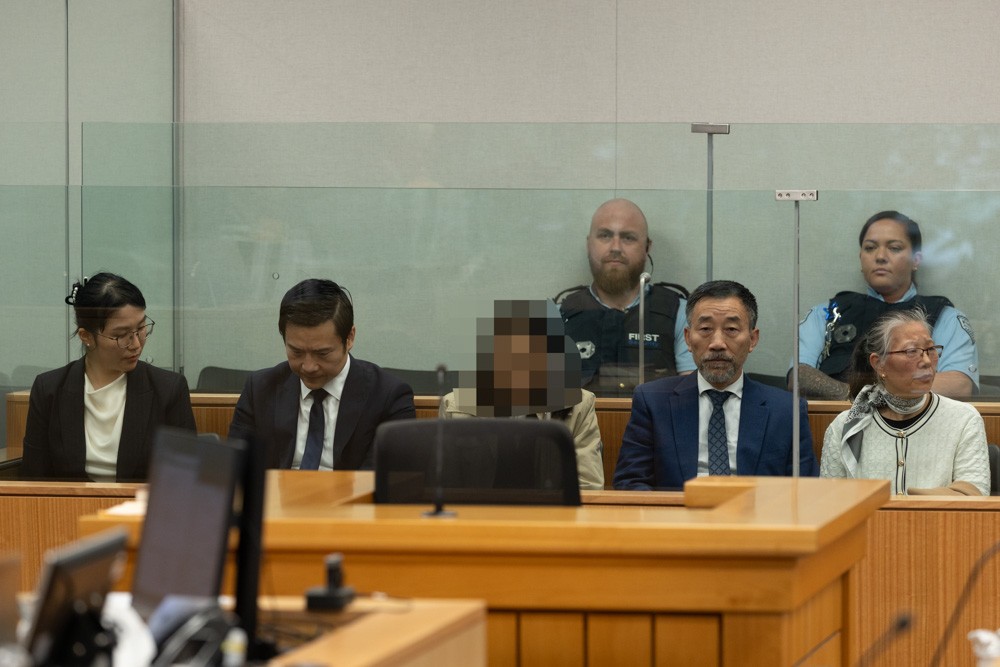
Religious sect leader Kaixiao Liu, his wife, Lanyue Xiao, and his parents, Xiuyun Li and Jingui Liu, have all pleaded not guilty to manslaughter. At the outset of the trial this week, Kaixiao Liu, who is representing himself, told jurors in the High Court at Auckland that he wanted the five deported women to give evidence at the trial.
He questioned immigration officer Mo Zarour today about how he could get them back in the country before the trial ends in several weeks.
“This is for open justice and the search of truth,” the defendant said.
Like Wang, the deported women had been living with the defendants in their Orewa home, where they toiled in “practical servitude” and received religious instruction under Kaixiao Liu, who ran a religious sect known as “The Ark”, prosecutors said. They had come to New Zealand on visitor visas in 2019 and 2023.

It was at that North Shore home, authorities allege, that Wang was singled out for punishment. The alleged punishments included locking her in a tent at the property, physical discipline, withholding food and being called “evil” by Kaixiao Liu.
A fisherman found Wang’s body days after the alleged killing.
Jurors today watched CCTV of a white Mercedes van owned by the defendants driving towards Gulf Harbour Marina on March 8, 2024. The occupants of the vehicle, however, could not be discerned on the video.
Footage from another CCTV camera at the marina showed the van arriving and multiple blurry figures moving back and forth between the vehicle and a bridge for about 20 minutes. The camera was far away and no one could be reliably identified, an officer acknowledged under cross-examination from the defendants.
Later in the day, jurors heard from two immigration officers who dealt with the deportation of the five women. Alexander Ballereau outlined how his department first consulted with police to make sure that the deportation process wouldn’t interfere with their criminal investigation. They were assured the women were no longer required for the investigation, he said.
As part of the immigration process, each of the women had been interviewed with the aid of a Mandarin interpreter, Ballereau said. None of the women said anything, he recalled. Three of them “simply smiled throughout the interview”, he agreed when questioned by prosecutor Emma Kerr.
Xiao asked why the women were not given a lawyer of their choosing. The immigration officer said they could have, and also had the option of an assigned lawyer, had they wanted one.
“They did not wish to do so,” the witness said.
Kaixiao Liu suggested to the witness that the women were “potential factual eyewitnesses”. Ballereau said it wasn’t his place to say if they were critical witnesses.
Zarour, the other immigration officer, was asked specifically how the defendants could succeed in getting the women back to New Zealand before the trial ends.
People who were deported were generally banned from re-entering the country for five years, but exceptions could be made, the witness said.
“The Minister of Immigration may override the prohibited period notice,” he explained, suggesting the defendant contact an immigration lawyer or adviser.
“Do you calculate it can be done within three weeks?” Kaixiao Liu asked.
“Unfortunately, I can’t answer that,” Zarour replied.
The trial is set to continue tomorrow before Justice Mathew Downs and the jury.
Craig Kapitan is an Auckland-based journalist covering courts and justice. He joined the Herald in 2021 and has reported on courts since 2002 in three newsrooms in the US and New Zealand.
Sign up to The Daily H, a free newsletter curated by our editors and delivered straight to your inbox every weekday.