Philip Polkinghorne trial live updates: Eye surgeon found not guilty of murder and manslaughter
WARNING: DISTRESSING CONTENT
Dr Philip Polkinghorne, the renowned Auckland eye surgeon whose salacious murder trial gripped New Zealand for nearly two months, has been acquitted.
Jurors returned their verdict this afternoon following 10 hours of deliberations that stretched over two days.
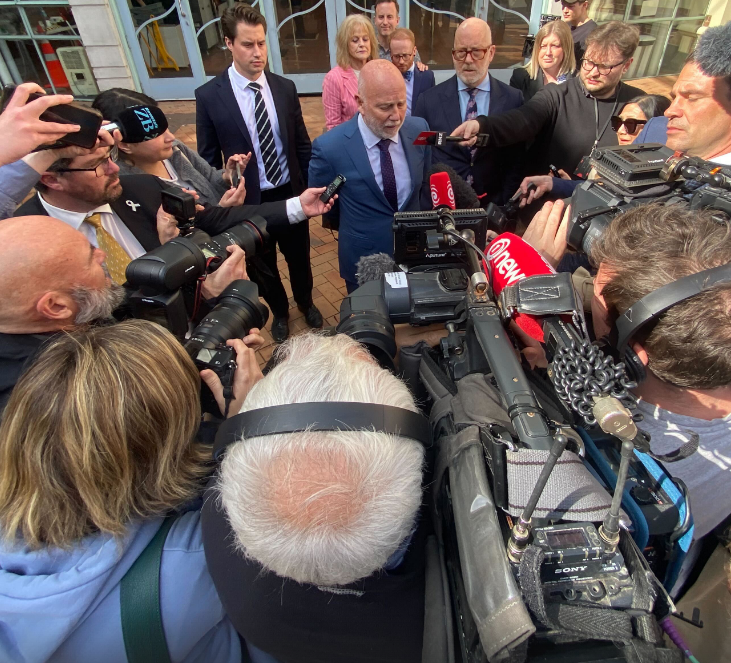
Outside court, Polkinghorne told media: “Today’s outcome is a huge turning point in our lives. This process has taken a massive toll on so many of us.
“But now we can grieve and let Pauline rest in peace and that is the best gift we can possibly give her.”
He thanked media and walked away, refusing to make any further comment
For eight weeks the jurors listened intently to evidence from the Crown who alleged Polkinghorne murdered his 63-year-old wife Pauline Hanna at their home in Remuera and arguments from the defence who claim she took her own life.
READ MORE: Full daily coverage of the trial
STORY CONTINUES AFTER BLOG
🎧 PODCAST | Accused: The Polkinghorne Trial
Vera Alves
Listen to the latest episode of "Accused: The Polkinghorne Trial", following the verdict.
Polkinghorne's only media interview after Pauline Hanna's death
Vera Alves
Herald investigative reporter Carolyne Meng-Yee interviewed Philip Polkinghorne three days after his wife Pauline Hanna’s death.
This story, which you can read in full below, was first published in April 2021. It remains his only media interview.
'I would've worn a wire': Sex worker Madison Ashton says police 'botched' Polkinghorne case
Vera Alves
In the High Court at Auckland, the jury were hearing a recording of Pauline Hanna venting about her husband, Philip Polkinghorne: “I know he loves me but he’s just a sex fiend he wants to have sex with everybody,” she had told her family.
That day, Madison Ashton – the runaway witness and Polkinghorne’s former lover – was having a cocktail in Sicily celebrating her 50th birthday.
Ashton declined to appear as a witness because she says police disrespected her because of her occupation – and now says she would’ve been prepared to wear a wire to help gather evidence.
"Pauline died never knowing the truth, I wish she had just called me," Ashton told Herald reporter Carolyne Meng-Yee.
Read the full story below.
Police reacts to verdict
Vera Alves
“Police acknowledge and respect the decision of the jury today,” Detective Senior Sergeant Chris Allan.
“The jury – they’ve had a particularly tough job, and some pretty confronting subject matter.
“In terms of where to from now... that is a coronial process," he added.
"At this stage, in terms of the investigation, this is the end of the matter.
“As Mr Polkinghorne has a number of matters before the court, that is all I’ll say at this stage," Allan said.
Watch: Pauline Hanna's brother Bruce Hanna reacts to verdict
Vera Alves
Pauline Hanna wasn’t the one on trial – here’s the happier life I wish she’d had - Niki Bezzant
Vera Alves
"Pauline’s story could so easily have gone another way. I feel so sad that it didn’t."
'Crap decision': Pauline Hanna's friend reacts to verdict
Vera Alves
“We think it’s a crap decision. She was an amazing person. She didn’t deserve this end. We just loved her very much,” close family friend of Pauline Hanna, Pheasant Riordan, said.
Vera Alves
Pauline Hanna's family react to verdict
Vera Alves
“We need to accept the decision and move on,” Bruce Hanna told media outside the court.
Pauline’s brother said it was “not the decision we wanted”.
He thanked the police and prosecution for their dedication and hard work.
'Shaking with shock': Sex worker Madison Ashton reacts to verdict
Vera Alves
Madison Ashton refused to give evidence at the Polkinghorne trial.
The Australia-based sex worker spent the trial travelling in Europe, following the Herald’s coverage of the trial.
Her response to today’s not guilty verdict was: “Unbelievable, unbelievable. I am shaking with shock.”
Ashton was on the Crown witness list but did not agree to appear.
The trial was told Polkinghorne had paid the escort more than $100,000 and that he was living a double life in a relationship with Ashton.
Polkinghorne leaves Auckland High Court after not-guilty verdict
Vera Alves
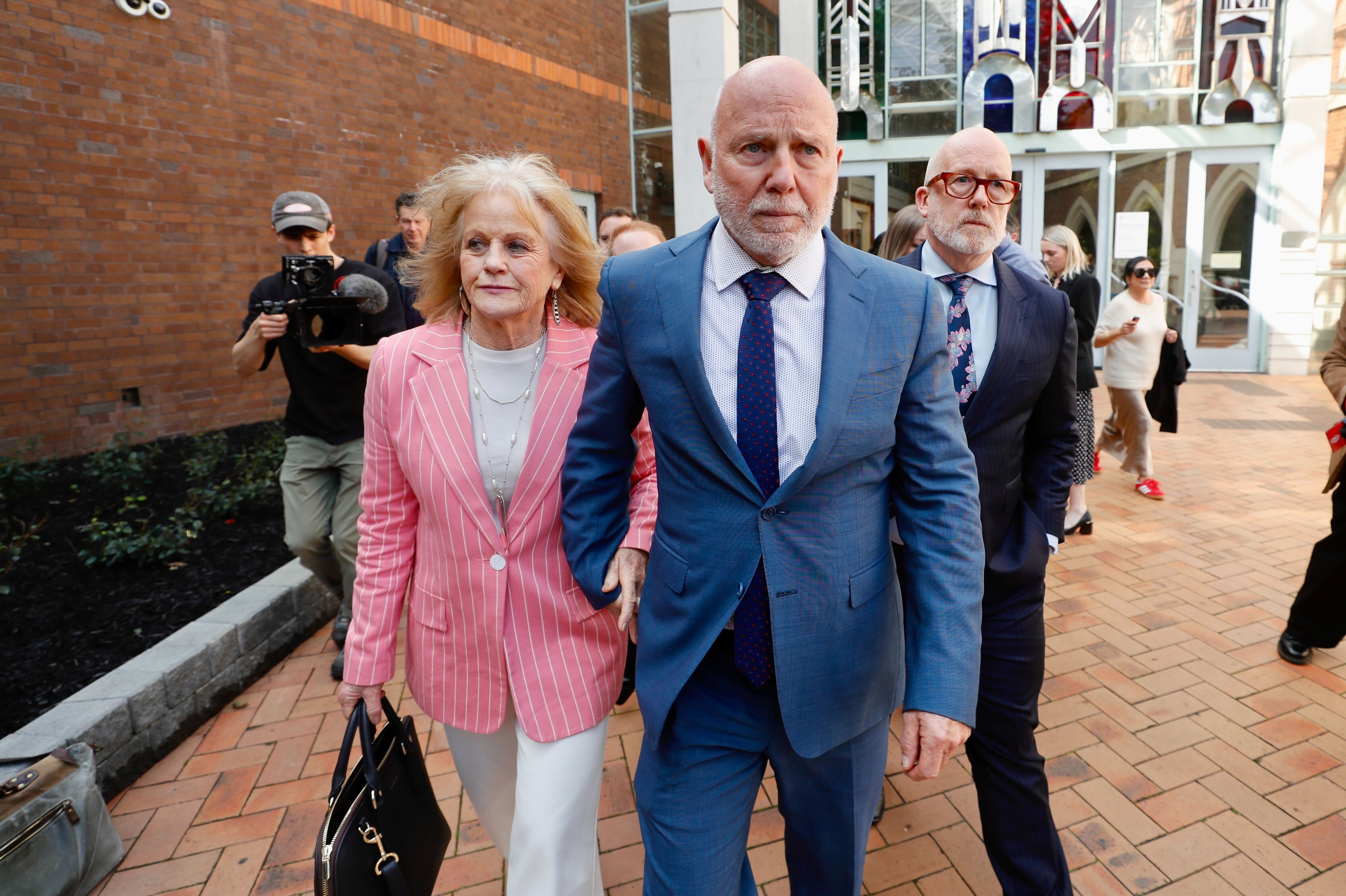
Philip Polkinghorne has left the court in Auckland with his lawyer, Ron Mansfield. His sister Ruth Hughes held his arm as they walked away.
Vera Alves
Polkinghorne’s lawyer, Ron Mansfield, made no comment and told media “that is enough, thank you”.
Polkinghorne speaking to media outside the court
Vera Alves
'Let Pauline rest in peace': Polkinghorne speaks after verdict
Vera Alves
Philip Polkinghorne says “today's outcome is a huge turning point in our lives”.
He told media “we can now grieve and let Pauline rest in peace”.
He thanked media and walked away, refusing to make any further comments.
'The way things go': Prosecutor acknowledges the verdict
Vera Alves
Crown prosecutor Alysha McClintock has acknowledged the verdict and said she respected the jury’s decision.
“The evidence was there to be pieced together, but at the end of the day the jury has to assess that.
“It was hard for everybody. But circumstantial cases, by nature, have to be pieced together," McClintock said, speaking to the media outside the court.
“This is the way things go."
“There’s been a great tragedy”, she said, referring to Pauline Hanna’s death. But she reiterated that she respected the verdict.
Polkinghorne waiting to thank security guards
Vera Alves
Polkinghorne is still in the courthouse. He has asked that the two courthouse security staff who were charged with guarding him over the past eight weeks be brought back to the courtroom so he could thank them.
Polkinghorne set to speak to media
Vera Alves
Polkinghorne is expected to make a brief statement to the media on his way out the courthouse.
He won't answer any questions.
Vera Alves
Over 20 members of the media are gathered outside the courthouse.
Sentencing date set for Polkinghorne's other charges
Vera Alves
Justice Graham Lang has set a sentencing date for November 1 for the remaining charges Polkinghorne is facing.
Although not guilty of having committed homicide, the surgeon pleaded guilty at the outset of the trial to two minor charges: possession of a meth pipe, punishable by up to one year imprisonment, and possession the meth, punishable by up to six months’ jail.
Vera Alves
Polkinghorne bowed his head and kept his eyes closed as the verdict was announced.
Vera Alves
The defendant’s sister, Ruth, pumped her fist as the verdict was announced. Hanna’s brother and other relatives looked shell-shocked.
Tears as verdict reached in Polkinghorne trial
Vera Alves
Pauline Hanna’s good friends Pheasant and John Riordan just arrived at the High Court. Pheasant, who gave evidence during the trial, had her hand over her mouth and was in tears.
Sentencing date to be set for Polkinghorne's other charges
Vera Alves
Justice Lang said it remained for him to set a sentencing date for the matters which Polkinghorne needed to be sentenced on.
These were in relation to the charges he already entered pleas for, possession of a meth pipe, punishable by up to one year imprisonment, and possession the meth, punishable by up to six months’ jail.
Vera Alves
Justice Lang thanked and discharged the jury.
Vera Alves
Sobs can be heard from the public gallery, which is half-full with about 20 or so people.
Not guilty
Vera Alves
Justice Graham Lang said in accordance with the verdict, Polkinghorne is allowed to leave the dock.
Vera Alves
The jury also found Polkinghorne not guilty of manslaughter.
Not guilty
Vera Alves
Philip Polkinghorne has been found not guilty of murder.
Jury reaches verdict
Vera Alves
The jury in the Polkinghorne murder trial has reached a verdict.
'Please can we have some direction': Jury's concerns addressed by judge
Vera Alves
The jurors are filing back into the courtroom now for the judge to address a note they sent out late Thursday afternoon.
The question: "Most of the people on the jury do not think there is enough evidence to support Pauline [Hanna] having committed suicide. However, some people on the jury do not think that the Crown has supplied enough evidence that we can answer yes to the question, 'Has the Crown made you sure that Dr Polkinghorne caused the death of his wife, Ms Pauline Hanna, by intentionally strangling her?' Please can we have some direction."
The judge responded by noting that each question in the question trail begins with "are you sure" and that the defence doesn't have the onus of proof.
"At the end of the day, it's not sufficient for you to say that Dr Polkinghorne is probably guilty or even very likely guilty," Justice Graham Lang repeated from his summing-up.
Justice Lang directed the group to return to the jury room to continue deliberating.
Jury back in court to continue deliberating
Vera Alves
After about six hours of deliberations, the jury was sent home on Thursday afternoon.
The jurors returned to the High Court at Auckland on Monday morning to continue deliberating in the Philip Polkinghorne murder trial, following a three-day weekend due to one juror's commitment on Friday.
Jury questions answered
Alanah Eriksen
Ever wondered how New Zealand jurors decide someone's fate?
Open Justice reporter Ric Stevens examined the dynamics in this piece published Thursday morning.
Accused sobs
Alanah Eriksen
On Thursday morning, Polkinghorne sobbed in court as the jury was again played the 111 call he made after his wife Pauline Hanna died.
The call was played earlier in the proceeding but the jury requested to hear it before they retired to deliberate their verdict.
Jury listened to 111 call and secret recording before deliberating
Vera Alves
Justice Lang indicated on Wednesday that a verdict might take days.
He has also said he wants the decision to be made without having regard to the pressures of time.
STORY CONTINUES
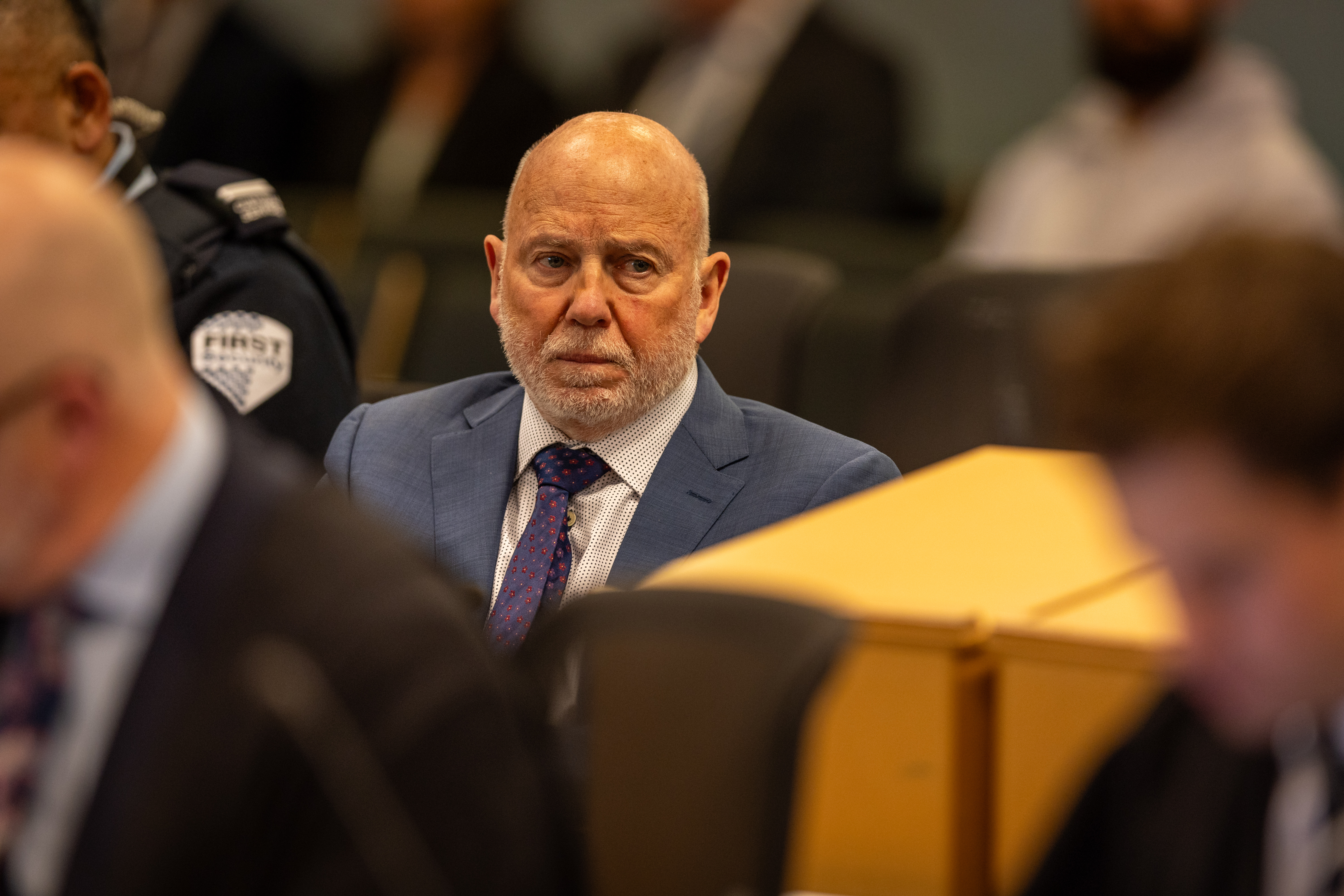
The 71-year-old defendant, who spent all of the trial seated at a desk usually reserved for lawyers in the High Court at Auckland’s largest courtroom, was escorted to the dock before the 11-person verdict was announced. Polkinghorne bowed his head and kept his eyes closed as the verdict was announced.
He was then allowed to leave the dock and sit in the gallery – where he stared ahead until the jury was thanked and dismissed by the judge.
Gasps could be heard from the courtroom gallery, which had been full for most of the eight weeks as lawyers combed over details of the surgeon’s seemingly voracious appetite for sex workers, his usage of methamphetamine – at home and, allegedly but disputed, at work – and his unusual activities before and after Hanna’s death on April 5, 2021. The gallery was only about half full as the verdict was read.
The defendant’s sister, Ruth, pumped her fist as the verdict was announced. Hanna’s brother Bruce and other relatives looked shell-shocked.
Bruce Hanna said outside court it was “not the decision we wanted”. He thanked the police and prosecution for their dedication and hard work.
“I thought the... proceedings were fair and we need to accept the decision and move on at this point.”
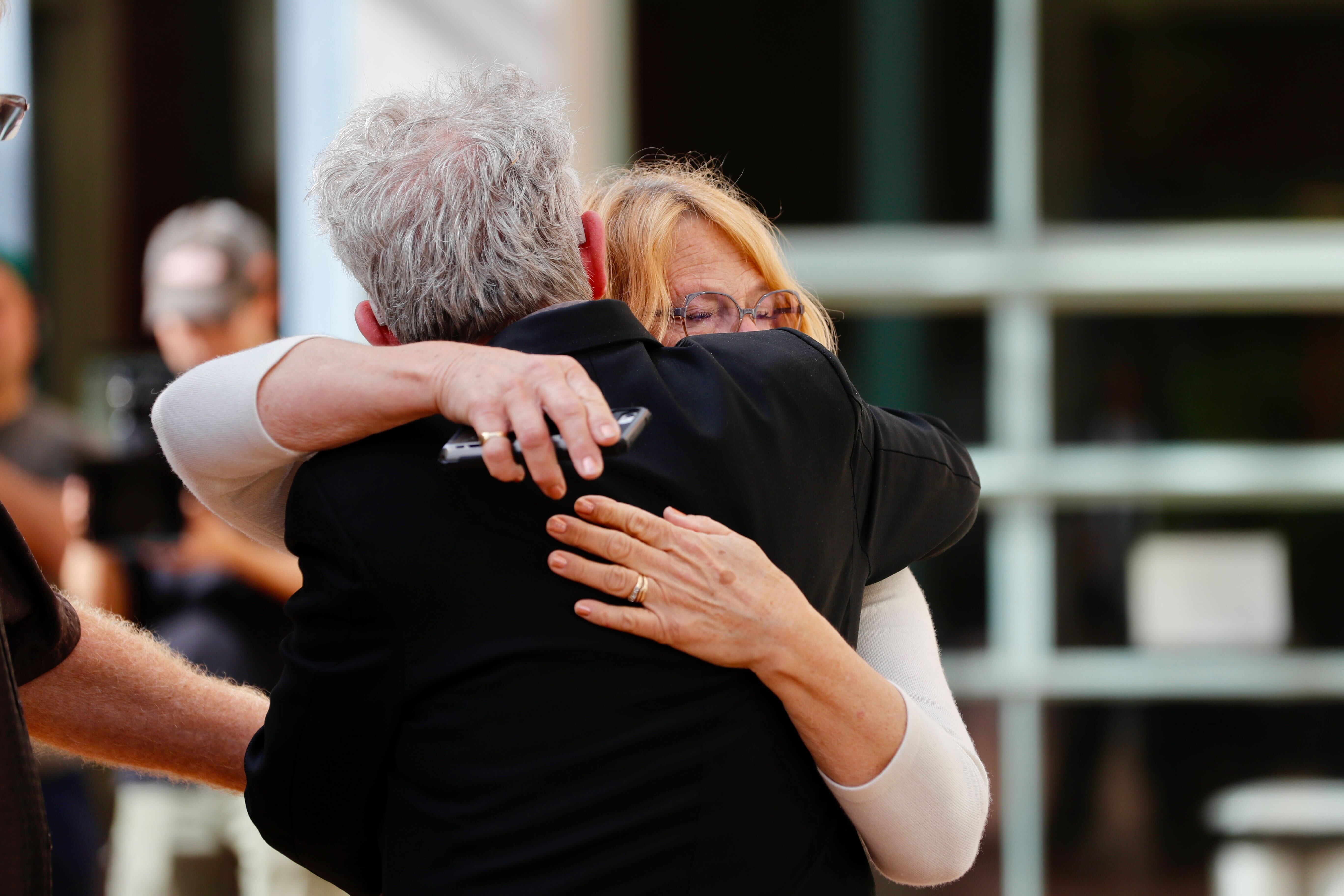
Hanna’s good friends Pheasant and John Riordan arrived at the High Court after the verdict. Pheasant, who gave evidence during the trial, said: “We think it’s a crap decision. She was an amazing person. She didn’t deserve this end. We just loved her very much.”
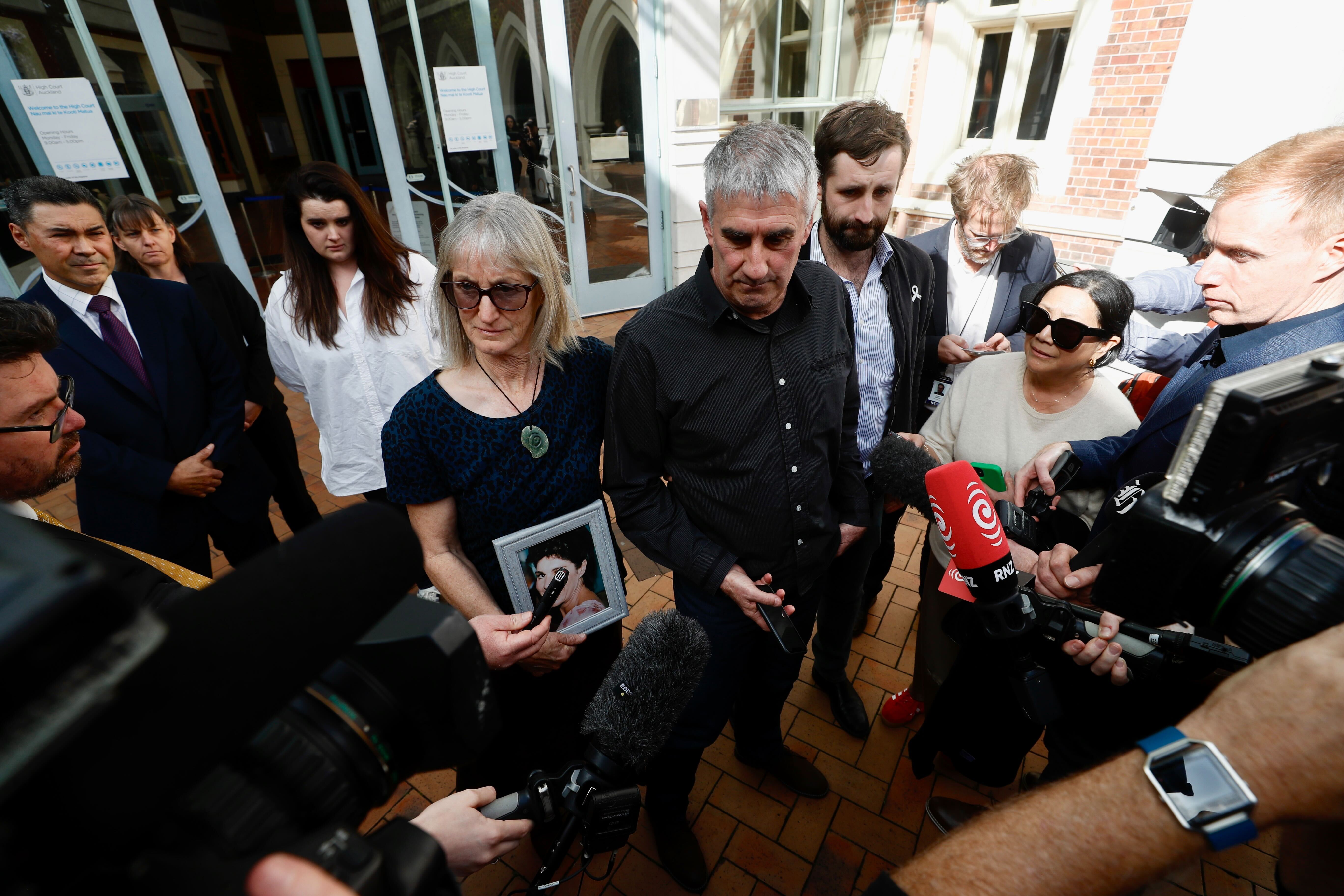
Over 20 members of the media were gathered outside the courthouse.
Polkinghorne’s lawyer, Ron Mansfield KC, made no comment and told media, “that is enough, thank you”.
Crown prosecutor Alysha McClintock acknowledged the verdict and said she respected the jury’s decision.
“The evidence was there to be pieced together, but at the end of the day, the jury has to assess that.
“It was hard for everybody. But circumstantial cases, by nature, have to be pieced together. This is the way things go.”
“There’s been a great tragedy”, she added. But she reiterated that she respected the verdict.
Detective Senior Sergeant Chris Allan said outside court that police acknowledged and respected the jury’s decision.
“The jury – they’ve had a particularly tough job, and some pretty confronting subject matter.
“In terms of where to from now... that is a coronial process.
“At this stage, in terms of the investigation, this is the end of the matter.
“As Mr Polkinghorne has a number a number of matters before the court, that is all I’ll say at this stage.”
Although not guilty of having committed homicide, Polkinghorne pleaded guilty at the outset of the trial to two minor charges: possession of a meth pipe, punishable by up to one year imprisonment, and possession of meth, punishable by up to six months’ jail.
Immediately after the verdict, Justice Graham Lang set a sentencing date for November 1.
Sex worker Madison Ashton refused to give evidence at the trial. The Australia-based sex worker spent the trial travelling in Europe, following the Herald’s coverage of the trial.
Her response to today’s not guilty verdict was: “Unbelievable, unbelievable. I am shaking with shock.”
Ashton was on the Crown witness list but did not agree to appear. The trial was told Polkinghorne had paid the escort more than $100,000 and that he was living a double life in a relationship with Ashton.
Jury’s question
The jury resumed deliberations in the High Court at Auckland on Monday morning after being sent home on Thursday afternoon. Justice Lang addressed a note they sent out late Thursday afternoon.
It read, “Most of the people on the jury do not think there is enough evidence to support Pauline having committed suicide. However, some people on the jury do not think that the Crown has supplied enough evidence that we can answer yes to the question, ‘Has the Crown made you sure that Dr Polkinghorne caused the death of his wife, Ms Pauline Hanna, by intentionally strangling her?’ Please can we have some direction.”
The judge responded by noting that each question in the question trail begins with “are you sure” and that the defence doesn’t have the onus of proof. “At the end of the day, it’s not sufficient for you to say that Dr Polkinghorne is probably guilty or even very likely guilty,” Justice Lang repeated from his summing-up.
He directed the group to return to the jury room to continue deliberating.
On Thursday, the 11-person jury started deliberating at about 11am after listening to two bits of audio evidence for a second time.
The first was the 111 call Polkinghorne made after Hanna died. Afterwards, Polkinghorne began sobbing into a tissue. While he has cried before during the trial this was the first time he did so loudly enough to the point of interrupting proceedings. The second recording they listened to was of Hanna telling relatives of the wild sex life of her husband, herself, and other invited parties.
At about 4.30pm the jurors said they would not be returning a verdict by the end of the day and were sent home with a reminder from Justice Lang not to discuss the case with anyone.
They did not deliberate on Friday as one of the jurors had a prior commitment and Justice Lang said the long weekend may help crystalize their thoughts by the time they returned on Monday.
Polkinghorne’s trial began in late July as the Crown went about trying to convince jurors that Polkinghorne fatally strangled his wife before staging the scene to look like a suicide by hanging in the foyer of their $4 million Remuera home.
The Crown
It was a circumstantial case, and Crown solicitor Alysha McClintock told jurors she didn’t know if Polkinghorne attacked his wife amid an argument or if he snuck into the guest bedroom as she slept and killed her in cold blood. But the group could be fairly sure, she argued, that he took a “toot” from the “Sweet Puff” pipe found underneath his bed before lashing out at his wife of 24 years with meth-fuelled courage and rage.
The killing was the result, McClintock said, of his two worlds inevitably colliding. In one world, he was a respected medical professional – half of a power couple of sorts, with Hanna commanding a high-ranking health administrator job. But in his shadow world, she said, he spent hundreds of thousands of dollars on sex workers and paid particular attention to Sydney escort Madison Ashton – a well-known tabloid figure in Australia with whom he was infatuated and dreamed of starting a new life.
She pointed to the intimate WhatsApp messages between Polkinghorne and Ashton for years prior to Hanna’s death and in the immediate aftermath. They met at a secluded South Island chalet three weeks after Hanna died, at a time when Hanna and Polkinghorne should have been on a 4WD holiday in the South Island, and talked about how they should divide house chores.
“Honestly I really love you,” Ashton told him three days before his wife’s service. “Do not wear a f**king bow tie at the funeral. Keep the hat.”
McClintock said Polkinghorne was “arrogant” enough to think that his social standing would result in police “rubber-stamping” his wife’s death as a suicide. So he was caught off guard when investigators instead started poking around their home – at first finding the suicide rope to be suspicious, then noticing the oddly dishevelled guest room and about $13,000 worth of methamphetamine stashed throughout the house.
During a break in a four-hour police interview on the same day as his wife’s death, Polkinghorne deleted his WhatsApp message history with Ashton. He then searched “how to delete iCloud storage” soon after the interview – attempting to delete the search itself – before going to the website for encrypted app DuckDuckGo on April 7 and typing a search that prosecutors described as “hugely significant” to the Crown case: “leg edema after strangulation”.
“This search unmasks the murderer, I suggest,” McClintock said. “There is not an explanation for that search that is an innocent explanation.”
But the “single most significant piece of evidence”, she said, was Hanna’s outcry to friends John and Pheasant Riordan in January 2020 that her husband had previously strangled her.
“Sadly, John Riordan was right [when he told her], ‘If he’s done it once, he’ll do it again’,” the prosecutor said.
The defence
But defence lawyer Ron Mansfield KC disputed the prosecution’s interpretation of the outcry, as he did almost every other aspect of the Crown’s case. He noted that Hanna had been drinking that night and suggested she might have been lying or exaggerating in a bid to get sympathy about the admittedly rocky – but never violent – state of their marriage at the time.
He acknowledged his client might be seen as a “dirty old man who didn’t realise how good he had it with Pauline”, but he warned jurors to avoid “emotional vigilantism” based on sympathy for Hanna or disdain for Polkinghorne’s unconventional lifestyle.
“This has been a trial prosecuted by emotion and where the victim is logic,” he told jurors during his own closing address, suggesting that police and prosecutors were so intent on scandalising his client with drugs and sex because they knew they didn’t have any actual murder evidence to focus on. “A trial prosecuted by emotion allows our murder-mystery fantasies to run wild. It was like a binge of every Murder She Wrote all in one session by our own Angela Lansbury presenting.”
The forensic evidence – most importantly, the testimony of four different pathologists – “provides the complete answer and always has”, Mansfield argued.
Two pathologists hired by the defence said they would have determined Hanna’s death to be non-homicidal hanging had the case been theirs. The two pathologists called by the Crown agreed with much of what the defence witnesses said but left open the possibility Hanna could have been strangled without leaving any internal or external neck injuries.
Mansfield repeatedly rubbished that suggesting as a “phantom”, noting that the four witnesses combined could only recall two times when fatal strangulation left no injuries. The Crown repeatedly pointed out that, as a man with a medical degree, Polkinghorne would have known more about the body than most people. But Mansfield countered that his client would have to be a “highly efficient and well-trained killer to leave someone dead without any tell-tale signs”.
“It sounds absurd because it is,” he continued, describing the Crown case as “one of the most gravest nonsenses our courts have heard for a long time”.
The lawyer devoted his last hour of addressing jurors to focusing on Hanna and the many suicide risk factors pointed out by psychiatrists who had been called to testify by the defence. Among them was an alleged outcry in the early 90s in which Hanna was recalled by her sister to have insinuated that she had cut her wrists and a documented call to her GP in December 2019 saying she had suicidal thoughts – but no plan – about driving into a lorry after her husband disappeared for several days.
She might not have been depressed at all times and she certainly didn’t let most people know about her “vulnerabilities”, but writings, recordings and recollections from friends showed she suffered some dark moments, Mansfield said.
“I cannot live if that is the result that I got it wrong,” she wrote in March 2019 of the prospect her husband didn’t love her – a document that was found on her laptop after her death.
In April 2020, she sent an email to herself saying she was tired and not herself.
“I am never good enough despite my efforts,” she wrote. “I want desperately to tell someone and cry and ask for help but everyone seems to think I’m amazing and does not want to know that I have foibles and failings.
“... So I will go to bed and not sleep. V unusual for me – and it builds up – who knows what might follow. Have to tell someone even if no one but God ever sees this.”
Then on March 28, 2021, exactly one week before her death, she wrote to her son-in-law and his wife: “My life is insane and I do not know what day it is sometimes. I (reluctantly) took this role as Head of Logistics for Vaccine. I did not want to. But Philip was so proud of me when Outbreak happened, I thought he would be proud of this – which I guess he is – but it is incredibly difficult and lonely.”
That “bleak” and “desperate” feeling returned – no doubt amplified by a dangerous combination of sleeping pills and alcohol – when she woke up in the middle of the night on April 5, 2021, and decided to find a rope, Mansfield said.
“There is no more lonely place when you’re already feeling low than the early hours of the morning,” he told jurors.
Craig Kapitan is an Auckland-based journalist covering courts and justice. He joined the Herald in 2021 and has reported on courts since 2002 in three newsrooms in the US and New Zealand.
The Herald will be covering the case in a daily podcast, Accused: The Polkinghorne Trial. You can follow the podcast at iHeartRadio, Apple Podcasts, Spotify, through The Front Page feed, or wherever you get your podcasts.