Landslide victims in Pāpāmoa stuck paying mortgage on red‑stickered home they can’t live in and can’t afford to repair
Matt and Sian du Plessis own a house they cannot live in as it sits on the edge of a yawning, growing hole they cannot afford to repair, all while paying their mortgage.
On January 22, the day tragic landslides hit the Bay of Plenty, the couple went from living in their own rural sanctuary in Pāpāmoa to bouncing between rentals with their two young boys, wondering if they’ll ever find a way to escape their bind.
“We’re stuck in this grey area ... [the] council have said ‘it’s unliveable, it’s red-stickered, you can’t live there’ and insurance have said ‘your home is not damaged so it’s not covered, it’s only your land’,” Sian du Plessis told the Herald.
“We are just stumped. We’re now paying rent [to live elsewhere], we’re still paying our mortgage ... and we see no outcome as yet.”
Their conundrum began early on January 22 when wild weather caused slips to slide along Pāpāmoa’s Reid Rd.
A chunk of their 450sq m property gave way, leaving a large hole undermining the garage and sucking in land next to the house.
The home was untouched and was yellow-stickered by Western Bay of Plenty District Council (WBOPDC) because of the threat of further slides.
The du Plessis family were able to access the house to gather items but unable to occupy it, Sian du Plessis said.
Since January, with more rainfall falling, the original slip has grown and swallowed the garage, and the council red-stickered their home. That designation means the family cannot access the house at all.
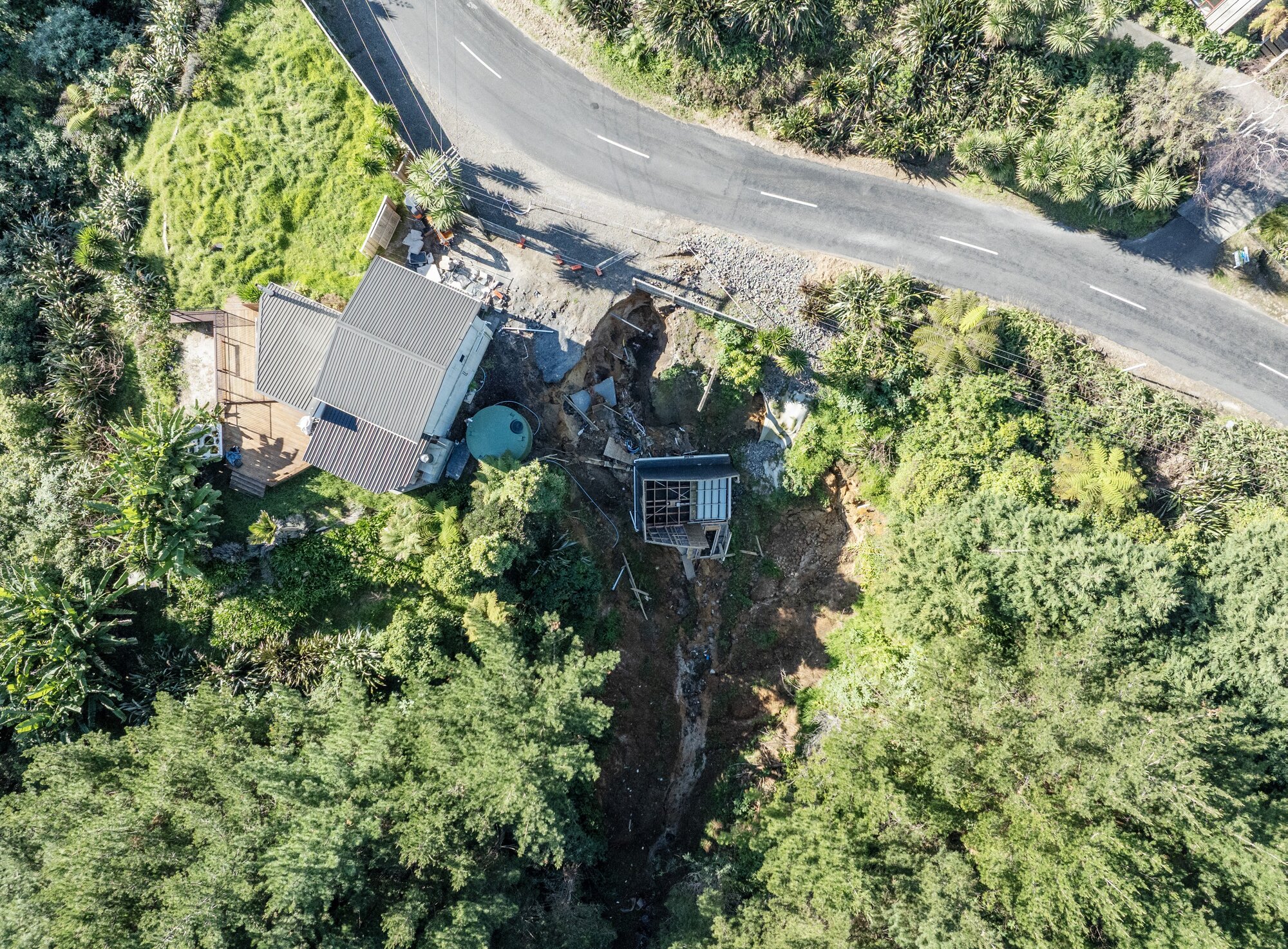
The couple have been advised that because the house itself is undamaged, their home insurance cover isn’t triggered even though they cannot live there, Matt said.
The Natural Hazards Commission (NHC) – formerly the Earthquake Commission – has accepted their claim and since the Herald first spoke to the couple, made a non-final offer of $128,277.
The amount covered $59,700 for 82sq m of land – some lost already, some predicted to go within 12 months of the original slip.
The remainder, $68,577, was for building damage including the lost garage and concrete pads.
In the initial offer, the NHC estimated remedial work to stabilise the land at almost $290,000.
Following its legal framework, the NHC will pay out the lesser amount meaning it will cover the land loss and building damage rather than the cost of stabilisation repairs.
The couple dispute the repair price. Geotechnical experts who visited the property put it at least “half a million dollars plus”, Sian du Plessis said.
The couple had been told any repair work could be impossible on such a small plot and likely uneconomic but even if the costs ballooned, the NHC is legally bound to pay only for the lost land, leaving them with a large financial gap, she said.
For the pair, it has been tough to accept.
“Not one part of that day [January 22] did I think we weren’t sorted,” Matt du Plessis said.
“I felt we paid insurance, our levies go to NHC, we’ll be walking away from this and the Government will look after us, we’re not living in a Third World country.”
Losing their loved home in single devastating morning
The du Plessis family moved to their Reid Rd home as first-home buyers with sons, Maeko du Plessis, now 10 and Tao du Plessis, 7, in early 2024.
“It’s certainly not the biggest or the best house on the street, but it certainly had potential for us,” Sian du Plessis said.
“We just loved it here.”
In January, the family had taken note of the bad forecasts and weather warnings.
“I took it with a grain of salt and was like, ’yeah, it’ll miss the Bay’ ... I didn’t prepare anything,” Matt du Plessis said.
It didn’t miss. Rain hammered the tin roof through the night of January 21 and in the early hours, he woke to the sound of “thunder in the forest”.
From the back door, he saw a landslide had run down the bottom of the hill.
The couple gathered the boys to the roadside, while Matt headed downhill to inspect the property and Sian packed essentials.
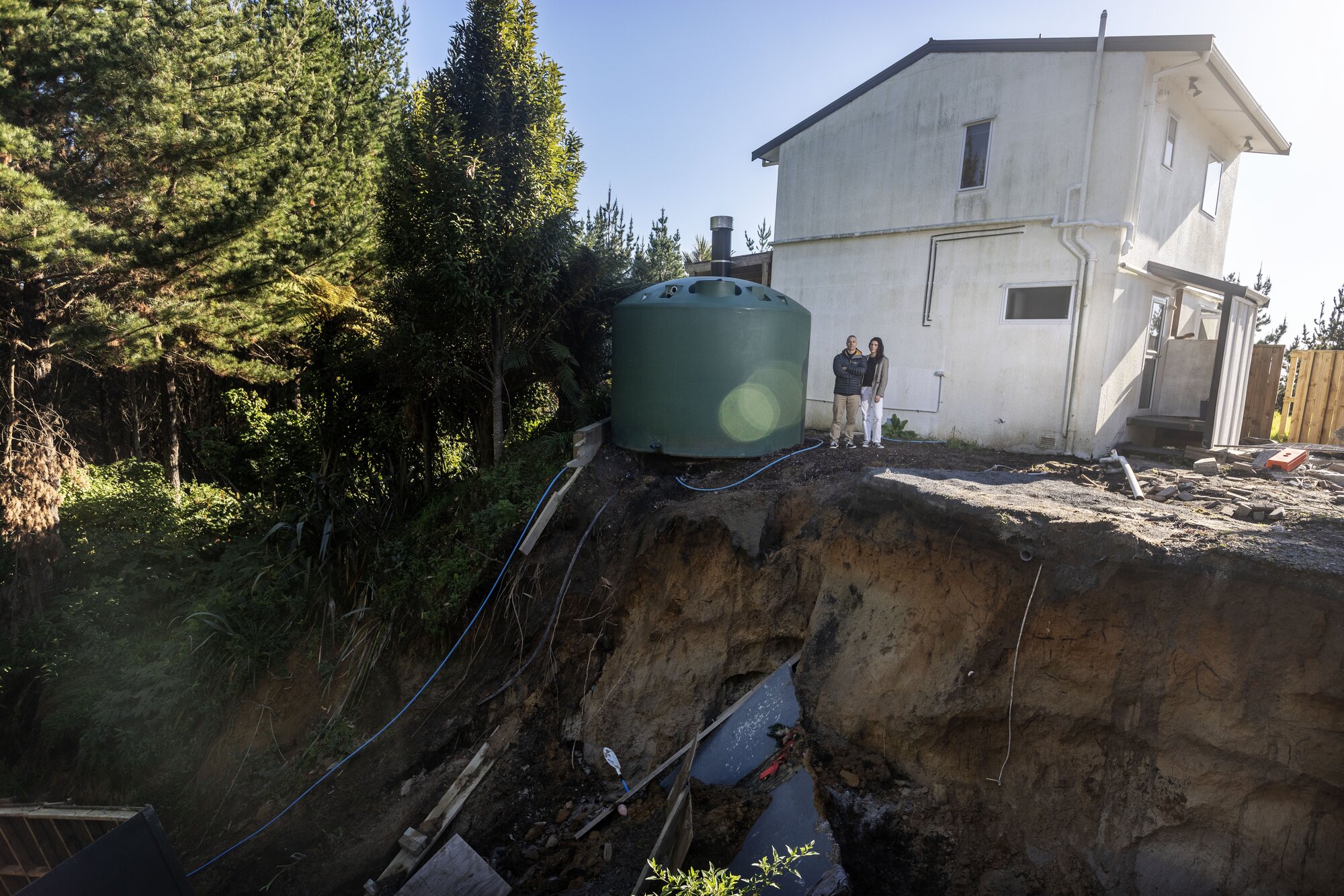
Behind the garage, large avocado trees and pines started to fall.
“You could hear it really loud, sounded like trees snapping and just going,” Sian said.
“It just looked like the earth was sinking down.”
With the boys in the car, Sian went to inspect the new hole to see how close it had come and then the earth crumbled before her.
“It very, very quickly went from under me, and I ran back and then did not go back in the house,” she said.
Separated, the couple were both in a panic thinking the slide had swallowed the other.
“My initial reaction was that Sian was gone so I was sprinting back up and was obviously relieved to hear her voice and the boys’ voices screaming – they were thinking I was gone,” Matt said.
With the road below blocked by slips, Sian drove the boys to friends near the top of the road before a crowd of people yelled for her to reverse as another slip came down in front of the car.
Matt was still down the road.
“It was probably the worst thing that I’ve thought about since - like, how stupid are you to send your family off thinking that they’re safe when you should have probably been there,” he said.
When Matt had called 111, the emergency services operator asked if they could fend for themselves – “we’ve got a lot going on at the moment, we’d really appreciate you guys trying to help yourselves”.
Only then did the couple realise the devastation was region-wide and included the tragic loss of life in landslides on Welcome Bay Rd and at Mount Maunganui.
“I was like, oh we totally can,” Matt said.
It would take three days before the roads were cleared and the family could get out.
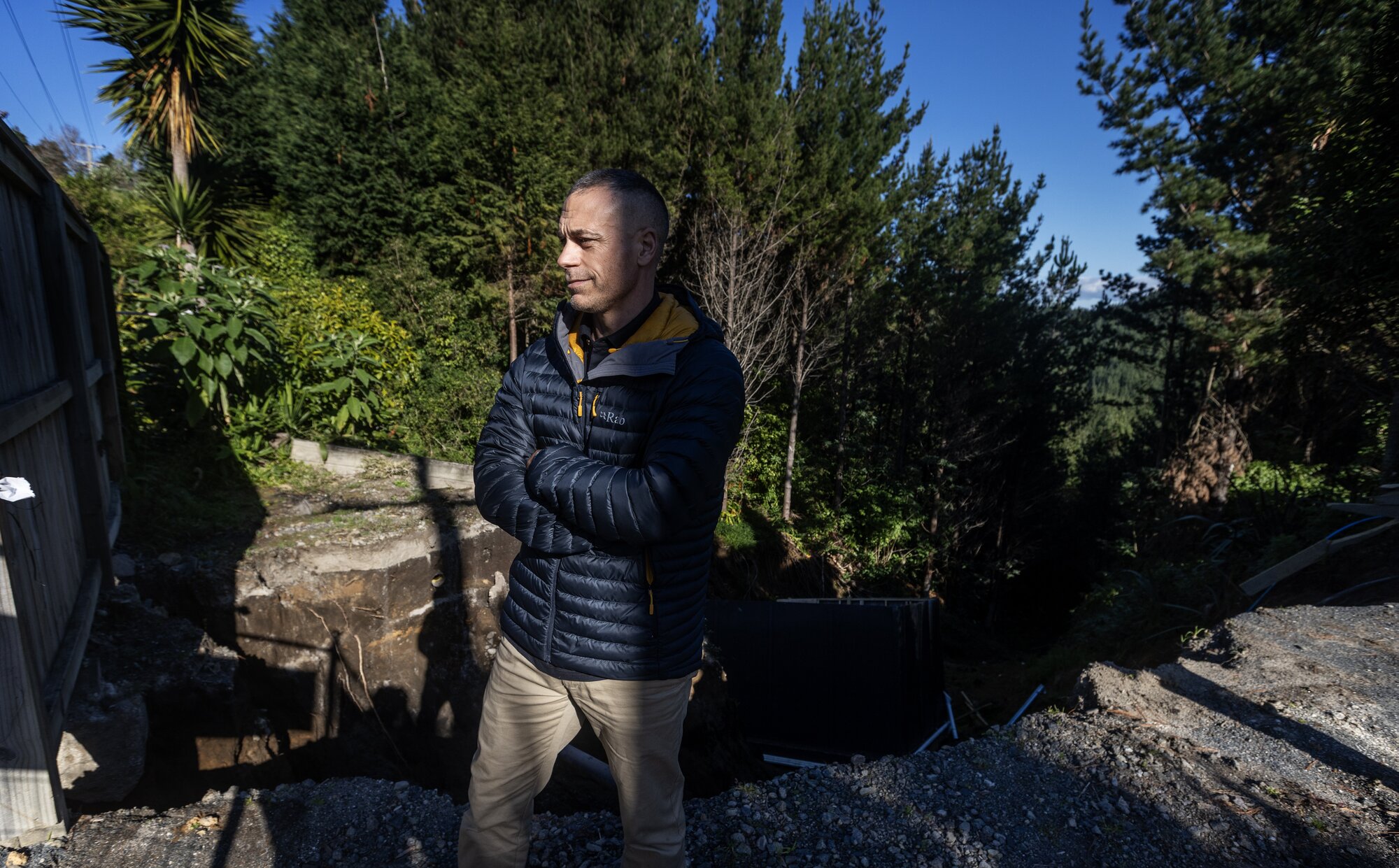
Reality sinks in
Matt assumed their insurance payout would be cut and dried.
“Then reality started to sink in ... that we’re going to be left with a red-stickered house with a gaping hole next to it, that we can’t live in, that we have to pay off still and there’s almost no relief for us,” he said.
The du Plessis family scrambled to find temporary accommodation and keep their own concrete contracting business – Off The Wall Construction – running while seeking advice from a string of agencies.
At least three geotechnical or engineering assessments have been made – by the NHC, WBOPDC and the du Plessis family themselves – variously gauging the extent of the damage, its likely cause and the scale of remediation required.
Under the Natural Hazards Insurance (NHI) Act, the NHC provides the first layer of cover for a damaged home – generally up to $300,000 – with a home owner’s private insurer covering anything above that.
The scheme also covers the land under an insured home, along with separate buildings, and the property within 8m of them.
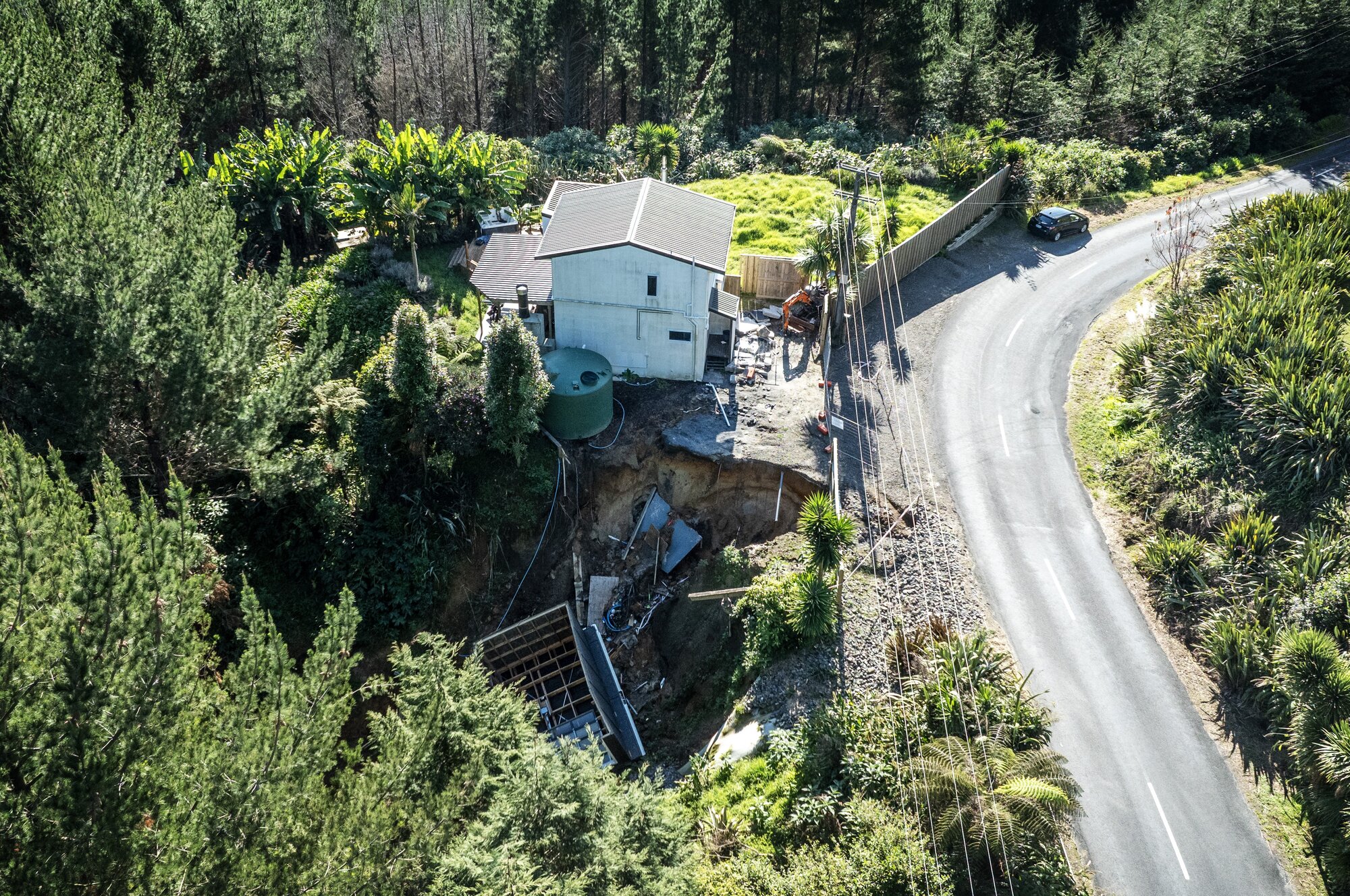
‘Horror situation’
The du Plessis family’s insurance broker Isaac Mutu, a director at O’Connor Warren Insurance Brokers, said that once the NHC’s decision landed, the couple could accept it or challenge parts of it.
The family’s next step was taking the NHC’s conceptual design to a specialist retaining-wall contractor and an independent geotechnical engineer, to establish whether the land stabilisation work could be done at all, Sian said.
“It’s just whether or not it could actually be built or find somebody who prepared to build it,” she said.
The firm GeoPlus made geotechnical assessments of the 450sq m section both before and after the January 22 landslide.
The site’s small size meant there was basically no room to manoeuvre the heavy machinery that would be needed to build retaining walls above an active slip, GeoPlus director Mark McDonald said.
“You’d struggle to turn the machinery round on the site with how tight it is.”
Consent regulations have changed since the du Plessis’ house was permitted and built in the early 1990s. A rural block must now fit a stable building platform, an on-site wastewater field sized to the number of bedrooms and a way to dispose of stormwater, he said.
“No one would ever put that amount of money into the ground to form a stable platform to then build with such limitations ... I’ve never come across a property like it really.
“It’s a bit of a horror situation for them.”
The couple believe a buy-out is the best solution and have proposed the WBOPDC use the land to manage the stormwater running off Reid Rd in order to protect the homes below.
WBOPDC general manager infrastructure Brad Singh acknowledged how “challenging and distressing” the situation had been for the family.
The council had connected the du Plessis’ with recovery services, relief funding – including $5000 from the mayoral fund set up to help home owners hit by the January storm – and rates remissions, he said.
However, direct financial assistance for private property was limited, and a buyout “would only be possible with support from central government”, Singh said.
“Central government has confirmed it will not support buyouts for properties affected by the January 2026 storms,” he said.
Buy-outs for undamaged, red-stickered homes have happened before, Victoria University professor Ilan Noy – an expert in the economics of disaster and climate change – told the Herald.
After the large disasters of the 2011 Christchurch and 2016 Kaikōura earthquakes and the 2023 North Island floods, red-stickered homes were bought back in deals typically funded by central government, often in partnership with local councils, Noy said.
However, the difference this time might be the smaller scale of the event, he said.
Noy had been part of an expert working group that suggested legislation which would set consistent parameters for buy-outs for people caught in situations similar to that of the du Plessis family.
“Unfortunately, neither of the two main parties seems keen to pass such an act that would clearly define the central government responsibilities in such cases.
“They both prefer an ad hoc system that allows them to step in with generous buybacks in large disaster events.
“Unfortunately, this means that this ‘uninhabitable but undamaged’ limbo then arises in smaller events.”
Mike Scott is a senior visual journalist at the New Zealand Herald. His work spans writing, photography and video and has won numerous journalism awards, including Videographer of the Year and Best Documentary. He has worked in media for more than 25 years, producing stories across New Zealand and internationally.
Sign up to The Daily H, a free newsletter curated by our editors and delivered straight to your inbox every weekday.