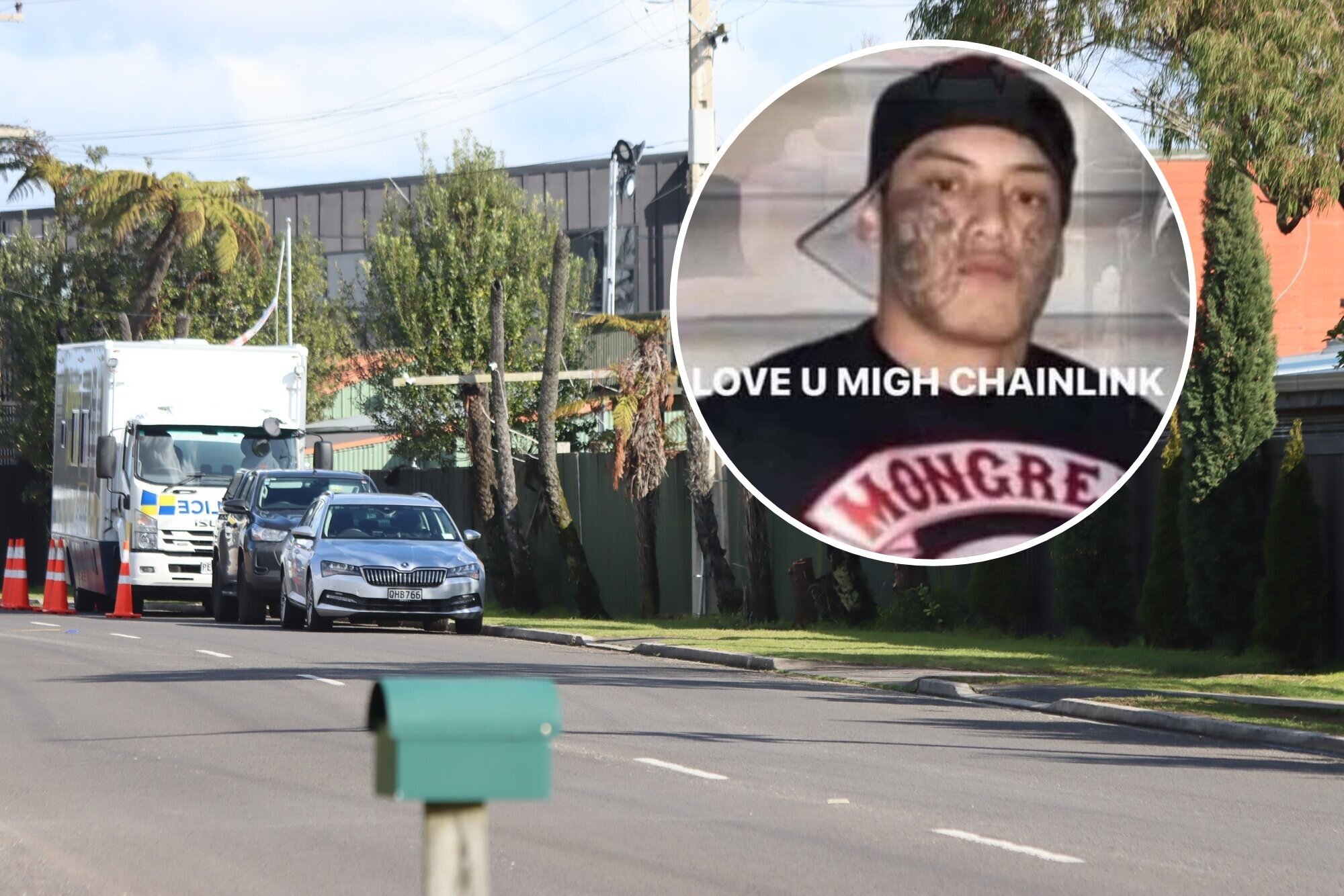
Mongrel Mob members sentenced for making false statements about Zain Taikato Fox’s death
“Rather than acting with honesty, courage, and integrity, you drove him to the hospital while stopping to plan your escape and create lies.”
Those were the words of the partner of the late Zain Taikato Fox, who died in what is alleged to have been an internal gang confrontation.
As the 20-year-old lay dying in the back of a car, his mates stopped to decide what they would tell the police: that he’d been hit by a car.
Damien Richard Beale, Brendon Major Nicholson and a third man who has name suppression all admitted that after they took Fox to Rotorua Hospital, where he was pronounced dead, they made false statements to police.
Now, Beale and Nicholson have been sentenced in the Tauranga District Court; the third man was sentenced for his role, and other charges, in another court earlier this year.
In her victim impact statement, Fox’s partner told Beale and Nicholson that Fox had trusted them.
“He believed you would stand beside him ... just as he would have done for each of you. Instead, you turned your backs on him, watching him suffer as his life slipped away.”
She said when he needed help most, the men “chose silence” and “showed cowardice instead of loyalty”.
She couldn’t “imagine the betrayal and fear he must have felt ... ” and said their actions were “weak, selfish, and shameful”.
“The betrayal and disloyalty you showed reveal the true depths of your character, and those choices will follow you for the rest of your life.”
A ‘selfish’ act of self-preservation
Beale, Nicholson and the third man had been near the alleged gang confrontation in Maketū involving Fox, which will form the basis of a murder trial, set to take place in 2028, in which 12 people face charges.
The charges Beale and Nicholson were sentenced on related to what happened after Fox suffered critical injuries.
According to the Crown summary of facts, the men had Fox lying injured in the back of a car as two groups made their way to Rotorua Hospital.
They stopped at some point on the way and Beale, who police say is the captain of the Hawke’s Bay Mongrel Mob MC chapter, told the others to “lie and say that Mr Taikato Fox had been hit by a car”, and the others agreed.
When they arrived at Rotorua Hospital, they stopped for a few minutes in a staff carpark, before continuing to the hospital’s emergency entrance.
Beale and the man whose name is suppressed went inside to get help.
The summary noted that “the defendants were all aware that Mr Taikato Fox had died when they arrived at the hospital”.
Fox was pronounced dead shortly upon arrival, and police spoke to the defendants, all of whom provided written statements.

Beale told police he had gone to Maketū to “deal with some personal stuff between him and his friends”, and, while heading back to Rotorua with Fox in his car, and others in convoy, they pulled over so the occupants “could urinate”.
He told police he heard a “thudding” noise and saw Fox lying in a ditch on the side of the road, and that he was “pretty damaged and injured”.
Nicholson told police he had been driving in convoy, and saw the other vehicle had stopped, so he stopped too.
He said he saw Fox “on the ground rolling around and moaning”, and told police that Beale had told him Fox had been hit by a car.
He said he helped get Fox into the back of his Nissan and took him to Rotorua Hospital.
An ‘unsophisticated’ plan that ‘slowed’ police investigations
Crown prosecutor Tobias Taane said it was accepted the attempt to pervert the course of justice wasn’t “entirely sophisticated” and likely a “one-off decision”, albeit they had stopped on the side of the road to come up with a plan.
The key aggravating factor had been the fact that it occurred in the context of a murder investigation.
Nicholson’s lawyer, Matthew Dixon, said his client wanted Fox’s family to know he “wishes that he had done more that day”.
He said Nicholson had travelled to the tangihanga, staying in a motel in Rotorua with his partner and children, and attending the urupā.
However, Fox’s whānau indicated to the judge, through the police officer in charge of the case, that they hadn’t seen Fox there.
Beale’s lawyer, Stephen Yee, acknowledged that “what happened that day was obviously a horrible situation, and it is tragic, and that’s accepted”.
The whānau’s “anger and grief” was “entitled, justified, and recognised”.
Judge Greg Hollister-Jones questioned Yee about Beale’s motivation to lie, saying that as captain of his chapter, he would have wanted to “protect the gang”.
But Yee said his actions had been about “self-preservation” and a concern over what questions they might be asked when turning up to the hospital with someone who had died.
When it came to sentencing the men, Judge Hollister-Jones said there had been an element of premeditation, but it “was an unsophisticated plan and the falsity was not going to last long”.
An aggravating factor had been the “seriousness of the underlying charge” with the judge noting that with a murder investigation, “police need the best evidence at the earliest stage”.
The men’s plan “slowed matters down” and enabled those allegedly involved in the fatal assault to “dig up the ground” and “bury some clothing”.
“Forensic analysis of clothing in these circumstances is critical. Anything that might detract from the quality of that evidence is serious,” he said.
There was harm to the Fox’s whānau, and to the community when justice was perverted, and it was aggravating that the offending was gang-related.
Nicholson was given a starting point of two years’ and four months’ imprisonment.
He got a 22% discount for his guilty plea and 3% for remorse.
That led to an end sentence of 21 months’ imprisonment ,which was commuted to one of 10 months’ and two weeks’ home detention, with the judge acknowledging Nicholson wasn’t “the architect” of the plan, and had employment.
Regarding Beale, the judge noted he had come up with the plan.
He’d “exercised [his] leadership”, as a captain, to involve other young people, and there had been a breach of trust because Fox had been taken to the alleged confrontation by Beale.
The judge also thought Beale had, at least in part, been motivated to lie to protect the gang after Fox died.
Judge Hollister-Jones adopted a higher starting point of two years and 10 months’ imprisonment, applying a 5% discount for remorse and 22% discount for his guilty plea.
This led to an end sentence of two years and one month’s imprisonment, with the judge stating that even if he had reached an end sentence of two years or less, he would not have commuted it to home detention, given Beale’s leadership role and the need for deterrence.
Hannah Bartlett is a Tauranga-based Open Justice reporter at NZME. She previously covered court and local government for the Nelson Mail, and before that was a radio reporter at Newstalk ZB.