ACC’s national injury snapshot: Where and how we get hurt, and $8.7b in lost productivity
Be wary of the garden, young male drivers, the gym or rugby field, and agriculture, manufacturing and construction sites.
These are all associated with more injuries in the home, on the road, in sport and recreation, and in the workplace, according to ACC’s annual “Injuries in New Zealand” report for 2025.
The report is a fascinating snapshot of how New Zealanders get hurt, broken down into those four categories.
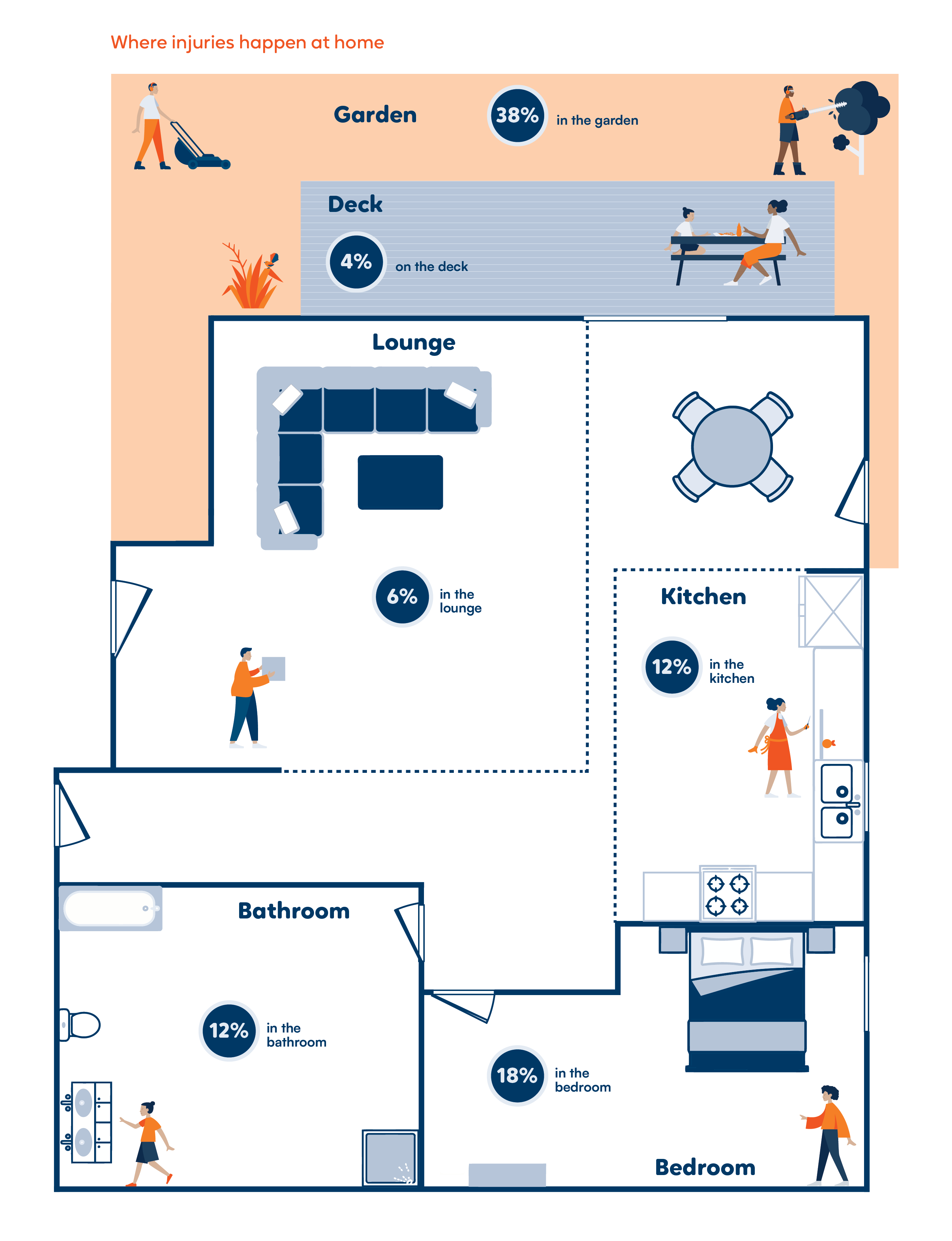
The most common place of injury was the home, especially in the garden, which accounted for 38% of all home injury claims, more than three times higher than the bathroom or kitchen (12% each).
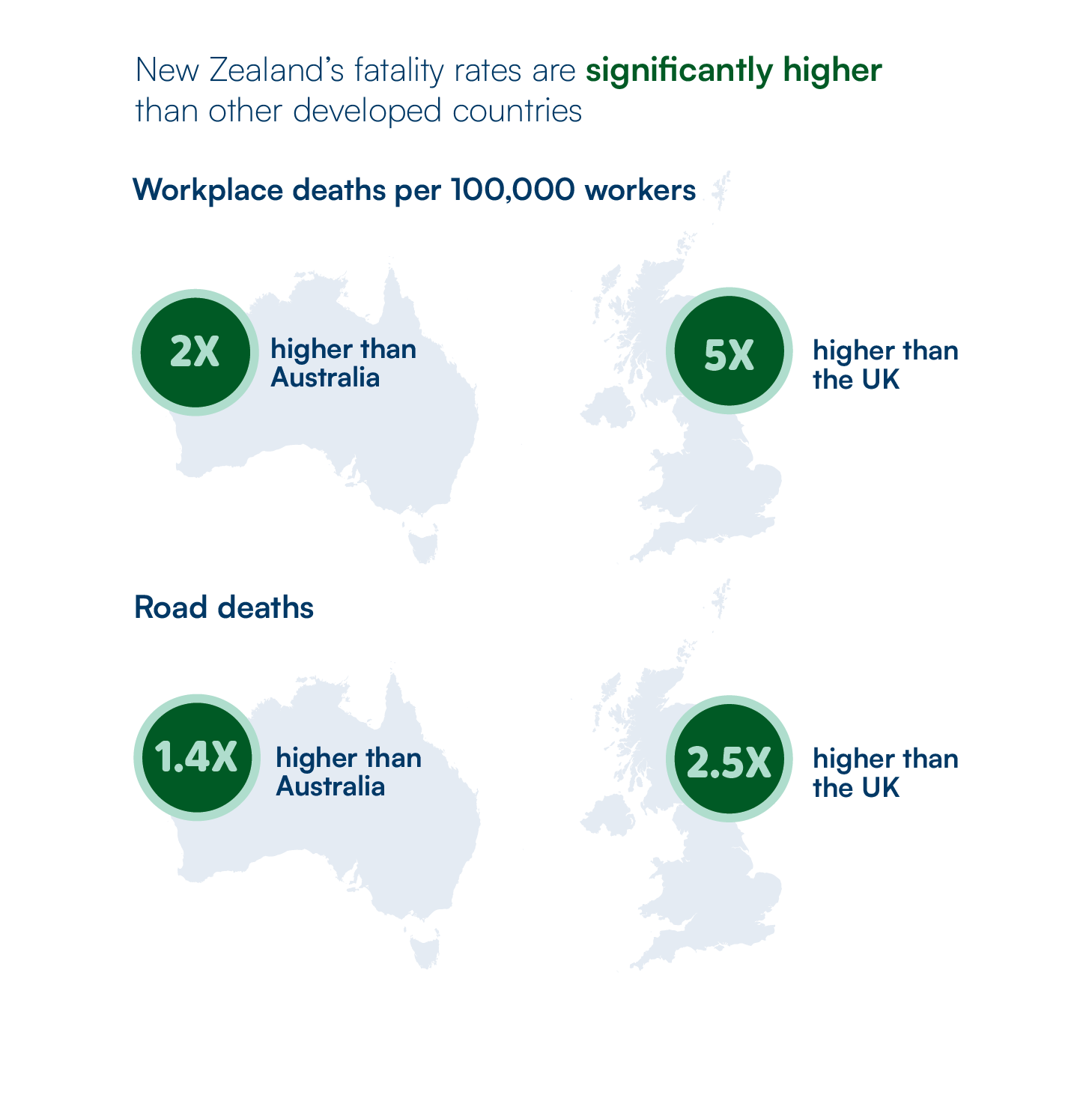
But the cost-per-claim was significantly higher on the road and in the workplace. New Zealand has a high per-capita fatality rate on the road (1.4 times higher than Australia, and 2.5 times higher than the UK) and in the workplace (twice as high as Australia, five times higher than the UK).
Population changes are also coming through in the data with 6.3% rise in injury claims from Asians, and, with an ageing population, more claims from older people as they stay in the workforce longer.
Gym and fitness injuries overtook rugby as the most common claim in sport and recreation, with women over 40 more likely to get hurt than their younger counterparts. This pattern was curiously reversed for men, for whom there were more injury claims from those under 40.
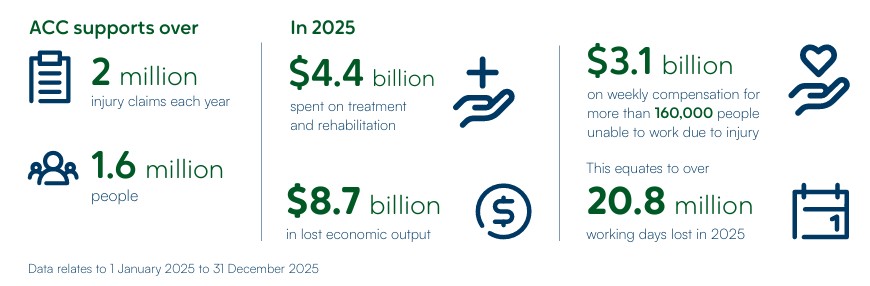
Overall, ACC processed 5500 claims per day last year, spending $4.4 billion on treatment and rehabilitation and $3.1b on weekly compensation to more than 160,000 people – or about 5.5% of the working population – who were too injured to work.
These figures are similar to 2024, when the same amount was spent on treatment and rehabilitation for the same number of claims.
But the 2025 weekly compensation bill was $600 million higher than the previous year.
“What we’ve seen over the last decade and a bit is an increasing number of people with less serious injuries – so sprains and strains – being on weekly compensation, and also being on weekly compensation for longer,” ACC chief executive Megan Main told the Herald in an exclusive interview.
“The percentage of injury claims that convert to weekly compensation has increased only about a fraction of 1%, but that’s enough to make quite an impact to the overall cost.”
The report also noted an increase in the number of sexual violence claims – up 30% in five years – adding to long-term cost pressures.
This is thought to be an increase in reporting rather than a rise in the number of sexual violence acts, which has been trending down, according to NZ Crime and Victims Survey data.
All of Nelson off work for a year
ACC released its “turnaround plan” at the start of this year to change the trajectory of its finances – from a projected deficit of $26b to a $2b surplus by 2030 – while supposedly not making it harder for people to get ACC cover.
Part of the formula is that people, following the annual release of injuries reports as well as specific campaigns, will be less injury-prone after becoming more aware of how injuries happen.
“There are so many ways people can injure themselves. It impacts their everyday life, their independence, their family, their community, their workplace,” Main said.
“The bottom line is the vast majority of these injuries are preventable.”

Preventing them, or some of them, would not only help to avoid those personal costs, but also the wider impacts on the economy as well as ACC’s longer-term financial viability.
The cumulative 20 million injury-related days away from work in 2025 amounted to the population equivalent of Nelson being off work for a full year, or $8.7b in lost productivity. This was higher than in 2024, when there were 18 million injury-related days away from work.
“That’s really the call to action we want to make through this report. We want everyone to play their part, ‘have a hmmm’, try to prevent injuries, but then also to take a really active role in recovering if you have been injured," Main said.
“Pleasingly, what we’ve seen this year is we are turning around that rehabilitation performance. People are recovering sooner, getting back to work, getting back to living their life.
“The vast amount of that lost productivity doesn’t have to be lost.”
The shift to non-work injuries
The majority of injuries happen at home or in the community (67% of injury claims in 2025, up from 66% in 2024) or in sport and recreation (23% in each of those years).
But while the proportion of injury claims in the workplace (9%) and on the road (less than 2%) are much lower, they collectively account for almost a third of ACC’s costs (about 21% and 11% respectively in 2025).
“Work is down 1 or 2 [percentage points compared to 2024],” Main said.
“That’s been the swing, an increase in non-work injuries that result in people being on weekly compensation.”
This has led to an increasing focus from ACC on population interventions, or “behaviour shifts”, while also continuing to campaign in high-cost areas such as serious road injuries.
The former means, for example, asking people to be wary of falling over, which makes up half of all injuries at home.
“We’ll get claims from one in three people over 65 this year for falls around the home – that’s an incredibly high rate. Each one is someone who’s at best out of action for a bit, and at worst losing their independence for the rest of their life," Main said.
“I would encourage anyone who’s over 65 or knows someone over 65 to think really carefully about strength and balance.”
The data relies on information provided in ACC forms, so is indicative rather than definitive. It doesn’t mean, for example, that the garden is objectively more injurious than the bathroom.
Nor is there any indication of the most hazardous garden or bathroom characteristic. It can be assumed, for example, that sharp tools or holding awkward body positions might contribute to garden injuries, just as wet floors can lead to bathroom slips.
It’s also impossible to know from the data whether New Zealanders are clumsier or worse drivers than other nationalities.
“It’s more complex than that. You’d have to look at a range of [driving] factors: rural versus urban, in a country with the geography of New Zealand,” Main said.
There’s also generally a dearth of such nuanced data in other countries, she said, “because they don’t have the injury compensation scheme that we do”.

The rise of the gym and fitness injury
New Zealanders love rugby, so it’s no surprise that the physical sport accounts for a larger share of ACC’s sports-related costs relative to the number of balls purchased (four times greater than football, 100 times greater than softball, and 880 times greater than golf).
But the number of gym and fitness injury claims surpassed rugby in 2025, having grown 11% a year for the past five years.
“The biggest growth area has been middle-aged women going to the gym,” Main said.
”As a middle-aged woman who goes to the gym, that is a real reminder to me [that] we’re not as young as we used to be."
In the workplace, the agriculture, manufacturing and construction sectors were the most injury-prone. With more exposure to machinery, vehicles, manual handling, and working at height, these are inherently riskier.
Smaller businesses have a higher claims rate than larger ones in manufacturing, but the opposite is true for construction, a sector with a fatality rate in New Zealand four times higher than Australia’s and seven times higher than the UK’s.
ACC has raised concerns about the Government’s proposed health and safety reforms, which includes a carve-out for firms with 20 or fewer employees that would all but exempt them from the legislation except for “critical risks”.
Small businesses account for about 75% of work-related injury costs, while lower grade injuries are the most frequent causes of harm, according to ACC data.
Targeted interventions
Main, who announced in December that she is not seeking reappointment, cited ACC’s work with the Forestry Industry Safety Council.
Established in 2015, its collaborative work has contributed to “a sustained reduction in injuries and fatalities and saving an estimated $15.1m to date”, the injuries report said.
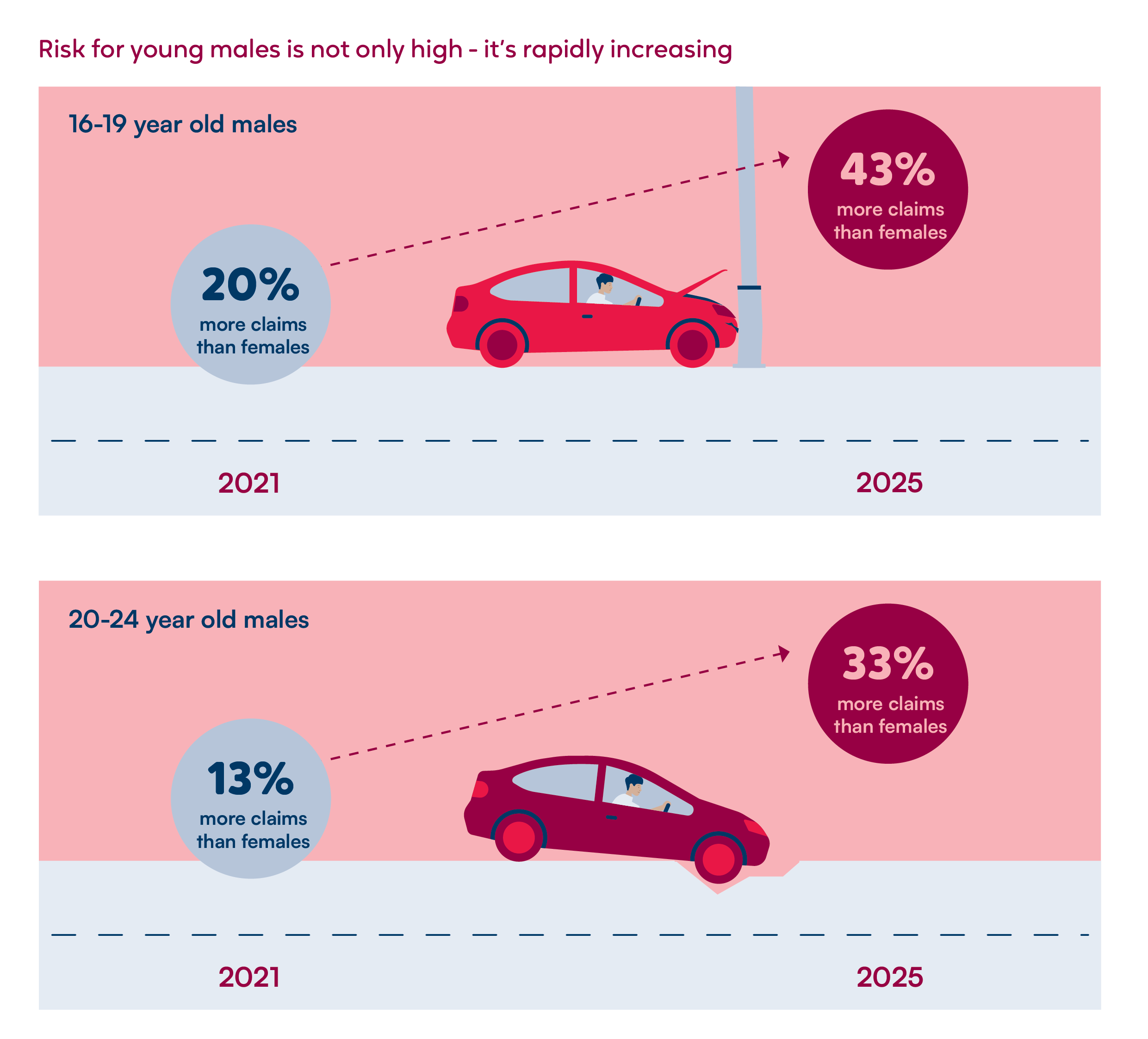
ACC has also worked with the NZ Transport Agency - Waka Kotahi on the DRIVE programme targeting young drivers. Those aged 16-24 make up around 14% of drivers but account for 38% of serious injuries, and 27% of fatalities on our roads.
The average cost per road-related claim is 10 times higher than for sports injuries, and three times higher than for workplace injuries.
“In 2024, more than 82,000 young drivers participated in DRIVE. Those who completed the programme had 26% fewer crashes,” the report said.
“They also had a 28% lower claim rate, resulting in more than 1800 claims avoided.”
Young male drivers make up an increasing share of ACC’s road-related claims, but that didn’t mean DRIVE should only target young men.
“We want all young drivers to do the programme,” Main said.
“They’re [young males and females] both driving and they’re the other drivers on the road. We want to create the safest, most aware drivers we can, early on.”
Main also cited market research that suggested a positive impact from ACC’s award-winning “have a hmmm” campaign, which has a multimillion-dollar price tag the NZ Taxpayers’ Union describes as lavish.
“Since we launched it in 2021, the proportion of people who’ve said they’ve taken action to prevent an injury to themselves has doubled [from 15% to 30%],” Main said.
“A couple of years ago we started asking people whether they had taken action to prevent injury to someone else, and that has increased from 9% to 21%.”
This suggests that ACC’s financial pressures would be even tighter were it not for the campaign, although by how much is impossible to quantify definitively.
Rising costs
An ageing population is also adding to the financial squeeze; claims from those 65 and older have increased more rapidly than other age groups, both in sheer volume as well as per capita.
But Main, who is finishing up at ACC next month, said the trend wouldn’t necessarily continue.
“It’s not a given that as the population ages, we should see more injury claims. In fact, we want the opposite. We want to get good practices happening now to prevent people from needing to claim in the future.”
Preventing injuries and working hard on recovery could be done well by anyone, she said, regardless of age.
“They’re the things that will shore up ACC as a scheme to be able to support people into the future.”
The Government has approved levy increases in 2024, but has so far declined to make legislative changes in response to a 2023 court ruling that could widen ACC cover for childhood sexual abuse victims to 100,000 more claims.
ACC had a deficit of $1.48b in 2024-25, about $660,000 less than expected, with a tighter focus on the right support for the right injury so people can return to work quicker.
The better-than-expected result was also due in part to halting payments for a record number of long-term clients, prompting some to seek a review on the basis that they’re not, in fact, work-ready.
“The natural justice process is really important for people to have the opportunity to review a decision that they’re not happy with,” Main said.
“At the same time, our public trust and confidence has held or increased slightly. We’re seeing client satisfaction increase slightly.”
Over the last decade, the number of claimants accessing weekly income compensation for more than one year has roughly doubled.
The amount spent over a year on rehabilitation and treatment support more than doubled, from $2.1b to $4.4b, an increase well above the rate of inflation or population growth.
ACC Minister Scott Simpson said “promising steps” had been made to reduce financial pressure.
“The ‘Injuries in New Zealand’ report shows we all play a role in preventing injuries for friends and family, supporting recovery, and in protecting the scheme for future generations.”
Derek Cheng is a senior journalist who started at the Herald in 2004. He has worked several stints in the press gallery team and is a former deputy political editor.