Crime: Latest survey shows overall crime steady, rise in feeling unsafe, biggest increases in fraud, vehicle theft
People are feeling more unsafe despite crime rates remaining steady, with the latest crime survey showing an increase in fraud and motor vehicle theft.
The sixth New Zealand Crime and Victims Survey, released today, is considered a more accurate picture of crime because it includes unreported incidents (only 28% of crime is reported to police), though it excludes crimes against businesses.
Based on thousands of interviews with New Zealanders aged 15 and up, the survey found 31.5% of New Zealanders experienced at least one crime incident in the year to October 2023.
This was the highest rate across the survey’s six years but the figure has remained steady, oscillating between 31.5% and 29% since 2018.
“This overall figure has been relatively stable since the survey began,” Ministry of Justice general manager sector insights Rebecca Parish said.
This contrasts with claims repeated by Prime Minister Christopher Luxon that crime, and violent crime in particular, is out of control – though there are many different sets of crime data, with reported crime statistics showing an upward trend in sexual and violent crime.
Of particular interest to Luxon will be the data on assault, robbery and sexual assault. One of his nine public service targets is to have 20,000 fewer victims of these “violent offences”.
Since 2018, the first year covered by the survey, there has been “no significant difference” in the proportion of New Zealanders who experienced a violent offence (4.3% in 2023, or 185,000 adults), or in the number of those offences (449,000 in 2023). This makes Luxon’s target in 2029/30 a drop to 165,000 victims.
Despite the steady crime rate, fewer people are feeling safe – a global trend:
The survey noted that racism against Asians since the Covid-19 pandemic could have contributed to an increase in them feeling unsafe.
These results sit alongside the police module part of the survey, reported by the Herald this morning, which showed 69% of people in 2023 feeling safe/very safe in their neighbourhood after dark, down from 72% in 2021.
Justice Minister Paul Goldsmith said the survey data showing 1.88 million incidents of crime for 2023 was “shameful”.
He said it justified the Government’s law and order agenda, even though Ministry of Justice officials have described much of it – including the anti-gang measures and Three Strikes 2.0 – as not being backed by evidence.
“Sadly, the survey found more New Zealanders felt unsafe than the year prior, even if they weren’t a victim of a crime. This is unacceptable. That’s why this Government backs the police to do their job more effectively and will ensure there are serious consequences for crime.
“Yesterday I announced a sentencing reform package to ensure criminals face serious consequences for crime, the needs of victims are prioritised and faith in our justice system is restored. This Government will not sit by and let these figures get worse. We’re taking action and will ensure all Kiwis feel safe in their communities.”
Other key trends in the survey include:
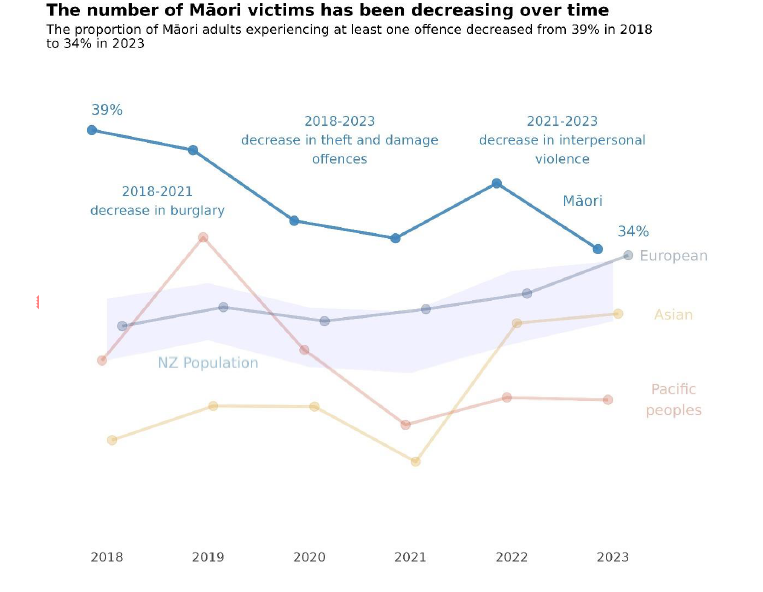
While higher than average, the proportion of Māori adults experiencing crime each year has dropped from 39% in 2018 to 34% in 2023.
This correlates with a drop in burglaries between 2018 and 2021 (from 18% to 12%), in interpersonal violence crimes between 2021 and 2023 (from 13% to 10%), and in theft and damage offences across all survey years (from 8% to 4%).
The survey points to justice reforms coinciding with these drops, such as Te Pae Oranga Iwi Community Panels, and support from community providers including whānau-centred initiatives assisting those suffering from family and sexual violence.
“Although some of these initiatives could reduce victimisation among Māori, there is currently no evaluative evidence linking these initiatives to the observed national decrease in victimisation of Māori adults,” the survey report said.
The downward trend in family offences also coincides with increased funding and new legislation that took effect in 2019, which encourages better collaboration across government agencies tackling family violence. Again, there is no evaluative evidence linking the legislation and funding to the decrease.
The survey also noted that service providers report an increase in reported family harm. This discrepancy might be because the decrease in the survey data is for one-off family harm from non-intimate partners. There has been no decrease in repeat offences by intimate partners (parent, child or other family relationship).
Parish said the most common offence in the country in 2023 was fraud – mostly unauthorised bank transactions (66%), followed by online scams (20%) – though it is the least-reported crime (11% of fraud and cyber crime is reported).
“The increase is a worldwide trend and is likely related to people carrying out more financial activity online, especially online shopping.”
The rise in vehicle theft also mirrored a global trend, she said.
The proportion of victims reporting to police has remained steady since the survey began in 2018.
“However in contrast to the number of victims, last year we observed a higher proportion of household incidents – burglary, theft, and vehicle theft – reported to police. Across all crimes, 28% of all incidents were reported to police.”
Vehicle offences (58%), interpersonal violence (40%) and burglary (43%) are the most commonly reported crimes.
Derek Cheng is a senior journalist who started at the Herald in 2004. He has worked several stints in the press gallery team and is a former deputy political editor.