Election 2026: Greens’ tax plan released online early, sees party dramatically rein in ambitions
The Green Party’s election tax package has accidentally been released early, with the Herald discovering it online hours before it was meant to be officially launched.
A Google search for the Greens’ tax plan on Sunday morning found the “A tax system for us all” document, containing a raft of new policies.
It linked through to the “tax_policy_2026_ONLINE.pdf” document. Google’s cache appears to show it has been online for two days.
It has since been taken off the party’s website.
Green Party co-leaders Chlöe Swarbrick and Marama Davidson were due to front a press conference on Sunday afternoon to announce details of the plan. However, that was brought forward to 11.30am after the online leak.
Davidson said the policy being put on the party’s website early was a “human mistake”.
The package dramatically reins in the party’s ambitions for a wealth tax, delivering less than half the revenue it proposed in its alternative Budget last year.
However, it still includes more than $32 billion of new revenue over four years, driven by a new “super-rich tax” and an inheritance and gifts tax, lifting the corporate tax rate for some and reversing coalition changes to interest deductibility.
As the Herald revealed on Sunday morning, the Greens also want to fund Inland Revenue to “properly” enforce tax laws the party argues are leading multinational companies to not pay their fair share.
The Greens have again come with a sweetener, promising to make changes to income tax rates that the party says will result in everyone earning under $160,000 receiving a tax cut.
That has also been changed since last year’s plan, which had anyone earning under $115,000 receiving a boost.
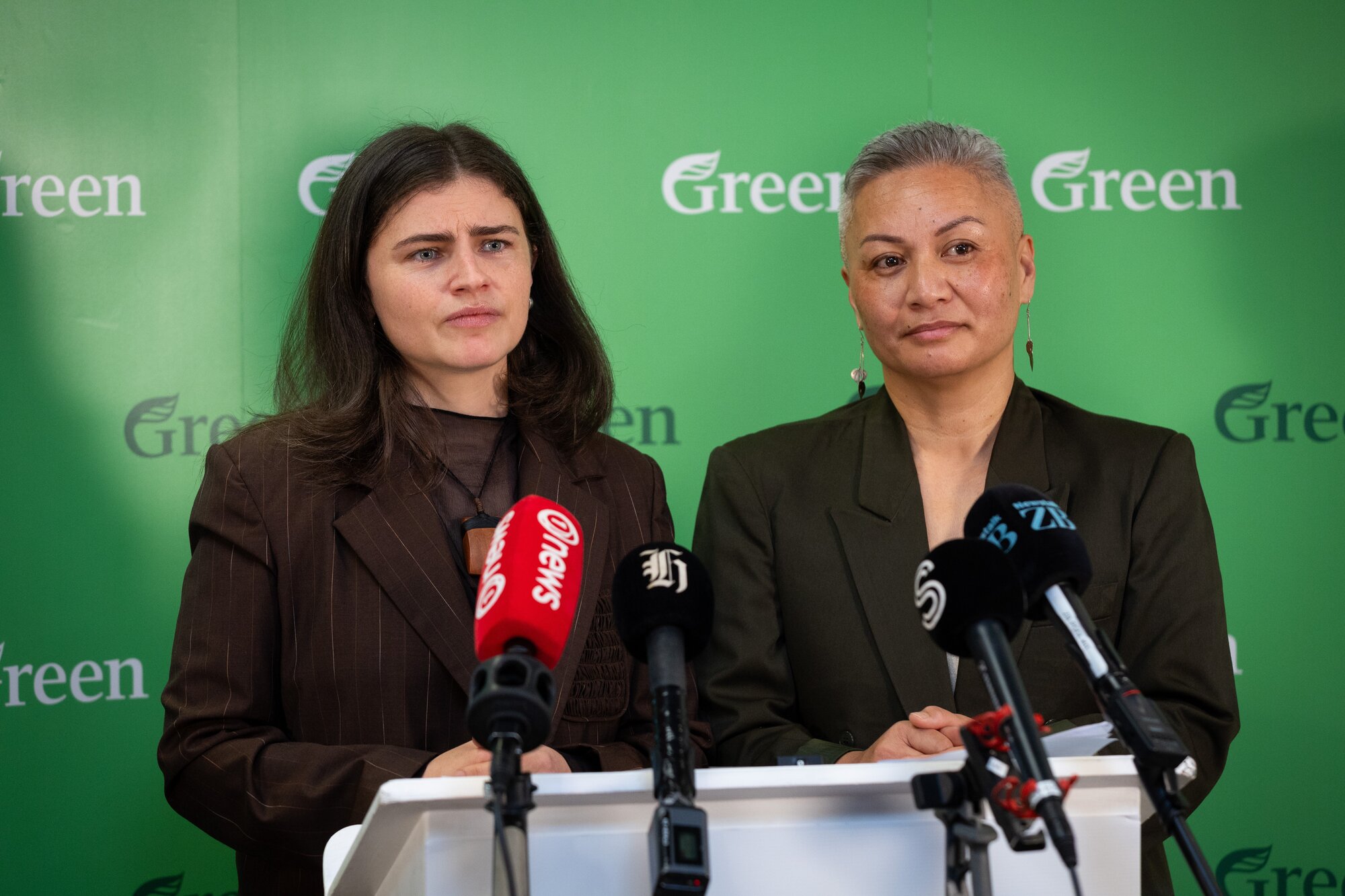
“All New Zealanders deserve the opportunity to thrive,” Swarbrick said in announcing the package.
“Today we are proud to announce a tax policy that will tackle inequality and corporate greed to rebuild our country and put more money in the pockets of 96% of New Zealanders.”
Co-leader Marama Davidson said if “everyone contributes fairly”, there would be “more than enough” for services like health and education and to help Kiwis with the cost of living.
The costings found in the Green Party’s policy have been independently reviewed by economic Brad Olsen at Infometrics.
He said the costings “appear to be reasonable assessments, conditional on the underpinning assumptions of each policy and commitment”.
Olsen did, however, note that there were “large numbers of proposed overlapping changes” which were “difficult to assess”. As the Greens were proposing large fundamental changes, the outcomes and flow-on effects were not easy to properly model.
“Tax changes at the scale proposed by the Green Party are difficult to fully model, given the substantial change in possible economic behaviour resulting from the various changes in taxable treatment, adding a level of complexity and uncertainty to the results.”
Wealth and inheritance taxes
The tax package pales in size to the $88b in new revenue the Greens proposed in its 2025 alternative Budget.
Though as Swarbrick told the Herald this week, that plan was meant to reflect the party’s grand ambitions if it controlled portfolios across Government.
This one was meant to have a “very intentional focus on the things that will be outright practical common sense to most people”.
The key change appears to be in the Greens’ wealth tax, which it has renamed its “super-rich tax”.
Under the old 2025 policy, a 2.5% tax would be applied on net assets, such as property and shares, over an individual threshold of $2 million.
That policy would have generated more than $72b over four years, including via anti-tax avoidance measures.
That has been dialled way back to an election policy of a 2.5% annual tax on net assets above $10m (as opposed to $2m). It’s now expected to make $15.8b over four years.
The Greens’ policy document goes into detail about how different assets would be valued and dealt with. While it will cover property, shares, bonds and other assets, the tax won’t apply to the family home and also doesn’t affect wages or work.
Next on the tax list is what the party is calling a Capital Acquisitions Tax – essentially a tax on inheritance or gifts. The Greens had this in their 2025 plan, but it was rolled into the wealth tax costings.
This year’s policy is a 33% tax on inheritance or gifts valued above $1m, but family farms and the family home would be exempt.
The person receiving the inheritance or gift would pay the tax and it’s estimated to hit about 1100 people a year. It would make $4.1b over four years.

It appears the tax would apply to values above $1m. An example the party gives is if someone is gifted a family home worth $1.5m and $1.25m of shares and bonds, they would pay the 33% on the $250,000 – the value of the shares over $1m.
“The 33% rate matches the base tax rate for income earned by a trust and income earned by the estate of someone who has recently died,” the party said.
‘Corporate greed’
The Green Party is also explicit about wanting to tackle what the party calls “corporate greed”.
Its plan includes hiking the corporate tax rate from 28% to 33% for companies with an annual turnover exceeding $30m. This would impact 0.7% of businesses, according to the party’s policy document, including banks, supermarkets and energy companies.
According to the Green Party’s costings, this would pull in about $5.9b over four years. This is less than the party’s 2025 plan, as that one increased the corporate tax rate for all businesses.
An annual major banks levy would be introduced on 0.06% of the total liabilities of banks with more than $100b in liabilities, bringing in $1.6b over four years. This tax is described as being in line with a major banks levy in Australia.
“The purpose of this is to address the fiscal risks of highly leveraged banks to the economy in Aotearoa, the high profitability of the big banks and [to] level the playing field for smaller competitors such as Kiwibank,” the party said.
Finance Minister Nicola Willis announced during the May Budget a new prudential levy on banks and other financial market players to be used to pay for their own regulation. It was expected to bring in $209m over four years, less than 1% of the total profit of the four biggest banks.
Next is a crackdown on multinational companies the Greens argue aren’t paying their fair share.
As the Herald reported on Sunday morning, the party is planning to fund Inland Revenue to “implement transparency work” to ensure these companies’ royalties – subject to tax – aren’t being misclassified as something else. The party believes it can bring in $874m over four years as a result.
The party is also planning to generate nearly $4b over four years by rolling back the Government’s decision to change interest deductibility rules and to also push the bright-line test out to 10 years.
New tax brackets
At the same time as introducing these new tax initiatives, the party would make changes to income tax thresholds, leading to 96% of New Zealanders receiving a cut.
The first change is introducing a $10,000 tax-free threshold. This means the first $10,000 someone makes isn’t taxed.
A series of adjustments would then be made to the rest of the tax brackets, with a new 45% threshold introduced for income over $160,000. Currently, the highest tax rate is 39% over $180,000.
According to the Greens’ calculations, the changes would mean anyone making under $160,000 per year will benefit.
The party has provided a number of examples. Someone with a gross annual income of $40,000 would benefit to the tune of $27 a week, while someone making $90,000 would get $10 a week back.
However, if you’re making $170,000, you’ll pay an extra $20 a week, while those on $300,000 would see their tax bill increase $181 per week.
The tax-setting changes have been costed at just over $10b over four years.
Reaction
National’s Simeon Brown responded to the Greens’ announcement by claiming the “smorgasbord of new taxes” would help Labour pay for its promises.
“What the Greens are proposing is economic lunacy,” he said.
“Their tax proposals would be a wrecking ball for economic growth. They would discourage investment, drive away talent and capital and make it harder for businesses to grow, create jobs and lift wages.
“But the reality is that Labour needs these taxes to make up for the $18 billion hidden bill for all the promises they have already made.”
But Labour’s Chris Hipkins later said his party had been very clear it would only implement its proposed capital gains tax and would not “support other new taxes like an inheritance tax or a wealth tax”.
Act’s David Seymour said the Greens’ tax policy was “written by the dark underbelly of our culture, tall poppy syndrome”.
“Instead of creating the condition for even more wealth, the Green vision is taking from those who’ve succeeded already.”
Jamie Ensor is the NZ Herald’s Chief Political Reporter, based in the press gallery at Parliament. He was previously a TV reporter and digital producer in the Newshub press gallery office. He was a finalist in 2025 for Political Journalist of the Year at the Voyager Media Awards.