Inside the drop in serious youth offenders, and where numbers remain stubbornly high
The number of serious and persistent youth offenders has fallen to pre-Covid levels, though the levels remain higher than the Government’s baseline target in Bay of Plenty, Eastern and Central.
The target - one of nine public service goals - is a 15% reduction compared to June 2023, which would see the number of recidivist serious young offenders drop from 1081 in mid-2023 to 919 by 2030.
The latest quarterly update revealed the target had almost been reached, with 942 such offenders in February this year.
Documents released to the Herald under the Official Information Act reveal this number was actually lower in January (934, or a 14% reduction) before rising slightly in February.
This was the first monthly increase since the middle of last year, but by such a tiny amount (less than 1%) that there’s no suggestion of a trend reversal.
Prime Minister Christopher Luxon has repeatedly trumpeted these law and order successes, though youth experts have questioned how much it has to do with the Government, given most of its flagship policies to reduce youth crime were yet to bite.
The exception regarding youth crime was the boot camp pilot, which was recently completed, with seven of 10 participants allegedly reoffending.

The post-Covid spike, then the post-post-Covid fall
After the Herald revealed the trend reversal in serious youth offenders last year, children and youth experts suggested it was a return to pre-Covid trends.
The number of serious young offenders started spiking in mid-2022, peaked towards the end of 2023, and then fluctuated before starting to drop in June last year.
A post-Covid increase in youth offending was observed not only in New Zealand but in several western nations, with several contributing factors such as increased isolation and loneliness during Covid restrictions, increasingly worsening truancy over this period, and a cost-of-living crisis in the aftermath, fuelled by high inflation.
February 2025 figures show the number of serious youth offenders falling to pre-Covid levels, at the start of 2020.
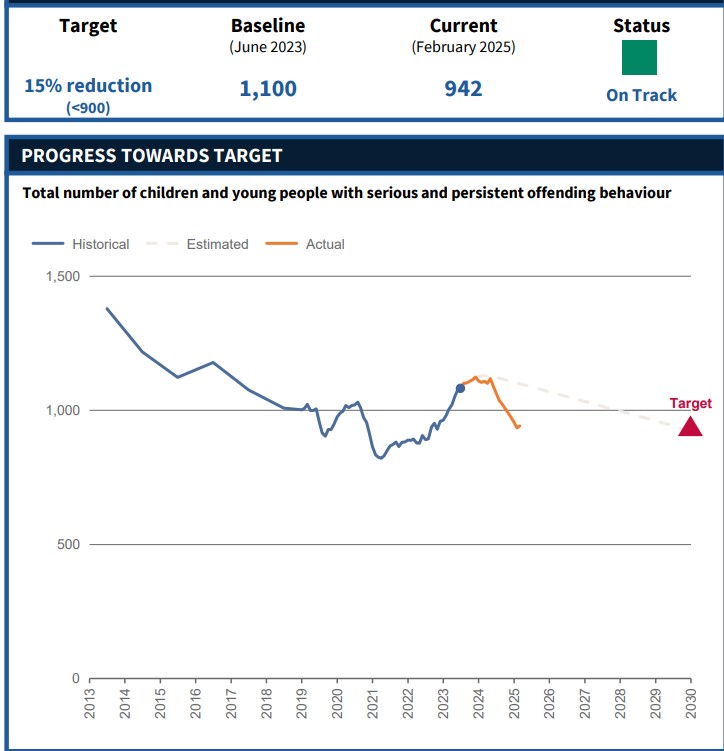
Several other indicators reinforce this downward trend:
There have also been drops across all age groups, though the biggest reductions have been among those aged between 14 and 17:
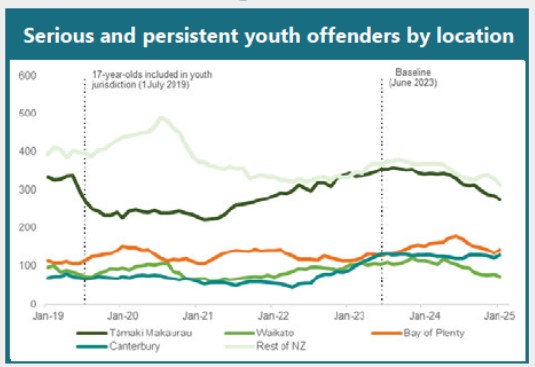
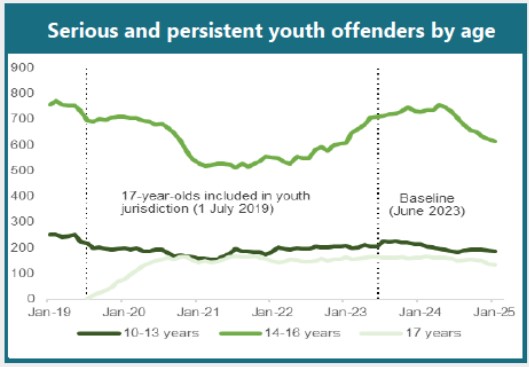
Regionally, there’s been a 20% fall in the number of serious and persistent youth offenders in Auckland for the year to January, compared to the previous year.
Bay of Plenty, Central and Eastern are the only areas where the numbers have gone up compared to the baseline data (June 2023), though the downward trend in recent months mirrors what’s been happening nationwide.
The baseline figure for Bay of Plenty is 126 serious and persistent young offenders. The number jumped to 159 in August 2024, before dropping to 143 in January this year - an 11% drop compared to the previous year.
“Most of the increase in Bay of Plenty is due to increases in all offence types in Rotorua,” an April briefing from Oranga Tamariki said.

Several initiatives have been rolled out in Rotorua to combat crime - more police foot patrols in the CBD, and an inner city community safety hub - while there’s been a huge reduction in the use of emergency housing.
“Lots of locals are loving that we’ve secured more police in town, and the feedback from businesses who are feeling more confident has been great,” Rotorua Mayor Tania Tapsell said.
“Rotorua is significantly better now that we’re stopping emergency housing motels with support from Government.
“There was a strong connection between a proliferation of emergency housing and crime, so it’s a relief to locals to see the end of this.”
The region that has not mirrored the declining national trend is Canterbury, where the number of serious and persistent young offenders has been relatively steady since the post-Covid spike levelled out in mid-2023.
Since this is where the baseline is drawn, the Government remains on target to meet its goal in Canterbury, even though the baseline figure is much higher than the pre-Covid one.
Intensive case management teams have been established in Christchurch and Rotorua, with recruitment underway for such a team in Hamilton “due to need”, an April briefing from Oranga Tamariki said.
Fall in violent crime generally
The Government has also been trumpeting the fall in violent crime and the positive movement towards its other law and order public service target: 20,000 fewer victims of violent crime (assault, robbery or sexual assault) compared to 185,000 such victims in the year to October 2023.
The latest quarterly figure shows this target has already been surpassed, with 157,000 such victims in the year to February 2025.
An April Oranga Tamariki briefing for justice sector ministers revealed other statistical trends to corroborate this trend:
As the Herald reported in May, officials speculated whether the drop in violent crime was a return to crime trends between 2018 and 2022.
“If you fit a linear trend to the number of victims of violent crime between 2018-2022 and then project that line forward to 2029, the February 2025 estimate falls very close to that line,” said a Justice Ministry briefing released to the Herald.
“This is consistent with [the] possibility there was a transitory increase in violent crime between 2022-2024 and violent crime rates are now returning to pre-2022.”
More data would be needed to confirm this, the briefing said.
Other advice from the Justice Ministry said the Government’s tougher law and order message - including policies that were yet to be implemented at the time - might also be contributing.
Officials also noted more police on the beat, which might have helped the number of violent crime victims fall in Auckland and Christchurch. But the number of victims rose in Wellington, where the police presence had also increased.
Derek Cheng is a senior journalist who started at the Herald in 2004. He has worked several stints in the press gallery team and is a former deputy political editor.