Modi visit highlights Luxon’s India trade success amid Peters’ barbs – Audrey Young
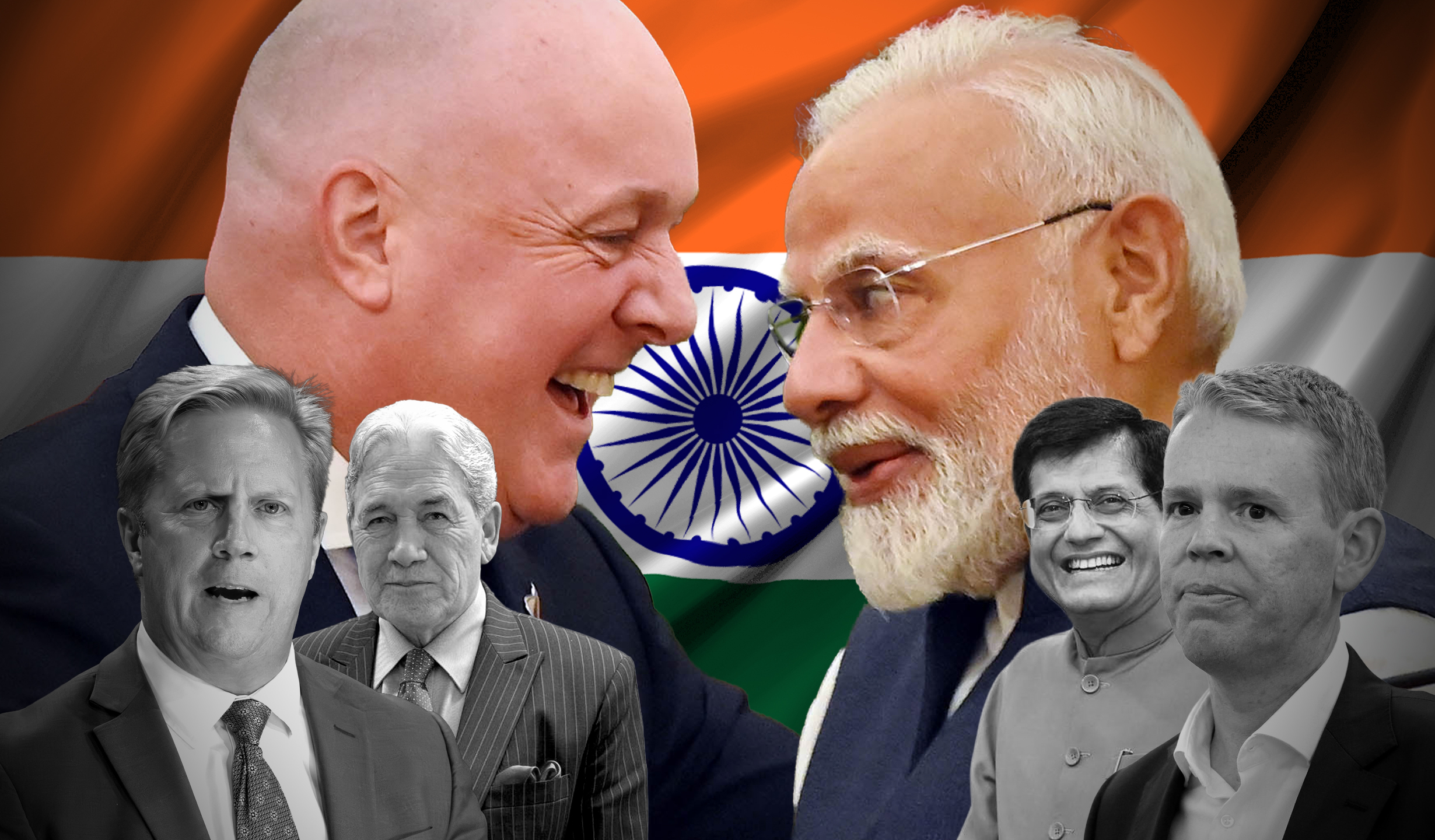
It should be some relief to Christopher Luxon that Foreign Minister Winston Peters will not be in town to rain on the parade of visiting India Prime Minister Narendra Modi tonight and tomorrow.
The free trade agreement (FTA) between New Zealand and India that Modi is coming to mark is Luxon’s biggest trophy so far from a patchy term as Prime Minister.
He promised to get it done, and he has. He does not deserve to have his own Foreign Minister sledging from the sidelines, as has been the case.
The usually moderate Luxon last week described Peters as trying to “sabotage” the deal.
He stopped short of describing Peters as putting politics ahead of the national interest, as he did over the release of emails on the Iran war which were damaging to Luxon’s reputation.
Peters is far better deployed on his current visit to Singapore and Japan.
In the week before he left, he sought to undermine the FTA by suggesting he had seen papers proposing covert settings that discriminate against Indians.
Peters did not release the paper because it was given to him in confidence by Immigration Minister Erica Stanford.
It is a consultation paper written by Immigration officials with proposals on how to operationalise decisions taken by both sides in the trade deal. Such papers are almost always kept confidential until decisions are made. That does not make it “covert”.
The fact that a temporary employment entry (Tee) visa was negotiated under the FTA with stricter conditions than the Tees negotiated under other FTAs does not make it discriminatory. All bilateral FTAs are bespoke, including employment provisions.
An experienced Foreign Affairs official would be unlikely to describe any such agreement as “discriminatory”.
For example, the China FTA allows for 1800 Tee holders at any one time in 20 skill-shortage areas; the India agreement, under which visa holders must return home after three years and cannot apply again for another three years, allows for 5000 holders at any one time, for 13 skill-shortage areas. It cannot be used as a pathway to citizenship.
Such visas in FTAs can be viewed as positive discrimination, not negative discrimination. They give skilled nationals in those countries an additional path for temporary employment in New Zealand.
And this is important: the FTA does not prevent skilled nationals from India or any other country from continuing to apply for a job under the green-list category, in which there is a pathway to residence.
Official statistics show that since September 2022, a total of 20,282 green-list roles have been approved, 5856 of them from Indian nationals.
Most were for jobs in the straight-to-residence pathway, where there were real shortages, including nursing, engineering and ICT (information and communication technology).
Peters originally objected to the FTA in the belief it opened up a backdoor pathway for 5000 temporary workers to bring in 15,000 family members.
Perhaps now satisfied that it doesn’t, and that it is a very strict visa, he is now claiming it discriminates.
There may be a risk that Indian citizens believe there is a pathway to residency through the Tee negotiated, and that may have to be worked through.
But Trade Minister Todd McClay and his Indian counterpart, Piyush Goyal, know very well what was negotiated.
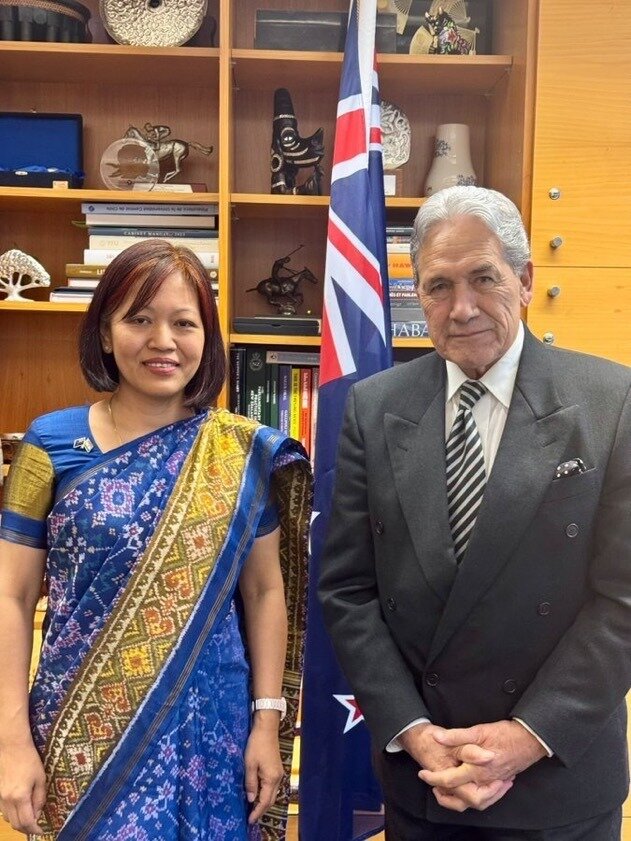
And India’s High Commissioner to New Zealand, Muanpuii Saiawi, on Herald NOW this week defended the Tee. She said India was well aware that the workers who would come here under it would have to return to India at the end of three years.
The criticisms of the FTA by Peters are not the primary issue that should be concerning Luxon.
Of greater concern is the timing of his criticism and whether it is based on a misunderstanding of the agreement – or a misrepresentation.
If it is the latter, then Luxon has every reason to question Peters’ suitability for the role of Foreign Minister in any second term. Or at the very least, to set some clearer guardrails.
So does the India FTA warrant criticism?
Well, it is more a case of not deserving exaltation. It is not quite as “outstanding” as Luxon insists. We will never know how much leverage New Zealand lost through his self-imposed deadline to have it done this term, but there was undoubtedly a cost.
It isn’t the same quality as many other FTAs New Zealand has done, given the exclusion of most dairy products by India. But a fairer comparison is against other deals India has done, and by that comparison, it measures up.
Luxon has politicised it too much in criticising Labour for not getting a deal. He should have anticipated that he could not rely on New Zealand First, that he might need the support of the Labour Party to pass it, and involved it more positively in the process earlier.
It wasn’t the fastest deal ever done, as Luxon claims. Even McClay has acknowledged that the first talks took place in April 2010. They were abandoned in 2015 with India’s intransigence over dairy.
But since talks resumed in March last year, there has been political will on both sides to complete the deal quickly.
And Luxon is entitled to relish Modi’s 24-hour visit as a political achievement that he can genuinely claim.