‘Move-on’ orders for homeless come as public disorder hits 10-year low
The Government’s work into moving on rough sleepers comes despite advice that disorderly behaviour is at a 10-year low, according to police data.
The issue is related to rising homelessness, concern among business groups that shoppers are deterred from coming into the Auckland CBD, and concerns that there isn’t enough housing for those who might be moved on.
Prime Minister Christopher Luxon has confirmed he is looking at “move-on” orders to clean up downtown Auckland, which would enable police or maybe a council officer to order someone to leave for a period of time because of anti-social behaviour.
With a new convention centre, the City Rail Link set to open and cruise ships arriving over summer, he wants the CBD to be seen as a safe place. He added that there needed to be support for anyone who might be moved on, rather than simply shifting the problem to a different part of the city.
Justice Minister Paul Goldsmith said last week he’d been tasked with providing police with the tools they needed to tackle public disorder.
“It’s blindingly obvious to everybody that the CBD, particularly of Auckland, but [also] a lot of places, have been characterised by disorder and real concern around public safety. We’re open to some new suggestions in that area.”
Luxon said no Cabinet discussions had taken place, but several ministers have been receiving advice on the matter for months.
“Data indicates that disorderly behaviour has been decreasing, but there is still concern,” says a September briefing from the Justice Ministry, released to the Herald under the Official Information Act, for a meeting involving 10 ministers across the justice and social sectors.
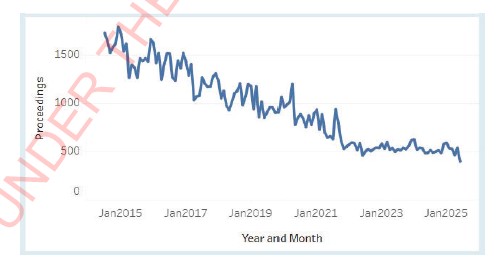
“Publicly available data on police proceedings indicates that there have been marginal peaks in proceedings against public order, health and safety offences in the past 18 months.
“Overall, however, proceedings against these offences are at a 10-year low.”
The paper did not include a regional breakdown, but this can be examined on the police data website.
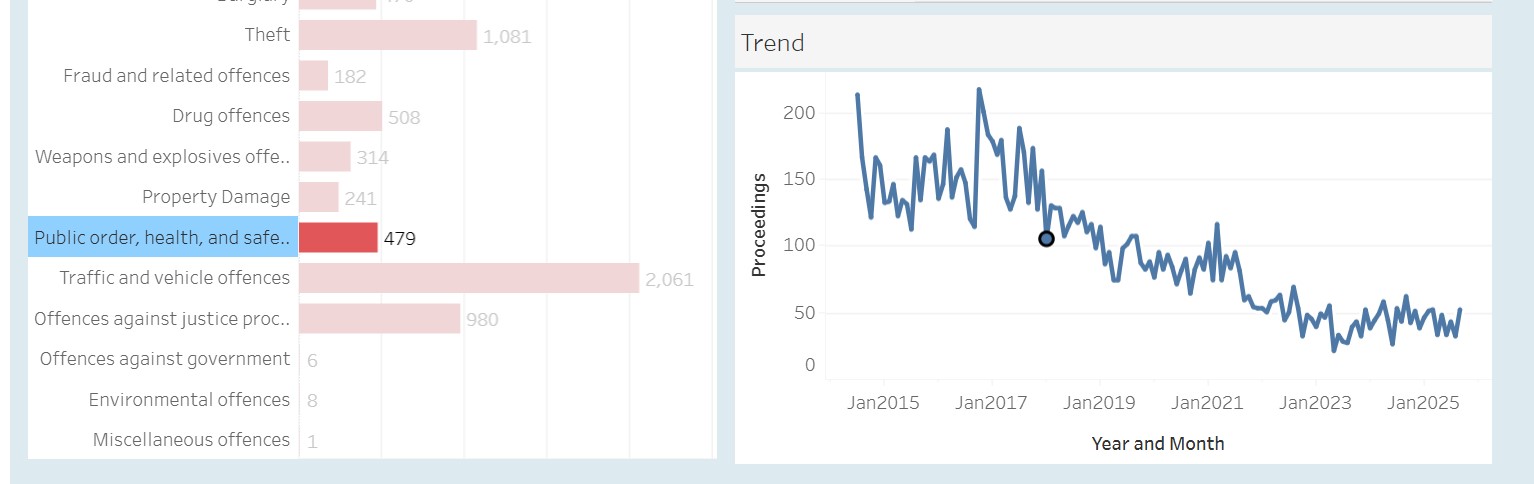
The national pattern is mirrored in Auckland City, where the number of police proceedings for “public order, health and safety offences” has been trending down over the last decade.
Over the last four years, the monthly number of proceedings has oscillated between 21 and 69, while the annual number has been about 500.
This is half the annual number in 2020 (about 1000), which was again about half the annual number in 2016 (about 2000).
This data does not include a breakdown for the Auckland CBD, where 90% of businesses say they are affected by rough sleepers and begging, according to a Heart of the City survey.
The ministry’s briefing said police already had many tools to deal with low-level offending, including referring people to support services for housing, substance abuse or mental health issues.
Police and social service agencies’ advice was that law enforcement was a “generally ineffective” response to homelessness, the briefing said.
Perception versus reality
Despite the data trend of decreasing public disorder, the briefing said there was a perception of a prevalent problem in city centres, “undermining safe and thriving urban economies”.
This can be attributed to:
The paper noted that disorderly and anti-social behaviour can be criminal in nature, “eg offensive or threatening behaviour, intimidation, urinating in public, wilful damage”, or below a criminal threshold, “eg disrupting businesses, aggressive behaviour, public intoxication”.
The document was provided for a meeting on “disorderly behaviour in public places, and the wider issue of homelessness”.
It was one of several regular meetings for justice sector ministers Paul Goldsmith, Judith Collins, Mark Mitchell, Nicole McKee, Casey Costello, Karen Chhour and Matt Doocey.
But this one was particularly high-level, as they were joined by housing and social sector ministers Chris Bishop, Tama Potaka and Louise Upston, alongside senior leaders from nine public service departments across justice, housing and the social sector.
Homeless does not equal disorderly
Social service agencies were careful not to conflate public disorder and homelessness, the paper said.
“Survival behaviours such as sleeping rough do not necessarily contribute to public disorder, and other actors who are not homeless are often involved in criminal and ant-isocial behaviours.”
It said survival behaviours by the homeless or “the manifestation of mental health illnesses (eg psychosis causing someone to yell in public) can make people nervous or uncomfortable”, impacting their enjoyment of public spaces.
“However, police, councils and social service agencies have advised that law enforcement responses to these behaviours are generally ineffective responses to homelessness, which is best addressed through collaborative place-based approaches.”
The Government has outlined a number of actions to tackle increasing homelessness, including 300 more Housing First placements, though Auckland and Wellington city missioners say this is nowhere near enough.
The paper said police already had a number of tools to use for “most instances of low-level offending”, including warnings, criminal offences, city bylaws and referrals to social service providers.
“Police engage with vulnerable populations daily, and [are] a connector to services for vulnerable individuals, which can include referrals for housing support, alcohol and drug treatment, and mental health support.”
Most of the paper’s contents were redacted under the provision to protect the confidentiality of advice tendered by ministers or officials.
Rising homelessness
While public disorder victimisations appeared to be at a 10-year low, homelessness has been rising, according to frontline agencies including the Salvation Army and the Auckland City Mission.
The Homelessness Insights Report in June shows at least 800 people estimated to be living without shelter in Auckland, with 270 people in Christchurch and 140 people in Wellington.
A July report from the Ministry of Housing and Urban Development said homelessness appeared to be growing faster than the rate of population growth (3%).
It comes as the doors to emergency housing have narrowed, with the number of applications plummeting following new rules allowing officials to decline grants if they believed a person had caused or contributed to their own need.
The Government has trumpeted its success in lowering the number of people in emergency housing. More than 1000 households with 2200 children have moved into stable homes.
But it has also admitted to having no information on the living arrangements for about 20% of those who have moved out of emergency housing.
Opposition parties have painted the Government’s consideration of “move-on” orders as a response to a problem of its own creation, by not letting those in need into emergency housing.
“Instead of coming up with a solution, they’re just trying to sweep it away,” Labour’s housing spokesman Kieran McAnulty said.
The Government’s consideration of “move-on” orders is being welcomed by Auckland business groups as well as Auckland Mayor Wayne Brown.
Heart of the City chief executive Viv Beck said most central businesses would support the move as long as there were good solutions available for vulnerable people.
Brown told the Herald the city’s bylaws were weak, and it was Luxon’s job, not his, to rid the city centre of its “scruffy” characters.
Derek Cheng is a senior journalist who started at the Herald in 2004. He has worked several stints in the press gallery team and is a former deputy political editor.