NZ Coalition agreements live: The concessions Christopher Luxon had to make to get into government
A $1.2 billion fund for regional infrastructure, scrapping plans on allowing foreign buyers back into the housing market, allowing work that could lead to a referendum on Treaty of Waitangi principles, and keeping the superannuation eligibility age at 65.
These are among the biggest concessions incoming Prime Minister Christopher Luxon has made to get his three-party coalition over the line, but none of them mutate any of National’s core election promises beyond recognition.
Tax was always going to be a major sticking point, as New Zealand First has been a staunch opponent of Luxon’s wish to allow foreigners to buy $2 million-plus New Zealand homes, with a new tax on those purchases to help fund National’s tax package. The revenue from the tax was hoped to add an average of $740m a year to the Government coffers.
Instead, Luxon said the tax package - National’s centrepiece in the campaign - would be funded by other means, given there were already “buffers” in its fiscal plan and there would be other savings and “reprioritisations” that could be dipped into.
STORY CONTINUES AFTER THE LIVE BLOG
'Happy tears': Mike King's Gumboot Friday gets $6m per year in coalition deal
Royce
Mike King’s youth mental health charity Gumboot Friday will receive $6 million annually as a result of today’s three-party government coalition agreement.
King posted on Facebook today that the funding relieves such a heavy burden and “enables us to maintain our promise to continue providing our fast and effective free counselling”.
“I’ll admit there have been some happy tears today,” he said.
Read more here:
Listen: Inside the new Cabinet and policy priorities
Royce
Was the final deal a good one for National? How is Luxon feeling after his first press conference with Seymour and Peters? And what were the surprises from the coalition deal?
NZ Herald political editor Claire Trevett joins the final episode of On the Campaign as the country prepares for the new government to finally take office.
Derek Cheng: How Luxon made room for Act and NZ First without giving up much at all
Royce
ANALYSIS
Incoming Prime Minister Christopher Luxon has managed to bring two other parties into a coalition Government without seeming to lose anything substantive in his own party’s core election promises.
Whether the agreed-upon policy platform will go ahead without a hitch, however, is an entirely different challenge, especially when it comes to paying for National’s tax cuts.
As with any MMP election - with the exception of the outlier result in 2020 - the emerging Government was always going to have to make compromises in order to cobble together a parliamentary majority.
Read more here:
Todd Murray
Peters wants Covid inquiry to begin 'as soon as we can assemble it'
Todd Murray
Incoming Deputy Prime Minister Winston Peters said he wanted a Covid-19 inquiry to begin "as soon as we can assemble it and get it ready to go. Ideally, we'd have it in 2024."
Speaking to Newstalk ZB's Heather du Plessis-Allan, Peters said the current inquiry was not comprehensive.
"It's already had one person left the inquiry because of concerns about that.
"We want to know why you would limit the terms of reference," he said.
Peters couldn't answer whether the current inquiry would continue alongside another.
Speaking on removing Treaty principles from current legislation, Peters said there was no requirement for them to be there in the first place, "so why would they be there?"
Peters said the "Treaty of Waitangi industry" was creating work for itself.
He said it wouldn't be complicated to remove Treaty principles from legislation, "we live in a computerised age".
"How can you have a waka on the road?" Peters said of Waka Kotahi NZTA going back to using an English name.
"Can we agree that all communication is about comprehension and understanding?
"It's back to Health New Zealand," he said of Te Whatu Ora Health New Zealand.
Peters said building a highway around the Brynderwyns was the party's No 1 priority.
He wouldn't be drawn on when this would be done either.
Speaking on transgender athletes in publicly funded sports, Peters said, "it's called fairness".
Todd Murray
Todd Murray
Luxon says dropping foreign buyers tax package 'no biggie'
Todd Murray
Prime Minister-elect Christopher Luxon said taking 10 days since special votes had been counted to negotiate the formation of a government wasn't a bad thing.
Speaking to Newstalk ZB's Heather du Plessis-Allan, Luxon said it was "not long at all, especially when you think of the Dutch taking 10 months to do something very similar and having the government fall apart after 11 months".
Luxon said getting every party to sign off commitments was exciting.
"We want to get into it," he said.
He promised there would be no changes to National's tax plan - "all that changes is the way we go about funding it because we agreed with New Zealand First not to pursue the foreign buyers tax".
"There's a number of policy changes and policies [in the agreement] that means you make additional revenue and make additional savings.
He said it was "no biggie" he had had to drop the foreign buyers tax.
"New Zealanders will get the tax relief we talked about delivering for them," he said.
Funding for those tax cuts would come from "little things", he said. He mentioned changing the fees-free scheme for tertiary education, saying it could save $100 million.
"These are a series of things that all add up. All in all, what people need to know is the tax programme has been committed to by all three parties.
Luxon said, "it was difficult before the election because everyone said you're not going to raise enough money, or you're going to raise too much money, the reality was we were relaxed about it going into negotiations because we said we'd build buffer into our fiscal plan".
He said the government wouldn't be borrowing money to fund the cuts.
He also said the regional infrastructure fund was different to the Provincial Growth Fund.
"Both National, Act and New Zealand First had commitments to investing in regional New Zealand, he said.
"What we've done here is this is a capital budget. It can only be spent on hard infrastructure. It's a lot smaller than what was agreed in the Provincial Growth Fund."
On the Treaty Principles Bill, Luxon said there was no commitment to support the bill beyond select committee.
"There is no further commitment from the Government beyond that," he said.
We want to strengthen democracy, we want equal citizenship - Luxon
On scrapping two iwi seats on the Environment Canterbury regional council, Luxon said, "we just don't think it's one person, one vote".
"We really said very clearly we want to strengthen democracy, we want equal citizenship, and those were positions of all three parties, essentially, before going into the election," he said.
Luxon said he was looking forward to returning to Auckland this evening and having a sleep-in tomorrow.
He said he gets up at 4.30am every day and tends to work quite late.
"As you can imagine, it's been a big job, turning the National Party around in the past two years. We managed to go to the campaign, and then the day after the campaign we started thinking about all this.
"I think this is pretty historic. It's really special. For the first time, we've got a three-party coalition government in New Zealand. We've got a situation where we've had every party sign up to the detail of the policy programme, we've agreed on the ways of working, and we've put the right people in the right places.
"This is what you spend the last three years in politics trying to do, is to make sure we can get to government."
ASH 'shocked' Smokefree laws will be repealed
Todd Murray
Action on Smoking and Health NZ (ASH) says it is dismayed at the new coalition government’s announcement today that it will repeal the country’s Smokefree laws.
“We are shocked that one of the coalition's first health measures is to essentially grant a pardon to tobacco companies, and allow them to continue selling products that kill almost 5000 New Zealanders every year," ASH director Ben Youdan said in a statement.
“Repealing the Act puts the interests of the cigarette industry before the health of the nation. This will prolong the harm and suffering that smoked tobacco is causing to New Zealanders, especially those in the most vulnerable cohorts.
"Māori and Pacific people suffer the majority of premature deaths and illness from smoking."
The coalition government also announced that it will introduce penalties for selling vapes to those under 18 and will consider a liquor licence being required to sell vapes.
ASH said the move is a "distraction" from the fact that repealing the smoked tobacco retail cap, and denicotinisation laws will leave smoking tobacco for sale everywhere and will set back the fight to end smoking-related death and disease by years.
Todd Murray
Debate on Treaty of Waitangi principles is one Kiwis 'need to have', says David Seymour
Todd Murray
Act Party leader David Seymour says where the bill on Treaty principles went would depend on him persuading New Zealanders it should.
"Our coalition partners ... are nervous that it's going to create a lot of enmity and destruction - I don't believe that's true.
"I think it's a debate New Zealanders want to have, need to have, and are very capable of having," Seymour told Newstalk ZB's Heather du Plessis-Allan.
Seymour said giving Act the opportunity to prove its case was all it needed right now: "If we can't, then so be it."
On Māori wards, Seymour said people should have a say on whether wards are formed in their councils.
"It could be done in line with the next council elections or earlier, but that's a matter for the Minister of Local Government," he said of a referendum on Māori wards.
"What Act has agreed with our partners in coalition is that we are going to make sure people have a say. If they want divided, race-based wards, we won't stand in their way."
Seymour said he respected the Courts' independence, "but we can send messages from the New Zealand public to the judges through legislation".
"Changes we propose will be a shift in the principles of the Sentencing Act from what we have right now where it says the judge has to give the minimum possible sentence, instead they will have to give the minimum possible sentence with regard to public safety, which is already there, but also the victim.
"We want to send a message to judges that I think most New Zealanders want sent - we get the whole idea of being kind to the criminals and they'll be kind back, but we don't think it's worked."
Regarding the monitoring of ankle bracelets, Seymour said, "it had become clear, you know, look at the guy who shot some people in downtown Auckland six months ago, how somebody who was guilty of breaking a woman's throat bones by strangling her could be on home detention - that's the kind of case that triggers a review".
On interest deductibility for landlords, Seymour said he had compromised with National and New Zealand First.
"We made the argument it should be done immediately, the National Party would like to do it over a much longer timeframe of several years. We have compromised that it would be done faster."
On his relationship with Peters, Seymour said, "I know we can have a working relationship, which is what is important. We can work well, because we've achieved over the past four weeks or so a pretty big shift in our positions to form a coherent government.
"I don't really go to work to like people," he said of his feelings towards Peters, "that's why I've got friends and family."
What the coalition deal means for the economy
Todd Murray
PREMIUM: An overview of the policies that affect your back pocket.
Todd Murray
Todd Murray
'There is no plan' - Chris Hipkins says three-party coalition will 'take New Zealanders backwards'
Todd Murray
Labour leader Chris Hipkins has congratulated the new Government.
He said the caretaker government would work with it to ensure a smooth transition.
He called the policies agreed by the three parties "very confused and contradictory and grab bag of commitments that will ultimately take New Zealanders backwards".
Hipkins said the new government prioritised landlords over renters, the oil and gas industry over New Zealand's international reputation, and the tobacco lobby.
"We've also seen that even before they go into government, our predictions before the election that their tax cuts didn't add up have, of course, proven true," Hipkins said.
"They've been completely silent about how they're going to pay for that."
Hipkins said additional borrowing was likely so the new government could fund its tax cuts.
"That means inflation will stay higher for longer, interest rates will stay higher for longer, and ultimately, New Zealanders will pay more than they're likely to benefit from the tax cuts the National Party is offering.
This is definitely going to be a government that drives New Zealanders apart - Hipkins
Hipkins said David Seymour and Winston Peters had been "running circles" around Christopher Luxon over the past few weeks.
He said we had seen the "seeds of some very divisive debates" from the new government.
"This is definitely going to be a government that drives New Zealanders apart and leads to more polarisation of the country than we have seen to date," he said.
"They already committed to very, very significant reductions in government department expenditure, and now they're saying they think they can find more. At the same time, they're also making commitments to spend more money as well.
We've seen a real attack on workers. We've seen millionaires prioritised over workers - Hipkins
"There is no plan. There's a reason for that, over the past six weeks they've come up with a whole lot of commitments but have no idea how they're going to pay for them.
"It's interesting they're proposing to abolish co-governance arrangements when they're putting one in place for the deputy prime ministership."
He said Labour's role as in opposition would be to hold the government to account, to propose "better ideas" and to put itself in a position to win the next election.
"I'm very disappointed that, across the totality of agreements announced today, we've seen a real attack on workers. We've seen millionaires prioritised over workers," Hipkins said.
"Their plans to repeal a whole variety of provisions in our employment laws will ultimately help to drive wages down in New Zealand, leaving workers worse off," he said.
"That's the nature of democracy," Hipkins said of coalition talks and the election result. "I don't think New Zealanders necessarily voted for all the commitments in all of the agreements we've seen today, though."
The ongoing attacks on Māori ... will be a huge concern to Māoridom in general - Hipkins
Hipkins said a "te Reo Māori ban" was a step backwards.
"We've been making progress on that. Other countries with an indigenous language have been taking steps towards better integrating that into everyday use, and I think that New Zealand going in the opposite direction is a step backwards.
"In terms of repealing the Treaty provisions in legislation, let's see what that looks like, but I think there will be lots of unintended consequences. They're turning their backs on four decades of jurisprudence."
"I think the ongoing attacks on Māori, which are very prevalent throughout the documents released today, will be a huge concern to Māoridom in general."
He said parties would be switching offices around the Parliamentary precinct over the weekend.
"It seems a bit unusual that the Minister for Climate Change, being within the National Party, is not going to be in Cabinet," Hipkins said.
He said the last Minister for Climate Change not being in his Cabinet was a reflection of the fact he was not in the Labour Party.
"Every parent knows when you take turns at something that's a form of sharing," he said of co-deputy prime ministerships.
"Whether Winston Peters ever gives it up, who knows?
"He probably will."
Todd Murray
Todd Murray
The biggest concessions Luxon made to get three-party coalition over the line
Todd Murray
These are the biggest concessions incoming Prime Minister Christopher Luxon has made to get his three-party coalition across the line.
Todd Murray
Who gets what: Pay rates for the new PM and Cabinet
Todd Murray
The PM and ministers' pay revealed - and the pay rise they are about to get.
Audrey Young: Luxon had no choice but to split Deputy PM role between Winston Peters, David Seymour
Vera Alves
"Peters goes first, as no doubt he would have wanted, and then Seymour. That will allow Peters to reinforce his position of seniority for the first 18 months then give him perhaps a little more freedom towards the 2026 election," Audrey Young writes.
Vera Alves
Vera Alves
Vera Alves
Vera Alves
Vera Alves
Full details of new Cabinet
Vera Alves
Use the graphic below to see the makeup of the new government cabinet, announced today.
Watered down inquiry into Covid-19 response
Vera Alves
NZ First's intention to hold a new Royal Commission of Inquiry into the Covid-19 response has been watered down to changing the existing inquiry, but the extent of the changes aren't yet known.
The agreement between NZ First and National stated the coalition government would ensure a "full-scale, wide-ranging independent inquiry" was conducted by local and international experts which would, among other things, address the use of lockdowns, vaccine procurement and efficacy, social and economic impacts of the pandemic and whether certain decisions were justified.
National, Act and the Green Party had been critical of the inquiry's terms of reference when it was announced in December, but no other parties had called for it to be replaced like NZ First had.
Luxon said how the existing inquiry would be changed was not yet determined but it would be discussed. He couldn't answer whether those running the inquiry, like Australian-based epidemiologist Professor Tony Blakely would be replaced or retained.
During the campaign, NZ First leader Winston Peters had often referenced the need to get different people leading the inquiry.
No-cause evictions returned, pet bonds introduced
Vera Alves
The Act-National agreement says the incoming Government will bring back no-cause evictions, revert the notice periods for tenants (21 days) if they want to move, or for landlords (42 days) if they want to sell their property, and introduce "pet bonds" so it's easier for tenants to have pets in rental properties.
Three Waters, Auckland Light Rail, Let’s Get Wellington Moving, others get immediate stop-work notices
Vera Alves
The Act-National agreement also contains a number of stop-work notices to be issued immediately: including Three Waters, Auckland Light Rail, Let’s Get Wellington Moving, Income Insurance, Industry Transformation Plans, and Lake Onslow Pumped Hydro.
Vera Alves
The section of the Oranga Tamariki Act referencing Treaty of Waitangi principles will be removed, which require the agency, among other things, to develop strategic partnerships with iwi and Māori organisations. Instead a "truly independent monitoring and oversight agency" for Oranga Tamariki will be established, while care decisions will be devolved to local community organisations.
Vera Alves
There is nothing in the Act-National agreement about cutting benefit payments for drug addicts who refuse treatment, which was Act's policy. Instead there is a more general commitment for sanctions for beneficiaries "who can work but refuse to take agreed steps to find a job".
Changes to Pharmac and smoking laws
Vera Alves
Along with scrapping the Maori Health Authority and repealing the Therapeutic Products Act 2023, the Act-National agreement says Pharmac will have to consider patient voices "appropriately" - though this is undefined - and its funding model will take account of how its medicine subsidising impacts the Government's books overall.
The Ministry of Health will have to publish a Medicines Strategy every three years, Medsafe will have to approve new pharmaceuticals "within 30 days of them being approved by at least two overseas regulatory agencies recognised by New Zealand", pseudoephedrine will be allowed to be sold over the counter again, and it will be easier for some pharmacists to prescribe certain medicines.
The Act-National agreement also commits to repealing smoking laws that limited nicotine levels in cigarettes, and from the start of this year, meant that only a limited number of retail outlets could sell tobacco products, and only those born in 2009 or earlier could buy them.
The agreement also commits to reviewing government schemes aimed at the increasing Māori and Pacific health workforce.
The terms of reference for reviewing euthanasia laws will have to be agreed to by all three governing parties, but any changes would have to be made by member's bill rather than a government bill - meaning its passage would not be guaranteed by Government MPs' votes, but rather up to a conscience vote by each MP.
The Act-National agreement also pledges harsher penalties for under-18 vaping, and to consider requiring vaping stores to have a liquor licence.
Pseudoephedrine is back
Vera Alves
Pseudoephedrine will be allowed back into cold medication next winter - a win for Act leader David Seymour as part of the new coalition Government.
New government to add 500 police officers
Vera Alves
In addition to ditching the foreign buyers' tax, NZ First has also made ground on increasing the number of police officers as the next government commits to adding 500 more in the next two years.
National's policy heading into the election was to add 300 more officers in four years, the same as what Labour promised.
NZ First's policy was 500 officers in 18 months.
Luxon didn't answer directly when asked whether the timeframe extension to NZ First's policy was due to concerns about being able to increase police numbers within 18 months.
He said National largely adopting NZ First's policy was an example of how the parties had compromised through negotiations.
The next Police Minister will be National's Mark Mitchell, who was a former police dog handler and had been widely tipped to take over the portfolio.
New coalition Government details at a glance: What you need to know
Vera Alves
Mike Munro - let the drama begin
Andrew Laxon
Herald columnist and former Labour top staffer Mike Munro predicts an interesting time ahead for National leader Christopher Luxon.
Charter schools will be brought back
Vera Alves
Charter schools will be brought back, but Act's wish to have a school account for every child to be spent according to parents' wishes has been significantly blunted to a promise to "explore further options to increase school choice".
The incoming Government's policy agenda contains none of Act's detailed policy on publishing school league tables, and punishing schools - and even Early Childhood Education centres - where students aren't performing well.
The Act-National agreement pledges to "prioritise reporting and enforcement action to reduce truancy", though Act's detailed wishlist on graduated punishments for constantly skipping school - including police referrals - is absent.
Act's $250m-a-year "teaching excellence" fund to encourage teacher development is also absent in the incoming Government's policy agenda.
Instead there is a vague commitment to "restore balance" to the histories curriculum, "improve the cost-effectiveness" for the school lunch programme, move fees-free from first year to final year studies before 2025, and change the law so that tertiary education providers receiving state money "must commit to a free speech policy".
A law change will also ensure that "educational attainment" is " the "paramount objective for state schools".
Capital expenditure fund - what happened last time
Andrew Laxon
The coalition agreement includes a $1.2 billion capital expenditure fund and the appointment of Shane Jones as Minister of Regional Development. Here's a quick flashback to the Provincial Growth Fund, Jones' big project in the 2017 Labour-NZ First government.
No dedicated cyclone recovery minister
Vera Alves
There is now no dedicated Cyclone Recovery Minister, which was a Ministerial portfolio created by the previous Government after the devastation of February 14.
More prison beds, other changes coming to justice system
Vera Alves
Act has won a promise of additional investment to build more prison beds, including new youth justice beds, but has not convinced National to scrap cultural reports, which are used to provide context to offending and which judges often cite when granting sentencing discounts.
Instead those reports will no longer be state-funded, which was National's election policy.
A version of Three Strikes will be passed, with tighter definitions of strike offences and "some benefit for pleading guilty".
Act has won over National in creating a new aggravating factor at sentencing: if the victim is working sole charge or adjacent to a dwelling. This is intended to apply to, for example, ram raids on dairies where the owners live upstairs.
Sentencing laws will also be changed to give greater weight to the needs of victims and communities over offenders, though what that looks like in practice remains to be seen. There is also a vague commitment to "strengthen electronic monitoring".
Gang membership will also be an aggravating factor during sentencing, though this is already the case.
The incoming Government will also look at allowing police to seize any and all gang assets if an illegal firearm is found.
Currently the threshold for seizing assets is a value of $30,000.
Pseudoephedrine is back
Andrew Laxon
As part of the coalition agreement, the parties have agreed to allow the sale of cold medication containing pseudoephedrine, which was one of Act's priorities.
Over-the-counter sales of medicines containing the drug - found in cold and flu medicines - were banned in 2011 by the National-led government, due to fears it would be used for the production of methamphetamine.
Vera Alves
Taxpayers’ Union welcomes coalition deal
Andrew Laxon
The Taxpayers’ Union is welcoming today’s Coalition Agreements as reflective of what Kiwis voted for last month, and an endorsement for reform.
Taxpayers’ Union Executive Director Jordan Williams said: “If we have learned anything from the last Government it is that words are not enough - it is delivery that matters. Here at the Taxpayers’ Union, there is much to celebrate in these agreements furthering our core mission of lower taxes, less waste, and more accountability.
"So on Monday, let’s get on with it.”
Vera Alves
Vera Alves
Vera Alves
All leaders 'committed to climate change'
Andrew Laxon
Luxon says all the three leaders are committed to climate change.
"it is a major focus for us," he says.
He says the government is determined to get its "emission profiles" down but it will be different from the way the previous government did it.
Peters and Seymour say Andrew Hoggard as a farmer who still milks his own cows and has been president of the Federated Farmers Association is a perfect person to represent the interests of farmers.
Fair Pay Agreements will be repealed by Christmas 2023
Vera Alves
As expected, Fair Pay Agreements will be repealed by Christmas 2023, health safety laws will be overhauled, and 90-day trials will be expanded to all businesses.
Making it harder to bring personal grievance cases will be considered, "in particular removing the eligibility for remedies if the employee is at fault, and setting an income threshold above which a personal grievance could not be pursued".
Those who are have signed a contracting arrangement will not be allowed to see if they should be considered employees in the Employment Court.
Reserve Bank reform urgent but no date yet
Andrew Laxon
Luxon says the legislation to put the Reserve Bank back to a single mandate to tackle inflation only is urgent but he does not have a date for it yet.
Winston Peters; 'We're not job sharing'
Andrew Laxon
Peters has bristled at a comment from the media calling him and Seymour co-deputies.
He made it clear there is one deputy PM and that the person in the role will change half way through the government term.
On congestion charges and fuel excise taxes
Vera Alves
The Act-National agreement pledges to work with Auckland Council to implement congestion charges.
It will also look into replacing fuel excise taxes with "electronic road user charging for all vehicles, starting with electronic vehicles".
As expected, it will repeal the previous Government's RMA replacement laws by Christmas this year, change the RMA to make it easier for consents to be granted, and bring in a new replacement law that puts more focus on private property rights.
There are non-concrete options to accelerate building houses, including to "explore allowing home builders to opt out of needing a building consent provided they have long-term insurance for the building work", and to "consider" sharing a portion of GST on new residential builds with councils.
National’s Going for Housing Growth policy will now accommodate the Act/National agreement to make the Medium Density Residential Standards (MDRS) optional for councils.
The agreement also says it will reverse speed limit reductions "where it is safe to do so".
David Seymour lists Act polices adopted in coalition agreement
Andrew Laxon
David Seymour has released a list of several Act policies which had been adopted in the coalition agreement:
- Deliver savings by reducing non-essential bureaucracy and headcounts in government departments.
- Increase the speed at which mortgage interest deductibility is restored for rental properties with a 60 per cent deduction in 2023/24, 80 per cent in 2024/25, and 100 per cent in 2025/26.
- Tackle red tape by establishing a new Minister and Ministry of Regulation and pass legislation ensuring regulation is based on principles of good law-making.
- Ensure safer streets by restoring Three Strikes, introducing tougher sentences for criminals who attack victims in the workplace, increasing funding for prison capacity and new youth justice beds, and scrapping Labour’s prisoner reduction target.
- Introduce a Treaty Principles Bill based on ACT’s policy and support it to a select committee.
- Restore the right to local referendum on the establishment or use of Māori wards, remove co-governance from the delivery of public services and repeal race-based laws, ensure government contracts are not awarded based on race, and issue a directive to all central government organisations that public services should be prioritised on the basis of need, not race.
- Reintroduce partnership schools and introduce a policy to allow state schools to become partnership schools.
- Reduce the regulatory burden on farmers by ceasing the implementation of Significant Natural Areas, replace the National Policy Statement for Freshwater Management to rebalance Te Mana o te Wai to better reflect the interests of all water users, maintain a split-gas approach to methane and carbon dioxide through to 2050 and review the methane science and targets in 2024, improve Farm Environment Plans so they are more cost-effective and pragmatic, and enable farmers and landowners to offset sequestration against their on-farm emissions.
- Fix planning laws by making Medium Density Residential Standards (MDRS) optional for councils.
- Replace the RMA with new resource management laws premised on the enjoyment of property rights as a guiding principle and introduce financial incentives for councils to enable more housing.
- Encourage more landlords to enter the rental market by allowing 90 day notices to end a periodic tenancy, and return tenants’ notice to 21 days and landlords’ to 42 if the tenant wishes to move or the landlord wishes to sell.
- Give at-risk youth more opportunities to find a safe and loving home by reforming Oranga Tamariki, including removing section 7AA and creating a truly independent monitoring and oversight agency.
- Reform health and safety law and regulations, expand 90-day trials to apply to all businesses, and simplify the personal grievance process.
- Implement sanctions, including electronic money management, for beneficiaries who can work but refuse to take agreed steps to find a job.
- Pass the Constitution (Enabling a 4-Year Term) Amendment Bill through first reading.
- Immediately begin to repeal and replace Part 6 of the Arms Act 1983 relating to clubs and ranges, rewrite the Arms Act 1983 to provide greater protection of public safety and simplify regulatory requirements to improve compliance, transfer responsibility for the Arms Act 1983 to the Ministry of Justice and the Firearms Safety Authority away from Police, and review whether the Firearms Registry is improving public safety.
Vera Alves
Public service to lose jobs and programmes
Andrew Laxon
"All of us are united that we want the public service delivering," Luxon says, indicating public servant jobs will be under the microscope in the coming weeks and years.
"We want to get the dollars redeployed and the waste out of the system," he said.
That means public sector chief executives will be told that some programmes will need to go as will jobs, including replacing all vacancies.
The government will make it clear to the Reserve Bank it now once again has a single goal of keeping inflation tamed.
Price stability is a clear priority, Luxon says.
Vera Alves
How parties will deal with disagreement
Andrew Laxon
Peters says he will keep regular and strong relations with other countries.
He says some relations have been allowed to drop off under Labour.
Peters says New Zealand's policy hasn't changed towards China in recent years and won't do so now.
All New Zealand expects from China is for it to treat it with respect and not treat it as a minor or small country.
Luxon says the parties will meet regularly should any issues come up between them. They will also have a mechanism for the leadership teams to talk directly and speedily in moments when needed.
"We have massive alignment on the goals," Luxon says.
And while there will be times of disagreement he expects the parties will work constructively.
Seymour says while he is focused on reducing government spending he supports NZ First's push for a regional infrastructure fund.
Vera Alves
Immigration changes looming
Vera Alves
On immigration, the Act-National agreement commits to increase the cap on the number of seasonal workers, as well as introducing a "five-year, renewable parent category visa, conditional on covering healthcare costs, with consideration of a public healthcare levy".
Employers will no longer be required to pay those on skilled migrant category visas the median wage.
It will also be easier for family members of visa holders to work in New Zealand, beginning with Skilled Migrant Category visa holders.
Covid inquiry to be broadened
Andrew Laxon
Luxon says he wants to broaden the Covid inquiry's mandate so it looks at a wider range of issues.
"It is important for the future of New Zealand so we learn for the future."
"The plan from here is we're doing our formal plan today, while over the course of the weekend the parties will move into their offices and then a swearing in on Monday."
"A few cabinet meetings will then likely be held next week, and then we'll be ready to go for December 5," Luxon says.
Act wants to shrink public service back to 2017 levels
Vera Alves
The Act-National agreement promises to reduce the public sector by "reducing non-essential back office functions", with expenditure reduction targets to be set for each agency.
Act wanted to shrink the public service back to 2017 levels, but the agreement instead says the size of the reduction will be "informed by the increase in back office head count at that agency since 2017".
"When evaluating government expenditure, it should be assessed on the extent to which it is delivering public goods, social insurance, regulating market failure and political choice."
Christopher Luxon: $1.2 billion capital expenditure fund a fantastic plan
Andrew Laxon
Luxon says while National has agreed with NZ First it won't be repealing the foreign buyer ban it will deliver a full tax relief to Kiwis as promised, saying it has a "buffer" in its plans.
Luxon says the $1.2 billion capital expenditure plan for the new rural infrastructure fund pushed for by NZ First is a fantastic plan.
He says everyone is committed to getting reliable infrastructure across the country.
Vera Alves
The two co-deputy Prime Ministers shake hands during the announcement.
Christopher Luxon: Act's Treaty Principles policy will be advanced
Andrew Laxon
The government will also advance Act's Treaty Principles policy, arguing it will help put the Treaty in line with a modern democracy.
"New Zealanders want change that makes our lives easier," Luxon says.
He says the government will deliver this by undertaking a common sense approach.
It will take time to turn around the mess left behind by Labour, but the government can't wait to get stuck in, Luxon says.
All three leaders have now put pen to paper making the coalition deal official.
Luxon says the fact three parties are in coalition is historic and hence they have come up with a historic way to share the deputy PM role between Peters and Seymour.
Vera Alves
Act leader David Seymour: Oranga Tamariki will be reformed
Andrew Laxon
Oranga Tamariki will be reformed, Seymour says, calling it a dysfunctional organisation.
Who are the new Cabinet ministers? Full line-up revealed in National-Act-NZ First Government
Vera Alves
Click the link below to view the full-line up announced at the Beehive today:
Charter schools are back - David Seymour
Andrew Laxon
Education will see the return of partnership or the charter school system.
There is nothing more important in education than how many children so up each day and what they learn.
Vera Alves
Seymour: Seeking pet bonds, treat landlords with "dignity"
Andrew Laxon
The government will fully replace the RMA, treat landlords with "dignity" and look to introduce pet bonds.
It will also treat farmers with "respect" again, bring back the three strikes criminal policy so the victim is "put back at the centre" of the justice system and will change firearms laws.
Act gets new agency, funded by disestablishing the Productivity Commission
Vera Alves
Act has won a new agency, funded by disestablishing the Productivity Commission, to assess the quality of new and existing legislation and regulation.
Seymour will be Regulation Minister, and a new law - Regulatory Standards Act - to entrench principles of "good law-making and economic efficiency" for regulatory decisions.
Regular reviews will take place with relevant ministers to ensure the regulations are fit for purpose, "which could include the primary industries, the finance sector, early childhood education, and healthcare occupational licencing, in each case producing an omnibus bill for regulatory reform of laws affecting the sector".
There is also a commitment to "rewrite the Credit Contracts and Consumer Finance Act 2003 to protect vulnerable consumers without unnecessarily limiting access to credit".
Ministerial oversight of the application of the Overseas Investment Act will be limited to "national security concerns".
And market studies under the Commerce Commission will focus on "reducing regulatory barriers to new entrants to drive competition".
Deal includes policy to amend the Waitangi Tribunal legislation
Vera Alves
The new coalition Government will also conduct a review of all legislation, aside from Treaty settlements, that include reference to the “principles” of the Treaty of Waitangi.
The agreement with NZ First includes a pledge to replace all such references with specific words relating to the relevance and application of the Treaty, or repeal the references.
The deal also pledges to stop all work on He Puapua, and confirm the United Nations Declaration on the Rights of Indigenous Peoples (UNDRIP) had no binding legal effect on NewZealand.
These latter issues had been a flashpoint for all three parties in their criticism of the Labour Government.
The deal also includes a NZ First policy to amend the Waitangi Tribunal legislation back to the “original intent of that legislation”.
Seymour wants public service cut to 2017 levels
Andrew Laxon
He says that while the negotiations have been tough, so has the respect and trust grown.
He thanked his coalition partners for the at times tough and robust yet successful negotiations.
Act aims to bring big changes to regulations and seriously reduce government waste, Seymour says.
He aims to cut government worker numbers back to 2017 levels, will work on the job done by the Reserve Bank, and open up immigration numbers.
Sayemour: NZ voted for new direction
Andrew Laxon
Act's Seymour said far more people said the country is going in the wrong direction than the right and no wonder so many people voted for change.
He said crime and costs were going in the wrong direction.
Now the new government aimed to give Kiwis hope, unite them rather than separate them by their differences and take the country in the right direction.
Cabinet positions, leader statements
Andrew Laxon
All parties say they want to get the best bang for buck from government spending in education and health.
The government will set goals to reduce wait times for treatment and will keep itself accountable.
In a bid to raise education standards they will bring in an increase of one hour extra maths each week and accept NZ First's policy to focus on academic achievement and teaching the basics.
Turning to the structure of the government, Luxon said he will be the PM.
NZ First leader Winston Peters will serve as deputy PM for the first half of the government's three-year term, with Act leader David Seymour then taking over as deputy PM for the second half.
Peters will also be Minister of Foreign Affairs, and Seymour Minister for Regulation.
Cabinet will be made up of 20 MPs, including 14 from National, and three each from Act and NZ First.
Five ministers from National, two from ACT and one from New Zealand First will also serve outside Cabinet.
Luxon says it will be a very strong term and congratulated the first time ministers.
Nicola Willis will be Minister of Finance, Brooke van Velden will be Minister for Workplace Relations and Safety and Hon Shane Jones will be Minister for Regional Development
National will be nominating Gerry Brownlee as parliament speaker.
NZ First's Peters thanked Luxon and Seymour, saying congratulations for giving him the chance to form a government badly needed at this time.
Peters argued the negotiations weren't 40 days but instead started after the special votes were counted.
He says everything NZ First wanted is in the coalition agreement.
"We know from NZ First's perspective, this is going to be a much much better government."
The coalition talks were long and arduous yet Peters expected nothing less because life is also difficult and should be tackled seriously, he said.
Vera Alves
Vera Alves
Luxon: NZ First and Act will support each other's agreements
Andrew Laxon
Luxon said the National and Act coalition agreement outlines a series of Act goals that will be supported by NZ First.
Equally the National-NZ First agreement outlines NZ First goals that will be supported by Act.
The government aims to deliver policies that will make people safer in their businesses and homes and will make it easier for ordinary Kiwis to get by.
The coalition believes hardworking Kiwis should be rewarded for what they do and this will be achieved through tax relief.
Act has not won repeal of firearms registry
Vera Alves
Act has not won a repeal of the firearms registry, but instead has been granted a review of it to see if it is "effectively improving public safety, beginning by June 2024".
There is also a commitment to "rewrite the Arms Act 1983 to provide for greater protection of public safety and simplify regulatory requirements to improve compliance", to be passed into law this parliamentary term.
The Department of Internal Affairs, instead of the Justice Ministry, will be responsible for the Arms Act.
Vera Alves
The three coalition leaders arrive for the announcement
Vera Alves
Vera Alves
Coalition agrees to address principles of the Treaty of Waitangi
Vera Alves
The new National, Act and NZ First coalition Government has agreed to proceed with Act’s policy to address principles of the Treaty of Waitangi.
The agreement includes a pledge to introduce a Treaty Principles Bill based on existing Act policy and support it to a Select Committee “as soon as practicable”.
The agreement does not mention a public referendum on the matter, as Act had proposed.
The agreement also includes pledges to remove co-governance from the delivery of public services, as all three parties had campaigned, along with instruction that public services be provided on the basis of need rather than race.
Other policies include restoring referendum requirements to introduce Māori wards and repealing the Canterbury Regional Council (Ngāi Tahu Representation) Act 2022.
Luxon thanks NZ public for their patience
Andrew Laxon
Incoming Prime Minister Christopher Luxon has thanked the NZ public for their patience in waiting for the coalition government to be formed.
He also thanked the outgoing Chris Hipkins Labour government for its caretaker role.
“I said on election night that we would be a government that would deliver for every New Zealander, regardless of who we are, where we are and whatever our life circumstances. How the coalition parties do that has been at the core of our negotiations," Luxon said.
He says that on election night Kiwis voted for change and put their trust in the new government.
Together with the right policies and direction, we can make this a great company, Luxon said.
Luxon says the new coalition government is a historic moment in the history of MMP, having three parties joined together, each with members in cabinet.
The National and Act coalition agreement outlines a series of Act goals that will be supported by NZ First.
Luxon on tax package, no foreign buyers tax
Andrew Laxon
“The tax package will continue to be funded through a combination of spending reprioritisation and additional revenue measures," Luxon said.
"However, as part of National’s agreement with New Zealand First, the proposed foreign buyer tax will no longer go ahead. Policy changes will help offset the loss of revenue from that change. National’s fiscal plan also had buffers which give confidence that tax reduction can still be funded responsibly."
The National-Act agreement says: "The parties have agreed to no ongoing commitment to income tax changes, including threshold adjustments, beyond those to be delivered in 2024."
It adds: "“The coalition parties have adopted ACT’s policy to speed up the rate at which interest deductibility for rental properties is restored."That is a commitment to restore mortgage interest deductibility for rental properties with a 60 per cent deduction in 2023/24, 80 per cent in 2024/25, and 100 per cent in 2025/26.
The National-Act agreement also says that the concepts of Act's income tax policy "are considered as a pathway to delivering National’s promised tax relief, subject to no earner being worse off than they would be under National’s plan".
Coalition announcement in full
Andrew Laxon
Here is the press release from the new coalition government.
National, ACT and New Zealand First to deliver for all New Zealanders
The new coalition government of National, ACT and New Zealand First will be stable, effective and will deliver for all New Zealanders, National Leader and incoming Prime Minister Christopher Luxon says.
“Despite the challenging economic environment, New Zealanders can look forward to a better future because of the changes the new Government will make,” Mr Luxon says.
“I said on election night that we would be a government that would deliver for every New Zealander, regardless of who we are, where we are and whatever our life circumstances. How the coalition parties do that has been at the core of our negotiations.
“New Zealanders have put their trust in us. In return, we trust New Zealanders. We believe in this country. We are ambitious for it. We know that, with the right leadership, the right policies and the right direction, together New Zealanders can make this an even better country.”
The three-party coalition government is the first in New Zealand’s MMP history, with all parties represented in Cabinet.
- New Zealand First Leader Rt Hon Winston Peters will be Deputy Prime Minister for the first half of the three-year Parliamentary term
- ACT Leader David Seymour will be Deputy Prime Minister for the second half of the term
- Mr Peters will be Minister of Foreign Affairs, and Mr Seymour Minister for Regulation.
- The 20-strong Cabinet will have 14 National Ministers, three ACT Ministers and three New Zealand First Ministers
- Nicola Willis will be Minister of Finance, Brooke van Velden will be Minister for Workplace Relations and Safety and Hon Shane Jones will be Minister for Regional Development
- There will be five ministers from National, two from ACT and one from New Zealand First outside Cabinet
- ACT and New Zealand First will each have one Parliamentary Under-Secretary
“The Government will manage a strong economy that will ease the cost of living and deliver tax relief, restore law and order, deliver better public services and strengthen democracy.“
The coalition documents between National and ACT, and National and New Zealand First, provide for both ACT and New Zealand First to support the major elements of National’s policy programme including our 100-day plan, our 100-point economic plan, and our tax and fiscal plans, with some adjustments.
“The National and ACT agreement provides that the Government will progress a range of ACT initiatives, and these will be supported by New Zealand First. Equally, the National and New Zealand First coalition agreement outlines a range of New Zealand First priorities, which will be supported by ACT.
“The coalition parties believe people should be rewarded for their effort and hard-working Kiwis should keep more of what they earn. National campaigned on that commitment and, next July, the Government will deliver it.
“The tax package will continue to be funded through a combination of spending reprioritisation and additional revenue measures. However, as part of National’s agreement with New Zealand First, the proposed foreign buyer tax will no longer go ahead. Policy changes will help offset the loss of revenue from that change. National’s fiscal plan also had buffers which give confidence that tax reduction can still be funded responsibly.
“The coalition parties have adopted ACT’s policy to speed up the rate at which interest deductibility for rental properties is restored.
“Delivering tax relief is just one part of the Government’s plan to rebuild the economy. The Government will ease the cost of living, reduce wasteful spending, and lift economic growth to increase opportunities and prosperity for all New Zealanders.”
“Restoring law and order will be as important to the Government as it is to the public. In addition to National’s policies to tackle gangs and youth crime, the parties have agreed with ACT to re-write the Arms Act, and agreed with New Zealand First to train no fewer than 500 new Police.
“Part of treating taxpayers’ money with respect is getting better value from public services. We will set targets, like shorter wait times in hospitals, and public services will be delivered on the basis of need.
“To lift educational performance, every class will undertake an hour a day each of reading, writing and maths. The parties have agreed to adopt ACT’s policies to reintroduce partnership schools and to allow state schools to become partnership schools.
Other key policies in the agreements include:
- A new agency, accountable to the Minister for Regulation, will assess the quality of new and existing regulation. This agency, proposed by ACT, will be funded by disestablishing the Productivity Commission
- A Regional Infrastructure Fund, proposed by New Zealand First, that will have $1.2 billion in capital funding
“I thank the public for their patience since Election Day. It’s a credit to our country that we now handle the MMP process with such calm and maturity.
“I also thank the caretaker government for their assistance during the transition period.
“It’s exciting to be on the cusp of delivering a big policy programme with two coalition partners who, alongside National, are determined to make New Zealanders’ lives better.
“On election night, I said that we’d listened to the public and heard a description of a better New Zealand. New Zealanders want change that makes our lives easier. We want change that improves our opportunities. We want change that makes this great country even better. The Government is going to deliver that change and we are ready to get on with it.”
National's proposed foreign buyers tax has been scrapped
Vera Alves
National's tax cuts will have to be delivered without a tax on foreign buyers after the proposal was scotched by New Zealand First.
Vera Alves
There will be five ministers from National, two from ACT and one from New Zealand First outside Cabinet.
ACT and New Zealand First will each have one Parliamentary Under-Secretary.
Nicola Willis will be Minister of Finance
Vera Alves
Nicola Willis will be Minister of Finance, Brooke van Velden will be Minister for Workplace Relations and Safety and Hon Shane Jones will be Minister for Regional Development.
Vera Alves
The 20-strong Cabinet will have 14 National Ministers, three ACT Ministers and three New Zealand First Ministers.
The three-party coalition government is the first in New Zealand’s MMP history, with all parties represented in Cabinet.
STORY CONTINUES
Among those is the estimated $555m National will no longer be spending to lift the Working for Families abatement threshold from $42,700 to $50,000 in 2026.
There is also the possibility of additional savings from a further shrinking of the public service. National had wanted a 6.5 per cent reduction from certain public agencies - with savings of $594m - while Act wanted a far greater reduction by returning the public service to 2017 levels. National has agreed to look for efficiencies in the public service while keeping the 2017 levels in mind.
Hitting pause on future changes to income tax beyond next year is also not going to lose Luxon any credibility; National’s tax package was to continue adjusting the income tax thresholds for inflation only if it was “affordable and responsible”.
During the election campaign, Luxon said it would be “divisive” to have a referendum on the Treaty of Waitangi principles, which was one of Act’s more important campaign policies.
Luxon has agreed to introduce a Treaty Principles Bill based on existing Act policy and support it to a select committee, which will ensure a national debate without necessarily leading to a referendum.
NZ First leader Winston Peters has long been a champion of keeping the superannuation eligibility age at 65, and Luxon has agreed to this for this parliamentary term - though this isn’t a massive concession as National’s policy was not to start increasing the age until 20 years from now.
The $1.2b capital funding for the regions isn’t totally unexpected; it harks back to the Provincial Growth Fund that Peters wrangled out of Labour in 2017, and while NZ First’s 2023 manifesto didn’t put a figure on such a fund, it stressed the importance of regional infrastructure.
Luxon has also agreed to fund 500 more police officers over two years, 200 more than National had campaigned on but with an extra six months to deliver than NZ First had wanted.
Luxon did not budge on Act leader David Seymour’s wish to scrap the firearms registry, but Luxon did agree to reviewing it, as well as a rewrite of the Arms Act.
Peters and Seymour to split Deputy PM
Peters and Seymour will rotate in the Deputy Prime Minister role in an unorthodox coalition Government arrangement.
Peters bristled at the suggestion he was “sharing” the role with Seymour as the new Cabinet was unveiled today.
The NZ First leader will be Deputy PM for the next 18 months before surrendering the position to Act’s Seymour on May 31, 2025.
Peters has also secured the coveted role of Foreign Affairs Minister – a job he has filled in previous administrations.
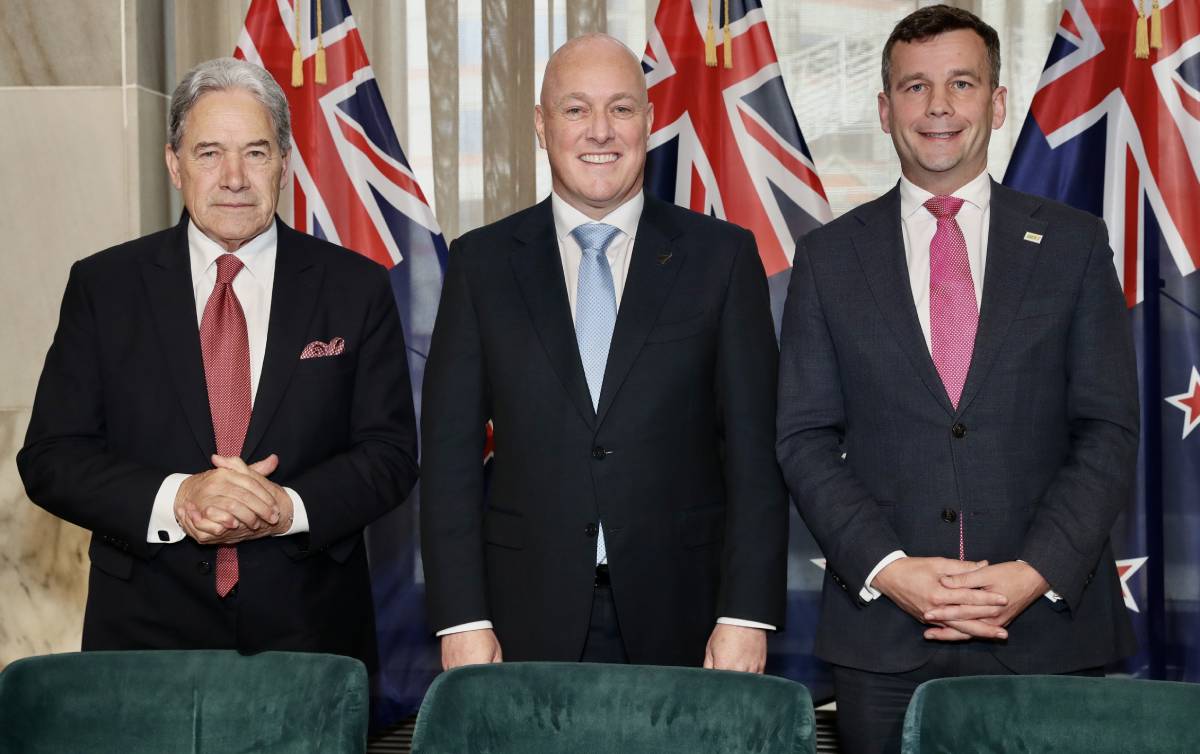
Seymour will become the Minister for Regulation.
Luxon has unveiled the Cabinet line-up. There are 20 Cabinet ministers - 14 from National, three from Act and three from NZ First.
In one high-profile coalition deal casualty, National has abandoned its policy to repeal the foreign buyers residential property ban - that is a significant win for Peters.
Hipkins reacts: Claims new Govt’s policies ‘will ultimately take New Zealanders backwards’
Outgoing Prime Minister Chris Hipkins has congratulated the new Government.
He said the caretaker Government would work with it to make sure the transition was smooth.
He called the policies agreed by the three parties a “very confused and contradictory and grab bag of commitments that will ultimately take New Zealanders backwards”.
Hipkins said the new Government was prioritising landlords over renters, the oil and gas industry over New Zealand’s international reputation, and also the tobacco lobby.
“We’ve also seen that even before they go into government, our predictions before the election that their tax cuts didn’t add up have, of course, proven true.
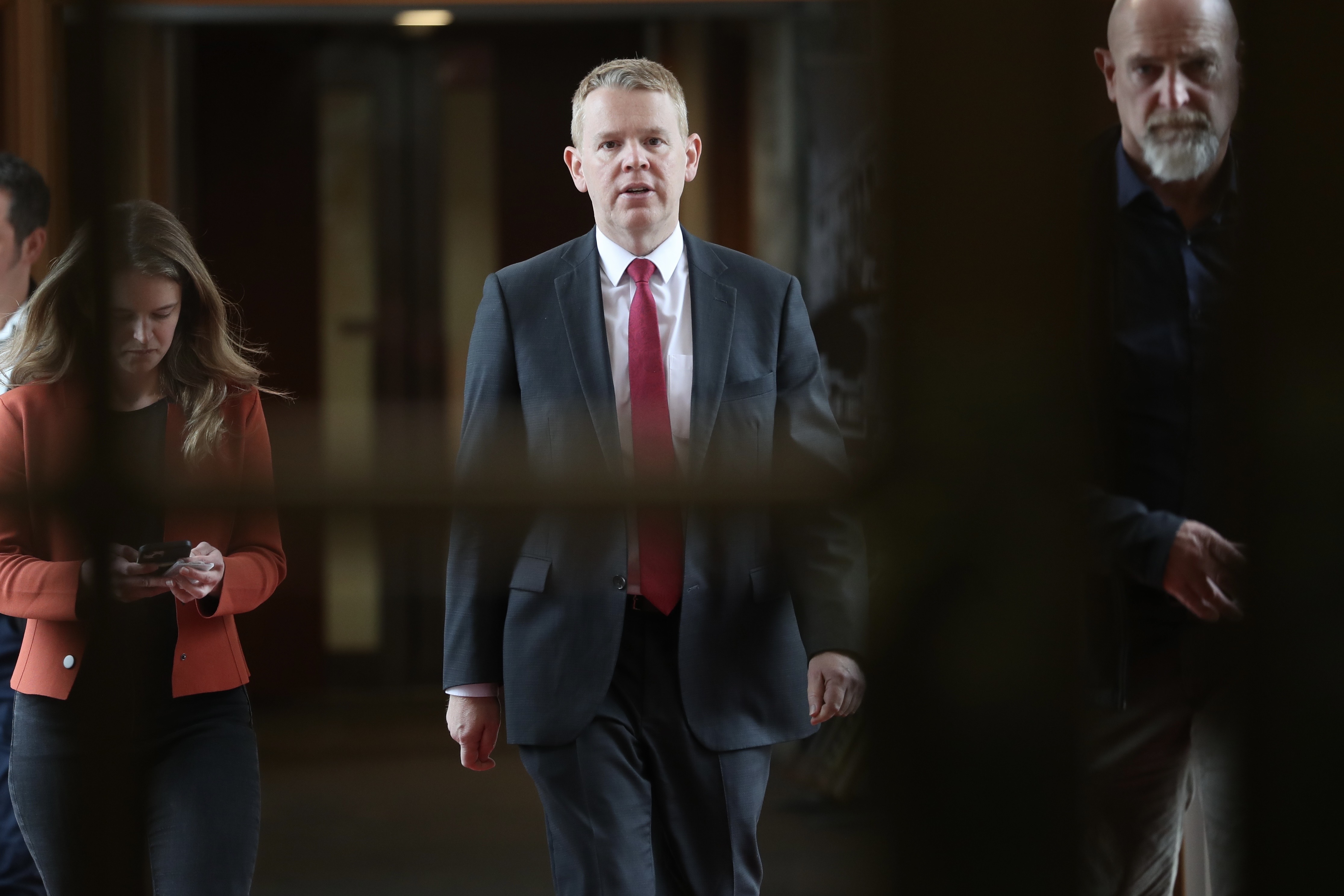
“By abandoning their plan to allow foreign buyers back into the market, which wasn’t going to add up anyway, they have revealed an at least $3 billion hole in their own tax plans.
“They’ve been completely silent about how they’re going to pay for that.”
Hipkins said he believed additional borrowing was likely so the new Government could fund its tax cuts.
“That means inflation will stay higher for longer, interest rates will stay higher for longer, and ultimately New Zealanders will pay more than they’re likely to benefit from the tax cuts the National Party is offering.”
Hipkins said he believed David Seymour and Winston Peters had been “running circles” around Christopher Luxon over the past few weeks.
He claimed we had seen the “seeds of some very divisive debates” from the new Government.
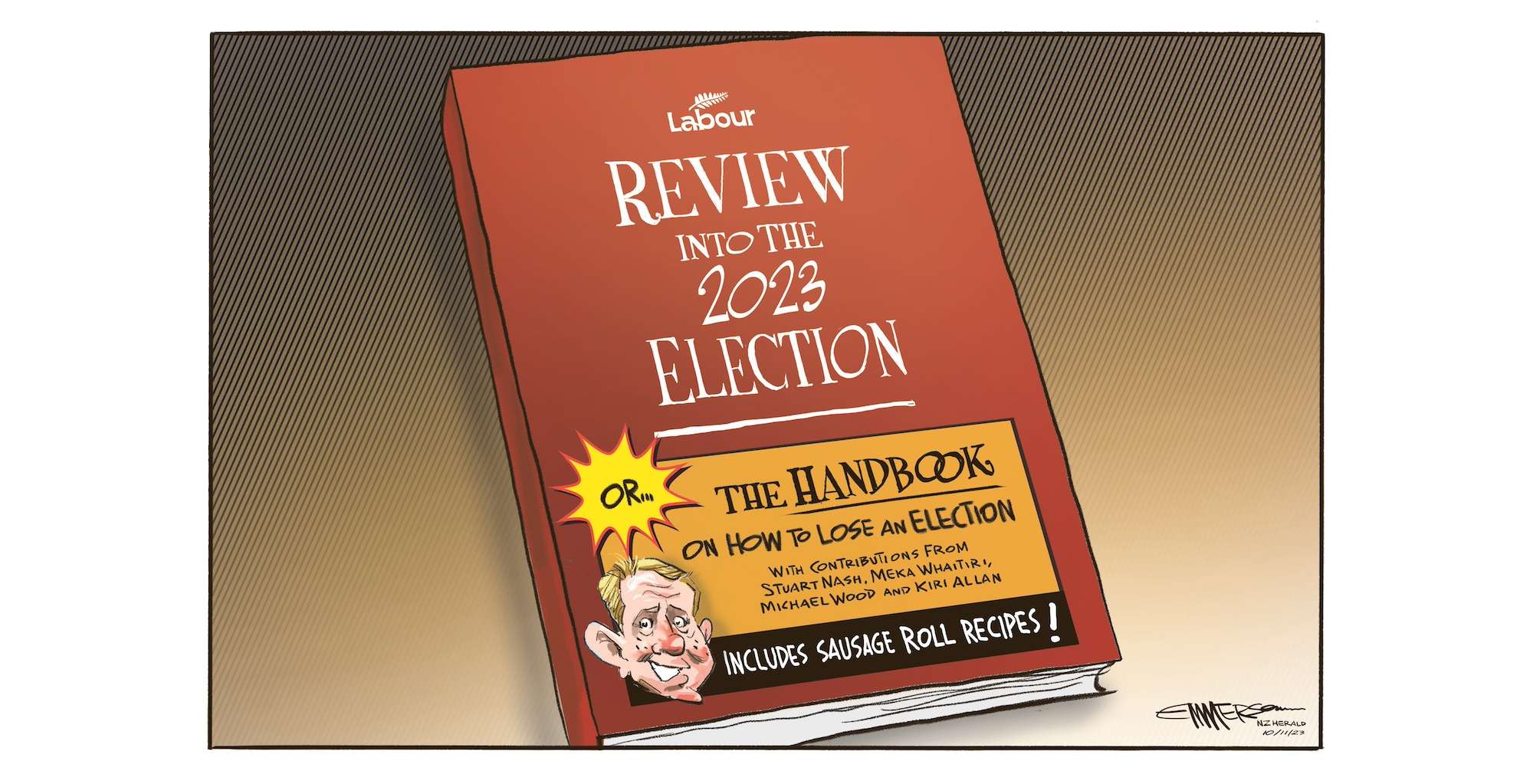
“This is definitely going to be a government that drives New Zealanders apart and lead to more polarisation of the country than we have seen to date,” he said.
“They already committed to very, very significant reductions in government department expenditure, and now they’re saying they think they can find more. At the same time, they’re also making commitments to spend more money as well.
“There is no plan. There’s a reason for that, over the last six weeks they’ve come up with a whole lot of commitments but have no idea how they’re going to pay for them.”
He said of tobacco changes: “Christopher Luxon and the National Party were attacking us for being too slow to do more around vaping.
“Now they seem to be dialling the clock backwards at a very rapid rate, deregulating more the vaping industry and committing to deregulating the tobacco industry. That’s not putting New Zealanders front and centre of the Government’s programme.”
Hipkins also said it was “interesting they’re proposing to abolish co-governance arrangements when they’re putting one in place for the deputy prime ministership”.
He said Labour’s role as the Opposition would be to hold the Government to account, to propose “better ideas” and to put itself in a position to win the next election.
“I’m very disappointed that, across the totality of agreements announced today, we’ve seen a real attack on workers. We’ve seen millionaires prioritised over workers,” Hipkins said.
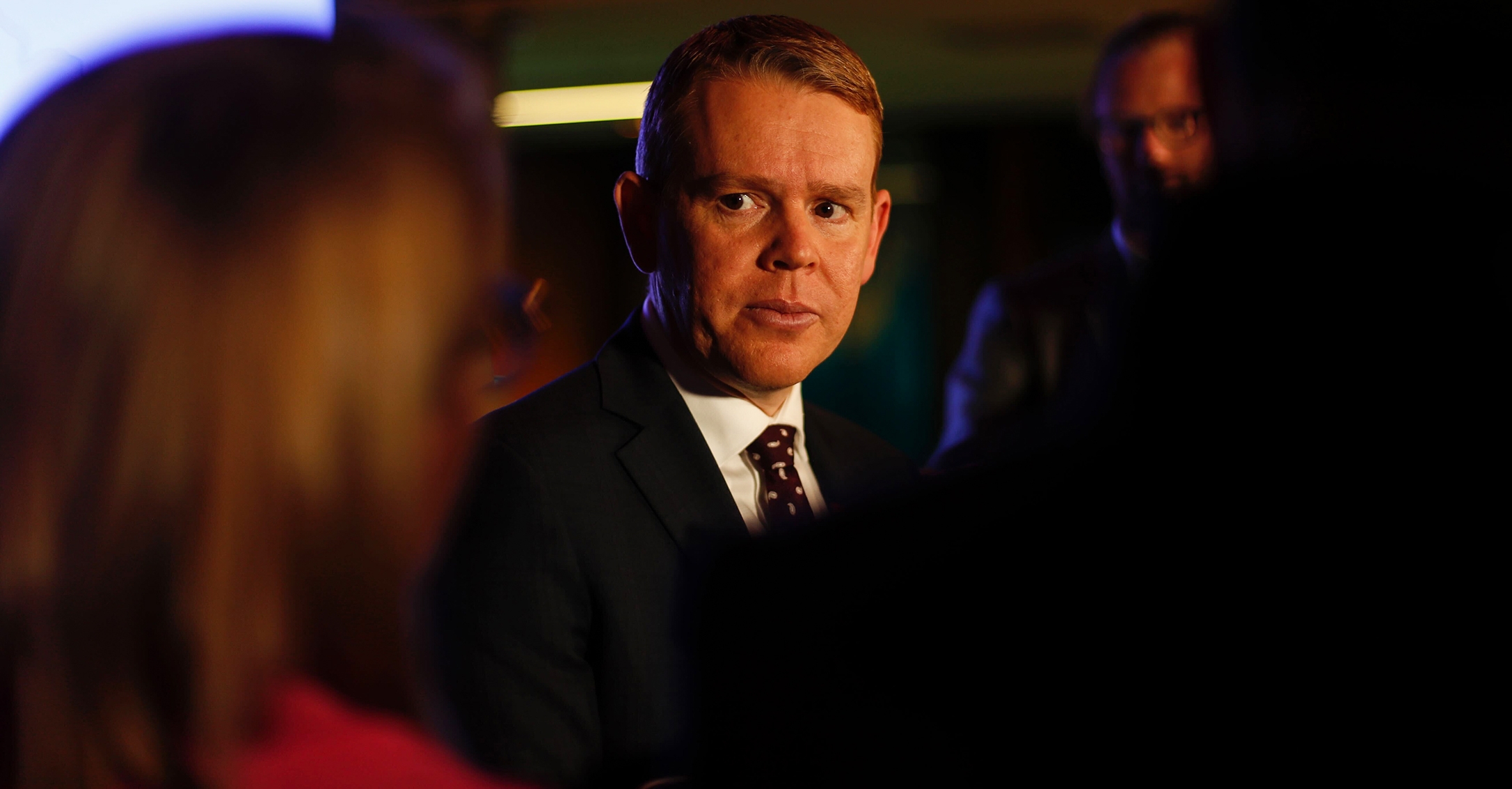
“Their plans to repeal a whole variety of provisions in our employment laws will ultimately help to drive wages down in New Zealand, leaving workers worse off.”
Hipkins added “that’s the nature of democracy”.
He said of coalition talks and the election result: ”I don’t think New Zealanders necessarily voted for all the commitments in all of the agreements we’ve seen today, though.”
He said parties would be switching offices around the parliamentary precinct over the weekend.
He said any “te reo Māori ban” would be a massive step backwards.
“We’ve been making progress on that. Other countries with an indigenous language have been taking steps towards better integrating that into everyday use, and I think that New Zealand going in the opposite direction is a step backwards.”
He added: “In terms of repealing the Treaty provisions in legislation, let’s see what that looks like, but I think there will be lots of unintended consequences. They’re turning their backs on four decades of jurisprudence.
“I think the ongoing attacks on Māori, that are very prevalent throughout the documents released today, will be a huge concern to Māoridom in general.”
Hipkins said he thought it was “a bit unusual” that the future Minister of Climate Change - a National MP - would be placed outside Cabinet.
He said the last Minister for Climate Change not being in his Cabinet was a reflection of the fact he was not in the Labour Party.
And he said of the Deputy PM situation: “Every parent knows when you take turns at something that’s a form of sharing.
“Whether Winston Peters ever gives it up, who knows?. He probably will.”
Seymour opens up on his party’s stance on Māori policies
Act Party leader David Seymour says whether the bill on Treaty principles made it off the ground would depend on him persuading New Zealanders it should.
Talking just an hour after Chris Hipkins’ criticism, Seymour provided further insight into what his party hopes to achieve and the battle they face.
“Our coalition partners ... are nervous that it’s going to create a lot of enmity and destruction - I don’t believe that’s true,” he told Newstalk ZB’s Heather du Plessis Allan.
“I think it’s a debate New Zealanders want to have, need to have, and are very capable of having.
“Once we get it [the bill] there, I think we’ll actually see some people change their minds, you know, the Treaty actually is worthy of debate.
“The principles have never been defined by anyone except the courts, the bureaucrats and the Waitangi Tribunal, instead of people at large who actually have to live in the country.”
Seymour said giving Act the opportunity to prove its case was all it needed right now: “If we can’t, then so be it”.
On Māori wards, Seymour said people should have a say on whether wards are formed in their councils.
“It could be done in line with the next council elections or earlier, but that’s a matter for the Minister of Local Government,” he said of a referendum on Māori wards.
“What Act has agreed with our partners in coalition is that we are going to make sure people have a say. If they want divide race-based wards, we won’t stand in their way.”
Seymour also took the chance to talk about the justice system, saying while he respected the courts’ independence, “we can send messages from the New Zealand public to the judges through legislation”.
“Changes we propose will be a shift in the principles of the Sentencing Act from what we have right now where it says the judge has to give the minimum possible sentence, instead they will have to give the minimum possible sentence with regard to public safety, which is already there, but also the victim.
“We want to send a message to judges that I think most New Zealanders want sent. We get the whole idea of being kind to the criminals and they’ll be kind back, but we don’t think it’s worked.”
Regarding the monitoring of ankle bracelets, Seymour said, “it had become clear, you know, look at the guy who shot some people in downtown Auckland six months ago, how somebody who was guilty of breaking a woman’s throat bones by strangling her could be on home detention - that’s the kind of case that triggers a review”.
On interest deductibility for landlords, Seymour said he had compromised with National and New Zealand First.
“We made the argument it should be done immediately, the National Party would like to do it over a much longer timeframe of several years. We have compromised that it would be done faster.”
On his relationship with Peters, Seymour said, “I know we can have a working relationship, which is what is important. We can work well, because we’ve achieved over the past four weeks or so a pretty big shift in our positions to form a coherent Government.
“I don’t really go to work to like people,” he said of his feelings towards Peters, “that’s why I’ve got friends and family.”
‘How can you have a waka on the road?’: Winston Peters on pending name changes
Incoming Deputy Prime Minister Winston Peters has wasted little time in taking aim at the rebranding of Government departments with Māori names.
“Can we agree that all communications is about comprehension and understanding?” he said while speaking to Newstalk ZB’s du Plessis Allan.
“It’s back to Health New Zealand,” he said of Te Whatu Ora Health New Zealand.
“We’ll get around to that,” he said of changing names. He wouldn’t be drawn on when.
“How can you have a waka on the road?” Peters said of Waka Kotahi NZTA going back to using an English name.
Peters also said he wanted a Covid-19 inquiry to begin “as soon as we can assemble it and get it ready to go. Ideally, we’d have it in 2024.”
,Peters said the current inquiry was not comprehensive.
“It’s already had one person leave the inquiry because of concerns about that. We want to know why you would limit the terms of reference.”
Peters couldn’t answer whether the current inquiry would continue alongside another.
Speaking on removing Treaty principles from current legislation, Peters said there was no requirement for them to be there in the first place, “so why would they be there?”
Peters said the “Treaty of Waitangi industry” was creating work for itself.
He said it wouldn’t be complicated to remove Treaty principles from legislation, “we live in a computerised age”.
Peters said building a highway around the Brynderwyns was the party’s number one priority.
He wouldn’t be drawn on when this would be done either.
Earlier: Seymour suggests Act trumps NZ First for ministerial roles
Seymour told media this morning he was confident his party has secured a favourable coalition deal - and suggested his party trumped NZ First in the ministerial stakes.
He wouldn’t directly answer questions about how many ministers Act had been given or how many spots the party had within Cabinet.
Seymour said he was unaware of what ministerial portfolios both National and NZ First had been allocated.
However, when pressed, Seymour admitted he thought Act’s presence in Cabinet was proportional to the election’s party vote. Act received 8.6 per cent of the party vote, while NZ First got 6.1 per cent.
What to expect in the first 100 days
On Thursday evwning a jubilant Luxon was evening giving nothing away about the deal National had struck, including who has been given the role of Deputy Prime Minister, which was one of the final sticking points in negotiations.
Luxon said “all of that will be revealed” today.
“I won’t get into any of that until the deal has been ratified by the respective parties,” he said, adding he was “100 per cent” confident the deals would be ratified by the parties’ respective boards. Act’s board had already been consulted on a deal as required under that party’s constitution. National’s board had signed off the deal as of late afternoon yesterday, leaving only NZ First.
Luxon promised to announce the shape of his Cabinet later on Friday, after briefing MPs.
He called the Governor-General Dame Cindy Kiro on Thursday to say he was on the verge of announcing the deal, and was set to call her again on Thursday night after the parties’ respective boards had ratified the deal. Kiro will look for public statements from the three parties that Luxon has the ability to form a government, which will be obvious by today.
Luxon said he wanted to have a swearing-in ceremony for ministers on Monday.
Rehearsals for the state opening of Parliament took place there yesterday. Luxon said he wanted Parliament open by December 5, allowing three weeks of sitting time before the House rises for Christmas.
Seymour told the Herald the Government would announce a 100-day plan shortly after the announcement of the coalition deal. Seymour hinted some of this would include repealing legislation, potentially under urgency.
“There may well be some things where the existence of legislation that we no longer want to exist and that is costing a large amount of money and therefore, it actually requires urgency to stop that waste.”
National had promised to repeal the Government’s RMA reforms by Christmas and revert to the old system. It also wants the Clean Car fee or “ute tax” gone by the end of the year.
Luxon defended the length of negotiations, the longest bar one since the advent of MMP in 1996, saying the deals were detailed enough to justify the length of time spent negotiating them.
“I’m really proud of the negotiations... When you see the deals... you will understand how comprehensive they are, we cover a tremendous amount of policy,” Luxon said.
“I’ll take as long as it takes, it’s been important for me to go through this in a really disciplined way.”
Derek Cheng is a senior journalist who started at the Herald in 2004. He has worked several stints in the press gallery and is a former deputy political editor.