Budget 2025: Christopher Luxon announces $164m for new 24/7 urgent care services
Prime Minister Christopher Luxon and Health Minister Simeon Brown announced a blitz of investment in urgent care across the country.
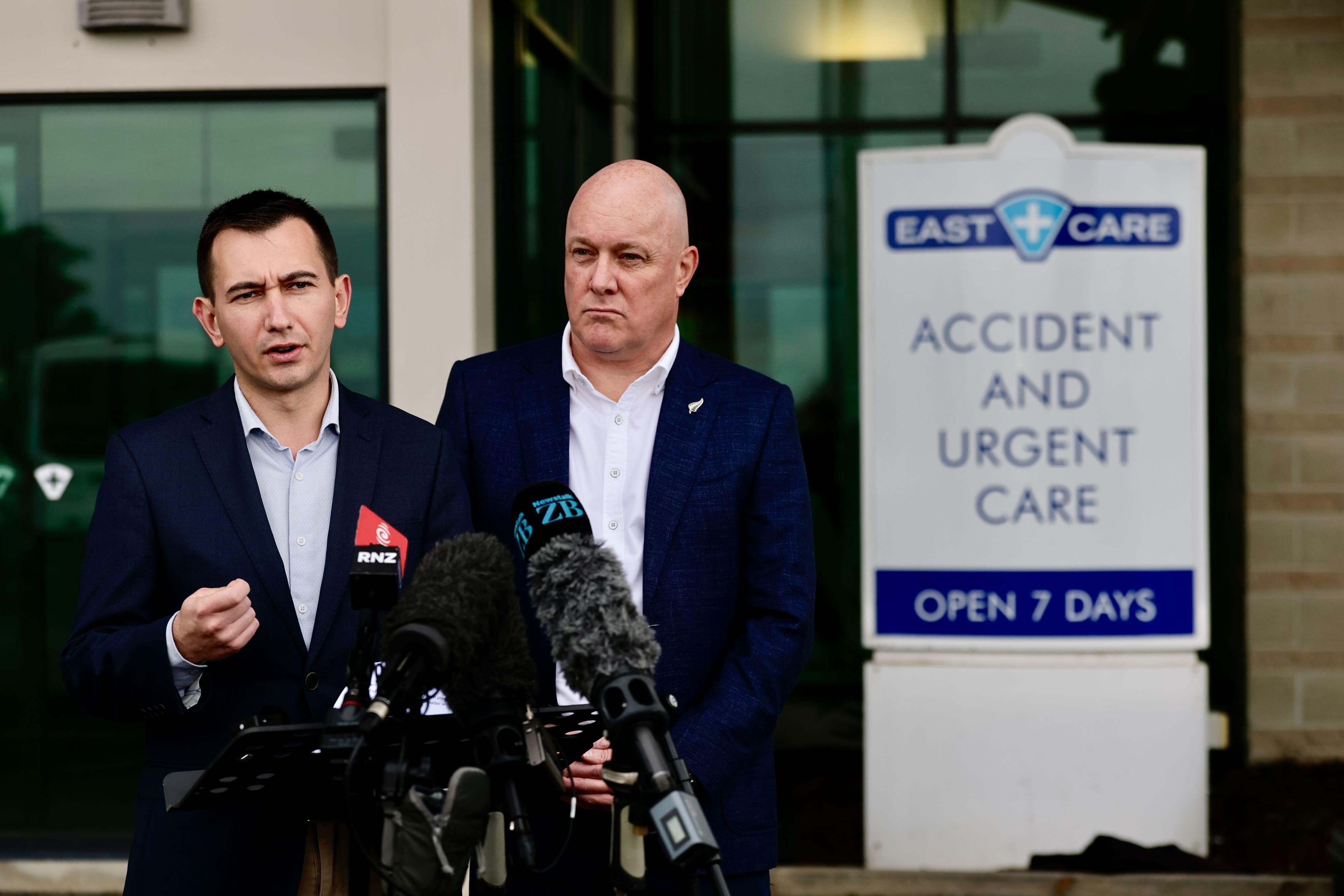
Speaking from Botany this afternoon, Luxon and Brown detailed new 24/7 urgent care services in Counties Manukau, Tauranga, Whangārei, Palmerston North and Dunedin, and new daytime urgent care services in Lower Hutt, Invercargill and Timaru – among other investments.
The Counties Manukau clinic will be the first cab off the rank, with a service likely to open before the end of the year.
Health New Zealand Te Whatu Ora had identified a number of areas that needed new clinics, which the Government would now fund.
Brown said Counties Manukau was the only part of Auckland that did not have a current 24/7 urgent care clinic. Brown said this would ease “pressure on the region’s already busy emergency departments, including Middlemore”.
He said about a third of patients who presented to hospitals had “acuity level 4 or 5″, which he said meant they could be treated in primary care.
Brown said the funding was in addition to the last Budget’s cost-pressure funding. In the last Budget, the Government announced it would be increasing the health Budget with a cumulative $16.68 billion over the next three Budgets to fund cost pressures. Additional pieces of that spend are dropped into the health system each Budget.
This Budget invests $164 million over the four-year forecast period into urgent and after-hours care nationwide.
“We’re investing in new and extended urgent care services across the Central region to ensure people can get the right care, at the right time, closer to home,” Brown said.
“These improvements will make it easier for New Zealanders to get help when they need it – whether late at night, on weekends or in more remote communities, while also reducing pressure on emergency departments,” he said.
Associate Health Minister Matt Doocey said the investments would improve healthcare for people living in rural and remote communities.
Kiwis living in rural and remote communities will benefit from a significant funding boost to urgent and after-hours healthcare services, Doocey said.
“Access to healthcare is one of the biggest concerns for people living in rural and remote communities.
“Our Government is committed to ensuring all New Zealanders can get the care they need, when they need it – no matter where they live. This investment will bring healthcare closer to home for more people,” he said, adding that the investment would mean “98% of Kiwis will be able to access [urgent and after-hours care] within one hour’s drive of their home”.
Where the investment will go:
Key Budget 2025 initiatives for the Northern region include:
Key Budget 2025 initiatives for the Midland region include:
Key Budget 2025 initiatives for the Central region include:
Key Budget 2025 initiatives for the South Island include:
Government defends pay equity overhaul, which might make pay equity for hospice and Plunket workers impossible
Luxon responded to allegations from Labour that women working in the funded sector were unlikely to get pay equity. The funded sector refers to services funded by the Government but delivered by someone else, often a private provider or a charity.
Labour had agreed to underwrite these pay equity settlements when it was in Government, accepting the funded sector could not pay for them itself.
Labour pointed to comments made by Workplace Relations Minister Brooke van Velden in Parliament last week, in which she said last year’s pay equity reset undertaken by Finance Minister Nicola Willis “suggested that the funded sector would not be funded by the Government for pay equity”.
Labour’s workplace relations spokeswoman Jan Tinetti accused the Government of “stringing women along for months before the law change two weeks ago”, saying without Government support, “pay equity in these sectors is unlikely to happen”.
Luxon said that under the new regime, people would be entitled to take a claim against their employer whether they worked in the public or private sector.
“We expect there will be pay equity claims, that’s why we’ve set money aside for that,” Luxon said.
Luxon said the Government would look at funded sector claims on a “case-by-case” basis.
“Obviously, the Government and government agencies that are supporting the funded sector, they’ll look at funding that through budget bids in the future,” Luxon said.
“There are obviously some organisations that the Government funds a large proportion of the funding and there are others that we fund a relatively small contribution. Anyone in the funded sector, or anyone in any sector, public or private, can make a pay equity claim under the new laws.
“We expect, sadly, there to be settlements that are needed. The Government will look at the funded sector on a case-by-case basis,” he said.