Government and council to ‘take back control’ of Auckland Transport’s policy functions – Transport Minister Simeon Brown and Mayor Wayne Brown
Transport Minister Simeon Brown and Auckland Mayor Wayne Brown have announced a major shake-up to the transport policy decision-making powers for the region.
The Council-Controlled Organisation (CCO) of Auckland Transport (AT) will be turned into a service delivery agency by transferring strategy, policy and planning functions to the control of Auckland Council, under new Government reforms.
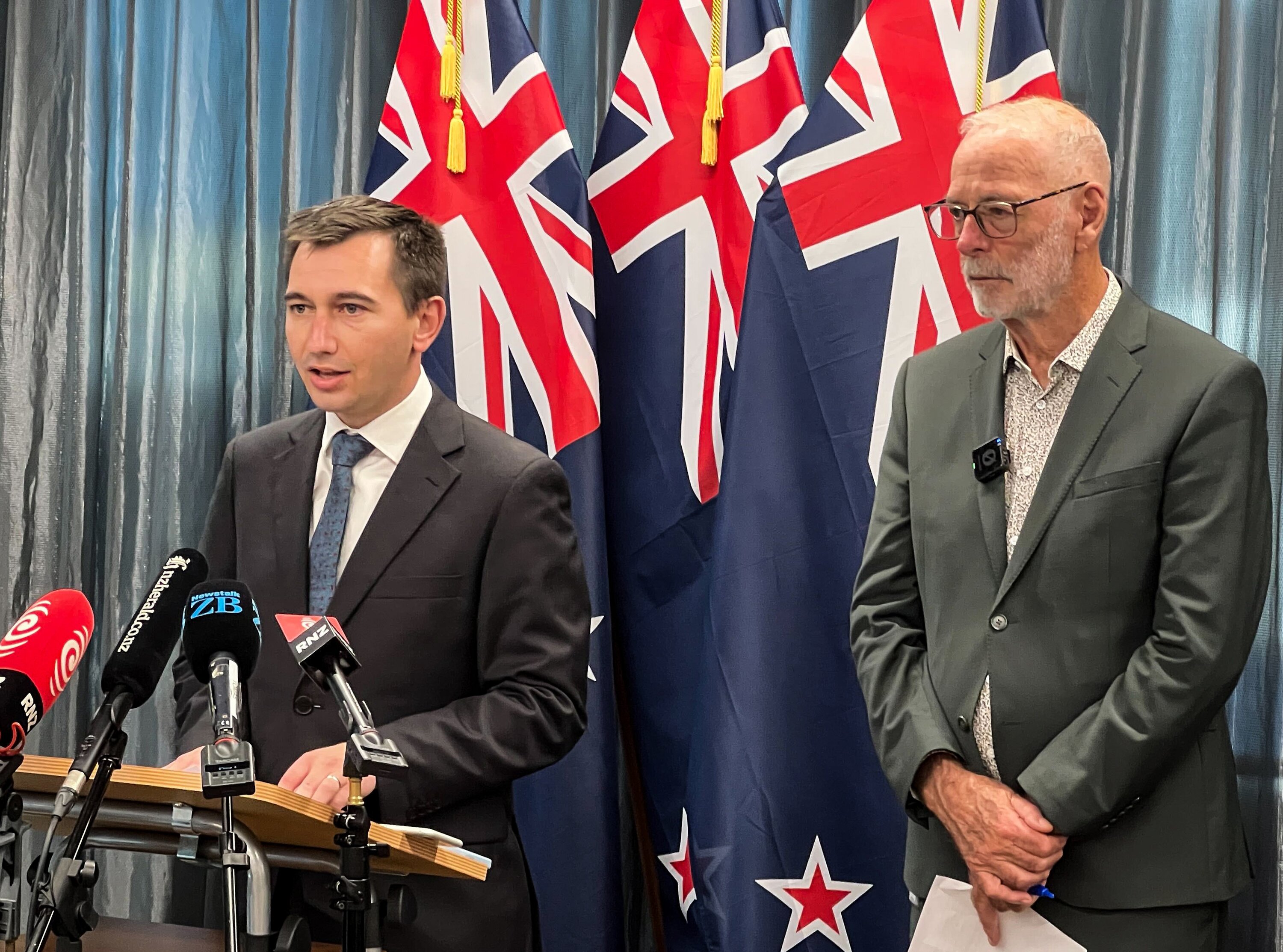
Simeon Brown, who is also the Minister for Auckland, announced the changes at a joint media conference in the central city at 3.30pm today.
Brown said the Government was “restoring democratic accountability” to transport decision-making in Auckland, ensuring voters could hold their elected representatives responsible for the city’s transport policies.
“Aucklanders have become increasingly frustrated with how transport decisions are made and how little their views are taken into account,” the minister said.
“Even Auckland Transport’s recent Annual Report highlighted that only 29% of Aucklanders feel the organisation listens and responds to their needs.”
Simeon Brown said significant reforms would be implemented by the Government to restore democratic decision-making for transport outcomes in Auckland.
Brown said transport policy and planning functions would move from AT back to Auckland Council, aligning with how other regional councils operate across New Zealand.
He said a new Auckland Regional Transport Committee would also be established and it would develop a 30-year Integrated Transport Plan for Auckland – to be agreed upon by both Cabinet and Auckland Council – that will ensure long-term strategic alignment between local and central government.
Auckland Council would also be designated as the road controlling authority and decision-making would be shared between the governing body and local boards.
“The existing transport governance model in Auckland is falling short of meeting the expectations of the Government, Auckland Council, and, most importantly, Aucklanders themselves,” Simeon Brown said.
“By returning decision-making power to elected representatives, we are enabling Aucklanders to directly influence the transport policies that affect their daily lives.
“Under these reforms, Auckland elected representatives will be responsible for key transport decisions such as approving the Regional Land Transport Plan, and the Regional Public Transport Plan.
“If Aucklanders feel the transport system isn’t working for them, or disagree with decisions made by their elected members, they can vote them out at the ballot box.”
Brown added the Government would devolve specific transport functions to Local Boards, giving communities more say over transport issues such as parking policies, setting of speed limits and approval of interventions on the roads, such as cycleways and pedestrian crossings.
“This change ensures that transport policies have democratic legitimacy and democratic accountability –something that has been sorely lacking.”
Scott Palmer
These live updates are now over.
Auckland Transport to be 'surgically changed'
Scott Palmer
"What we're taking away is the issues around policy, planning and strategy and that's where I think many of those decisions have been frustrating Aucklanders where they see an agency not reflecting their views," the minister said.
"By providing those decisions to elected members to make those decisions, Aucklanders will be able to hold their elected members to account to ensure they're reflecting the views of Aucklanders."
The minister said Auckland Transport would continue under this deal, but it would be "surgically changed" and "significant parts" of it would be changed.
"It will have a very clear mandate provided by the governing body, which will determine what its specific functions are that it will deliver upon."
Decision-making a key point
Scott Palmer
Simeon Brown said the issue was Auckland Transport makes decisions for the city and local communities were unable to make these decisions in their communities.
The minister said at the moment, Auckland Transport is the road controlling authority, so anything that happens on the road corridor, those decisions have to be made by Auckland Transport.
"Local boards can advocate for things, ask for things [but] they're not the decision making body."
Wayne Brown 'fulfilling that promise'
Scott Palmer
Auckland Mayor Wayne Brown said Auckland had elected him to take back control of Auckland Transport.
"And I'm fulfilling that promise with a good deal of help from the coalition and minister Brown."
The mayor said the changes would restore local democracy to Auckland by removing AT's independence and giving control to elected members.
"The existing model is broken," he said.
The mayor acknowledged hard-working bus drivers, and train and ferry crews who had been let down by the system too.
Asked how mayor Brown felt after campaigning on this issue, he said he was "quite satisfied", but there was a long way to go.
Elected representatives to be responsible
Scott Palmer
Minister Brown said under these reforms, Auckland's elected representatives would be responsible for key transport decisions, such as the regional land transport plan and the regional public transport plan.
He said Aucklanders could now hold decision makers accountable "at the ballot box".
Brown said the establishment of the Auckland regional transport committee would further enhance "strategic planning".
"The committee will develop a 30-year integrated transport plan considering the city's needs across roads, rail, public transport and freight."
Govt announces transport shakeup
Scott Palmer
Brown said first, the Government would return regional transport policy and planning to Auckland Council, meaning functions would move from Auckland Transport to the council.
He said a new Auckland regional transport committee would also be established.
Auckland Council would also be designated as the road controlling authority.
"Decision-making will be shared between the governing body and local boards, giving power to local communities," Brown said.
Fourth, he said, the Government would empower Auckland Council to have control over its transport council-controlled organisation.
"The existing transport governance model in Auckland is falling short of meeting the expectations of the Government, Auckland Council and Aucklanders themselves."
Govt takes action over Auckland transport
Scott Palmer
Speaking to media in Auckland, Transport Minister Simeon Brown said the Government was taking decisive action to restore "democratic accountability" to transport decision-making in Auckland.
The minister said he recognised how frequently Aucklanders got frustrated at decision-making about public transport.
"To address these concerns the Government will implement significant reforms to ensure that transport policies in Auckland reflect the needs and wishes of its residents."
Simeon Brown, Wayne Brown hold standup
Scott Palmer
Simeon Brown and Wayne Brown are holding a stand-up in Auckland.
The Transport Minister and Auckland Mayor are set to make a major transport announcement.
The Herald will be livestreaming the event at 3.30pm.
Wayne Brown said Aucklanders had elected him to take back control of AT.
“And I’m fulfilling that promise with a good deal of help from the coalition and minister Brown.
“This is the fundamental reset I have long advocated for. We can now begin transitioning AT to a CCO focused on delivering better transport for Aucklanders,” the mayor said.
The pair are working closely on several transport issues for the city, including time-of-using charging, or congestion charges, on busy motorways; the future governance of Auckland Transport, and ensuring the $5.5 billion City Rail link is delivered on budget and on time.
Wayne Brown’s plans for Auckland Transport
The mayor promised to reform AT as part of an election promise to “take back control of council organisations”.
In August, Brown said he wanted to “dethrone” AT by stripping its mostly unelected board members of powers and putting elected representatives in full control.
“The layers of bureaucracy and management within AT are totally impenetrable to elected politicians. We ask for information and don’t get it. We tell AT through the letter of expectations what they should do, and they often don’t do it. They have made some progress on a few things, but there is no sense of urgency.
“The only real power we have is to change the board. But we’ve tried that. It’s not effective because the culture of independence is so deeply embedded,” he said.
As part of next year’s budget, he has put forward three options for AT.
The mayor’s preference is to strip AT of its planning, strategy and policy roles.
The CCO reforms will be discussed at an extraordinary budget committee tomorrow.
How has AT responded?
At the time Wayne Brown flagged plans to “dethrone” AT in August, the AT board rejected the council’s idea of elected representatives setting the strategic direction and funding allocations for transport.
Instead, the board suggested an alternative Transport for Auckland Agency made up of AT, NZ Transport Agency Waka Kotahi and KiwiRail to plan and deliver the city’s transport system governed by a Government- and council-appointed board.
Background documents on the mayor’s latest plans for AT show chief executive Dean Kimpton agreed there was room for change, but not along the “full reset” proposed by the mayor to bring all transport policy, strategy and planning functions back to the council.
Kimpton agreed the council should have a statutory role in long-term planning for transport in Auckland.
But he said AT was established as a statutory body to ensure long-term infrastructure investment strategies and plans were not disrupted by regular changes in the political landscape, including Auckland Council.
“Long-term infrastructure investment requires certainty beyond the political cycle, which is somewhat ‘protected’ by AT’s arm’s-length status,” he said.
Short-to-medium strategy should remain with AT to avoid an “operational disconnect” between planning, funding and delivery, he said.
Simeon Brown’s role in the reforms
The Minister of Transport and Minister of Auckland was given Cabinet approval to engage with Brown to ensure stronger democratic accountability over AT and decisions on transport outcomes in Auckland.
The two leaders have held several meetings about potential reforms to make AT more responsive to the needs and views of Aucklanders.
“We both recognise that Auckland Transport needs reform and share concerns that its decision-making has not adequately reflected Aucklanders’ views or responded effectively to their needs for moving efficiently around our city,” the minister told the Herald last month.
The minister said 14 years after the Super City was created, it is time to assess whether the transport governance structure remains fit for purpose for Auckland’s unique challenges and growth.
Sign up to The Daily H, a free newsletter curated by our editors and delivered straight to your inbox every weekday.