$271b wiped from Auckland and Wellington house values since market peak
Auckland and Wellington home owners have had more than a quarter of a trillion dollars wiped off their theoretical or paper wealth, as residential property values plummeted.
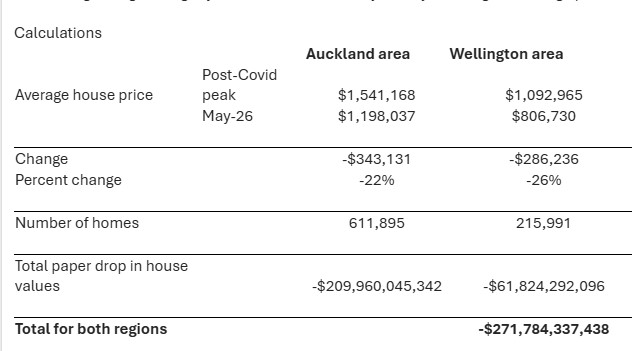
Satish Ranchhod, a Westpac senior economist, calculated $271 billion as the reduced value after being asked how much had been lost on home valuations in the two cities.
That figure is not an actual loss of physical money but a reduction in capital.
The $271b is calculated as the difference in the collective value of all the homes in the two cities since the peak of the market about four-and-a-half years ago to May, based on Quotable Value (QV) figures.
Ranchhod calculated a home valuation or paper loss for Aucklanders of $209.9b in the value of their homes in the last four-and-a-half years.
Wellingtonians have lost $61.8b off the value of their homes since the peak, variously calculated as being from late 2021 to early 2022.
The wealth effect, where properties rose in value from around 2000, ended then.
The softness in house prices has had important economic impacts on many New Zealanders’ finances, Ranchhod said.
The wealth effect meant many home owners behaved differently than they do now.
They borrowed more against rising capital values as well as spending more because they felt richer due to valuations rising.
Household debt and consumption are linked to the wealth effect.
Ranchhod said those who bought about five years ago could be hardest hit.
“In terms of the economic impacts, many of those who bought between 2021 and late 2022 will have seen the paper value of their property fall, and in some cases, purchasers will be dealing with a significant drop in the value of their assets,” he said.
The weakness in house price growth has had other effects, even for those who bought in the past couple of years when prices have been steady.
Historically, price rises and capital gains have allowed owner-occupiers to sell their existing property and move to a nicer or larger one, which is important for a lot of families, as they’ll often start in a smaller home, then move to a larger one as they have children.
“But with limited growth in prices the past couple of years, owner-occupiers are waiting longer to move. Lending to this group has been slower to recover than lending to other types of buyers,” Ranchhod said.
“However, the swings in the property market have very different effects on different groups, so I’d be cautious about calling this a ‘poverty effect’.”
For those who bought pre-2020, even if the value fell from the 2021 peak, it’s likely that it is up on the purchase price.
“In some cases, it could be substantially higher. For instance, if you purchased your home in 2019, average prices are around 15% higher in Auckland and 20% higher in Wellington,” Ranchhod said.
The flip side of the $271b loss is that first-home buyers are finding it easier.

“If you’re looking to get into the property market, it’s a lot more affordable now than it’s been for a long time. And consistent with that, we’ve seen solid levels of first home buyers,” Ranchhod noted.
QV this month released data which found Auckland’s average home value in the May quarter was $1,198,037.
That is 22.3% below its previous peak of $1,517,000 in the post-Covid era boom.
Wellington average home values in this latest May quarter were $910,286.
That is 27.6% below its previous peak, which was $1.09m average value per Wellington residence.
Census 2023 tells us Auckland had 611,895 homes. Based on the QV home valuations, at the peak of the market, those homes had a collective value of more than $900b.
Census 2023 says Wellington has 215,991 homes, which, based on the QV data, were worth a collective total of $268b at market peak.
Overall, Auckland’s 611,895 homes have declined in value by $201b since the peak of the market.
Wellington’s 215,991 homes have declined in value collectively by $70b.
Together, the total decline in house values based on these calculations is $273.1b.
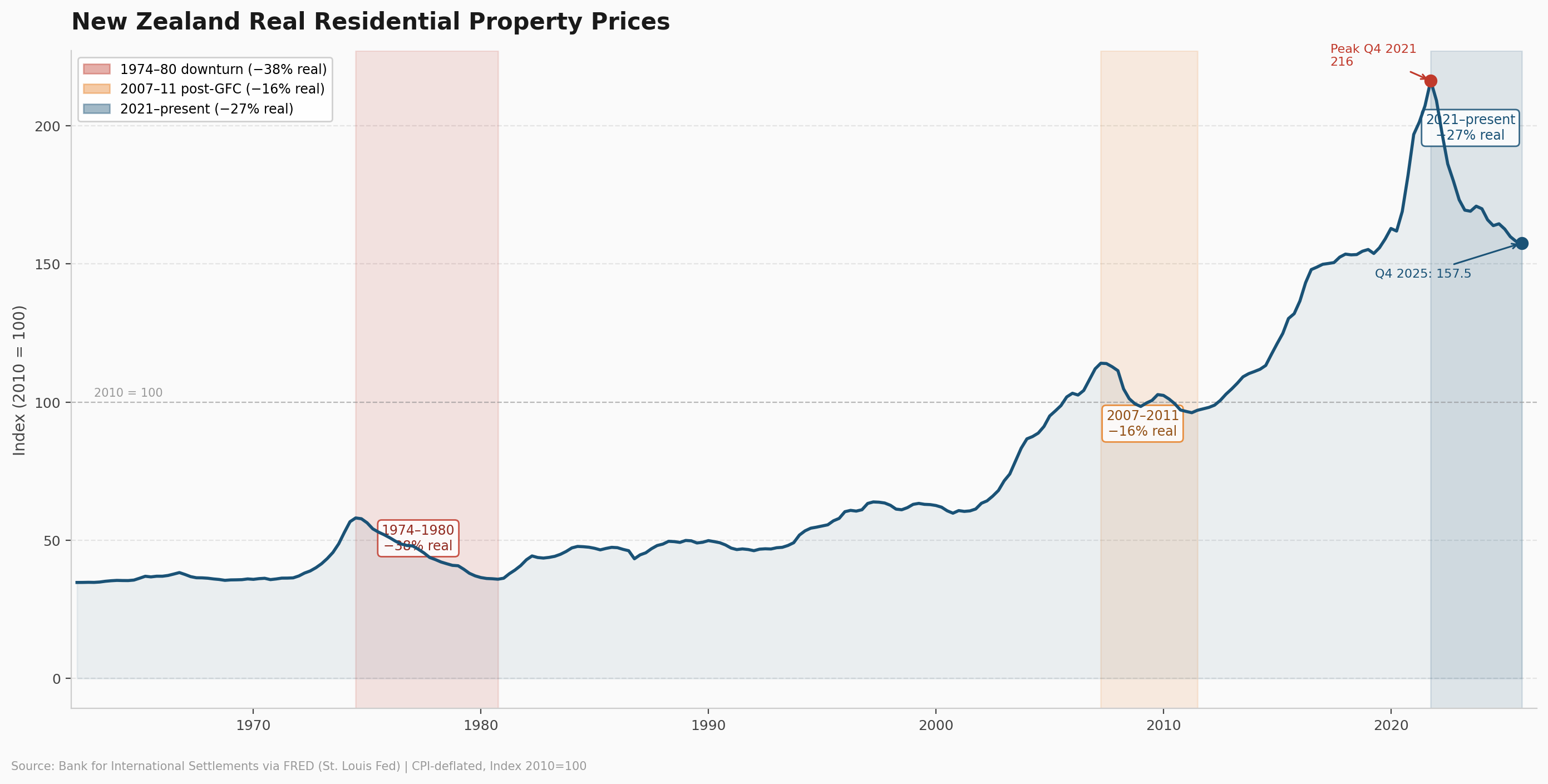
Liam Dann wrote on June 10 in his Inside Economics column that New Zealand’s current property downturn was already one of the deepest in our modern history.
The slump was also on its way to being the longest.
We’re four-and-a-half years into the slump.
The longest in records dating back to 1962 was five years, peak to trough, between 1975 and 1980.
For the falls in real or inflation-adjusted terms, Auckland and Wellington are now down 35.5% and 40% respectively.
Anne Gibson has been the Herald’s property editor for 26 years, written books and covered property extensively here and overseas.