Weak rental market to persist with low migration and slowing wage growth
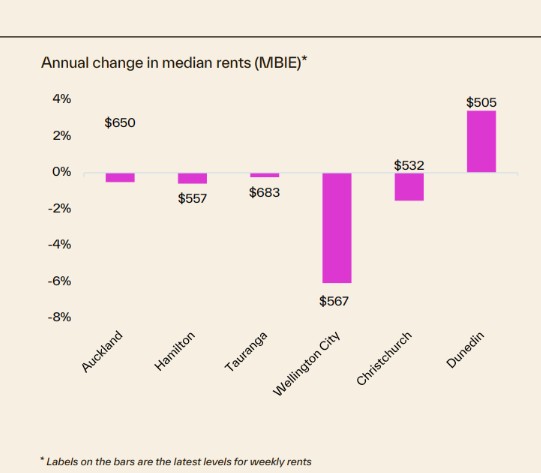
Falling rents are not forecast to reverse any time soon due to subdued migration, with Auckland rents down 0.5% annually.
“It’s difficult to see a strong return to growth in the near term,” the October update from insights business CoreLogic NZ, trading as Cotality, said.
Auckland rents have been in negative growth territory for the last 12 months and are now sitting at a median of $650/week, according to Cotality’s table.
Hamilton rents fell 0.6% to a median $557/week.
Wellington had the sharpest decline, falling 6.1% to a median $567/week.
Tauranga rents fell 0.2% to $683/week and Christchurch was down 1.5% to $532/week.
Dunedin is the only place in New Zealand where rents rose: up 3.4% to a median $505/week.
“Conditions remain subdued, with net migration having fallen a long way from its peak and the stock of available rental listings on the market still elevated,” Cotality’s commentary said.
“There’s also another constraint on rental growth, given that their level is already high in relation to households’ incomes: wage growth is slowing too.”
That weakness was clearly illustrated in the Ministry of Business, Innovation and Employment (MBIE) bonds data.
The median national rent in the three months to August fell 1.1% annually.
That was one of the first declines since late 2009.
Nationally, how much are rents down?
Cotality also presented a national chart on falling rental prices.
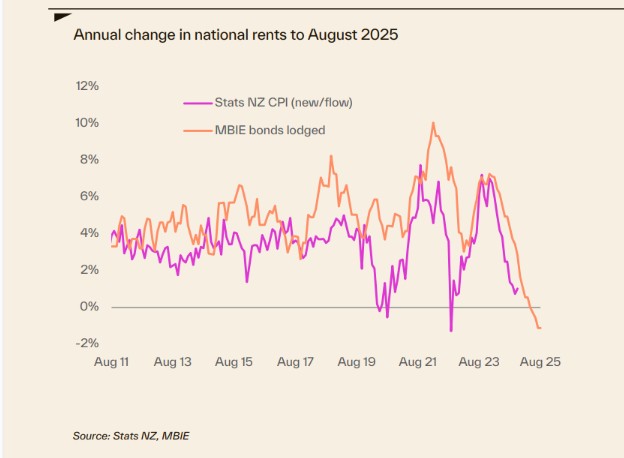
The graphic above compares the Consumers Price Index with rental prices and again shows a big drop lately.
Cotality chief property economist Kelvin Davidson said the rental scene was unusual lately.
“This is an incredibly weak period for rents. This doesn’t happen that often. To have rents this weak, you’d have to go back to the GFC, around 2009,” Davidson said.
Rents have previously risen considerably, but they have now tailed off, he said. The near-term chances for a continuation of the low rents would depend on when migration changed.
Although net migration was still positive, it was not rising as much as it had been.

The near-term was not defined, he said, “but rents are not going to change a lot soon.
“Net migration could turn on a dime but the economy is taking time to turn around. It will take a while for our labour market to look attractive to new migrants,” Davidson said.
How bad are migration numbers?
Last month, Liam Dann reported how New Zealand’s annual net migration rate had fallen again.
At just 10,600 for the year to August 2025, the net number of additional migrants in the country appears to be a reversal from a return to growth in the year to July.
The August 2025 year provisionally saw two annual records for New Zealand citizens, Stats NZ said.
There were 73,900 migrant departures, exceeding the previous record of 73,300 in the July 2025 year.

Davidson said new data for September will be released by the MBIE within the next week or two but he doesn’t expect any big changes.
“Rents could be sliding lower, which will be a continuation of what we’ve seen lately.”
It was too black-and-white a view to say it was a good time to be a tenant and a bad one to be a landlord, Davidson said.
“Remember, it’s still expensive to rent, it’s just that prices are not going up as quickly. It’s a better time to be a tenant, but rents are not massively falling, except in Wellington. Tenants will either secure a better property at the same rent or get a reduced rent for the same property in Wellington.”
Davidson said it was important to know that the data presented were only for new rental properties. They didn’t capture renewals of leases in existing rentals.

Cotality says New Zealand has 1.7 million dwellings. Home ownership is at 66%, meaning 34% of properties are rented, which Davidson said equates to about 570,000 dwellings.
Those residences are occupied by well over one million tenants, Davidson said.
Tenant lobby group boss remains unhappy
Renters United president Luke Somervell said people continued to leave New Zealand.

“But it’s good to hear that rents are falling. Always happy to see that, but it’s not a renters’ bonanza. Rents may be slightly cheaper but tenants are still living in the same decaying housing stock,” Somervell said.
“More people are leaving the country, so there are more rooms up for rent but this is only temporary, and we’re not seeing a major structural change.”

Somervell decried the coalition Government’s reversal of no-cause evictions, which means landlords can “evict at will”.
The market for tenants remained unfair, whereas other sectors like food and employment showed more respect to consumers and employees.
“It’s an embarrassment for us as a country,” Somervell said of the rental market.
“We’re told renting sucks, but save up and you’ll be able to afford a home,” he said.
How many properties for rent?
One online website today showed New Zealand had 13,200 rental listings nationally.
Of those, 6299 were for Auckland rental properties.
The most expensive at $8000/week is for the waterfront property 28 Blomfield Spa in Takapuna: a five-bedroom home with three toilets and garaging for five cars.
Now, rental supply is fast expanding
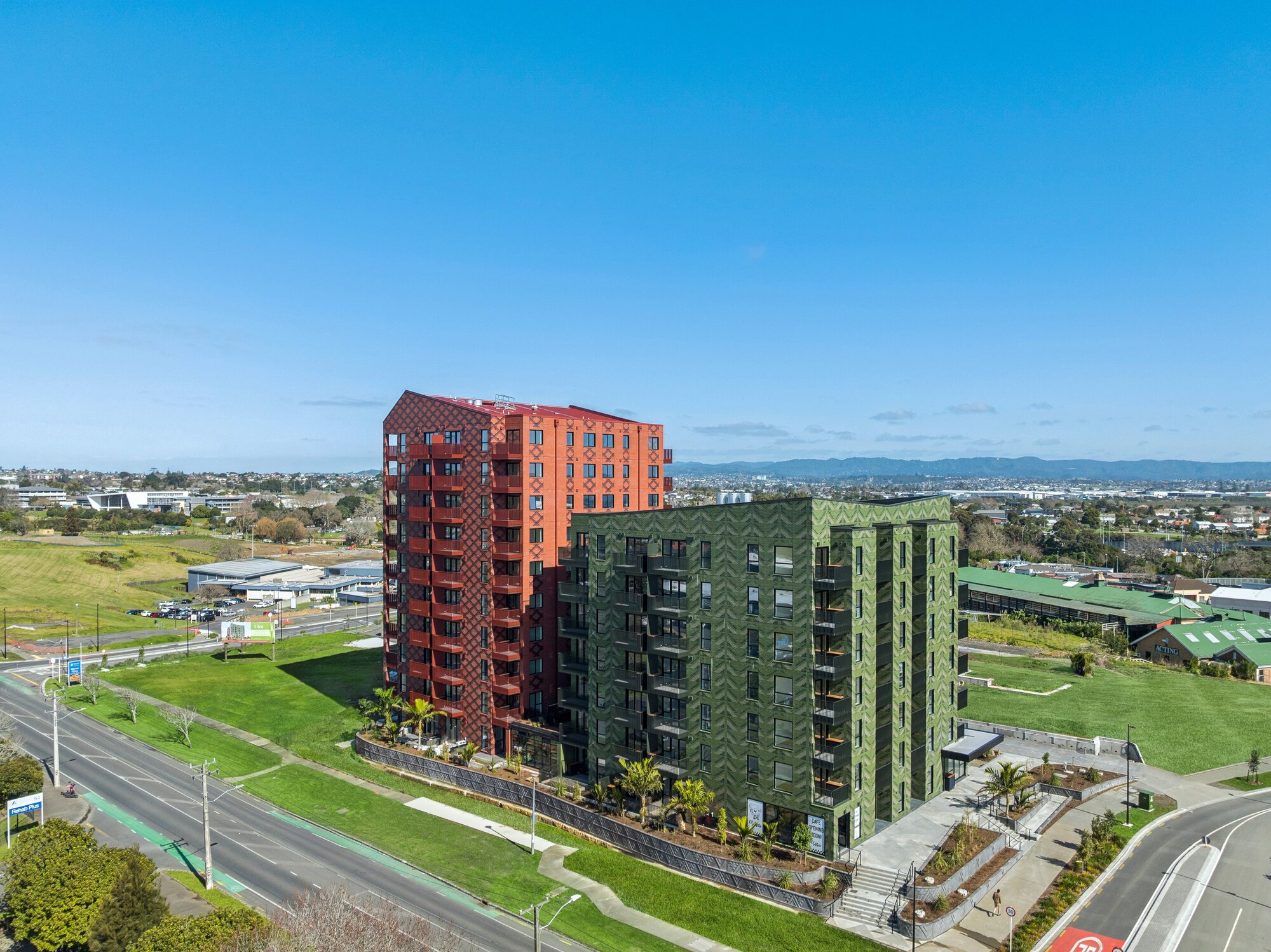
Apartment specialist Ockham Residential has sold some new apartments at Pt Chevalier’s Toi building.
But it decided to rent all units in the neighbouring, larger Whetū block.
The photo above shows the orange or red-colour Toi and the neighbouring green Whetū.
In September, Housing Minister Chris Bishop cut the ribbon beside Auckland Mayor Wayne Brown at the 65-unit Toi block on ex-Unitec land opposite the historic Carrington Hospital and near the Mason Clinic.

Falling rents come at the same time that Simplicity Living has become New Zealand’s largest rental property developer, working solely in Auckland but soon to expand to Queenstown.
Simplicity Living’s new build-to-rent projects
Anne Gibson has been the Herald‘s property editor for 25 years, written books and covered property extensively here and overseas.