All Blacks v Springboks: How contrasting cultures shape rugby rivalry – Gregor Paul
THE FACTS
The biggest theme underpinning the rivalry between the All Blacks and the Springboks is their stylistic, physical and strategic differences.
They play the game with the same singular aim of winning, but with vastly different approaches in the methods they employ, the athletes they build and the skillsets they develop.
The contrast is fundamental to the theatre – it creates a natural tension, a wider narrative of national character traits being reflected.
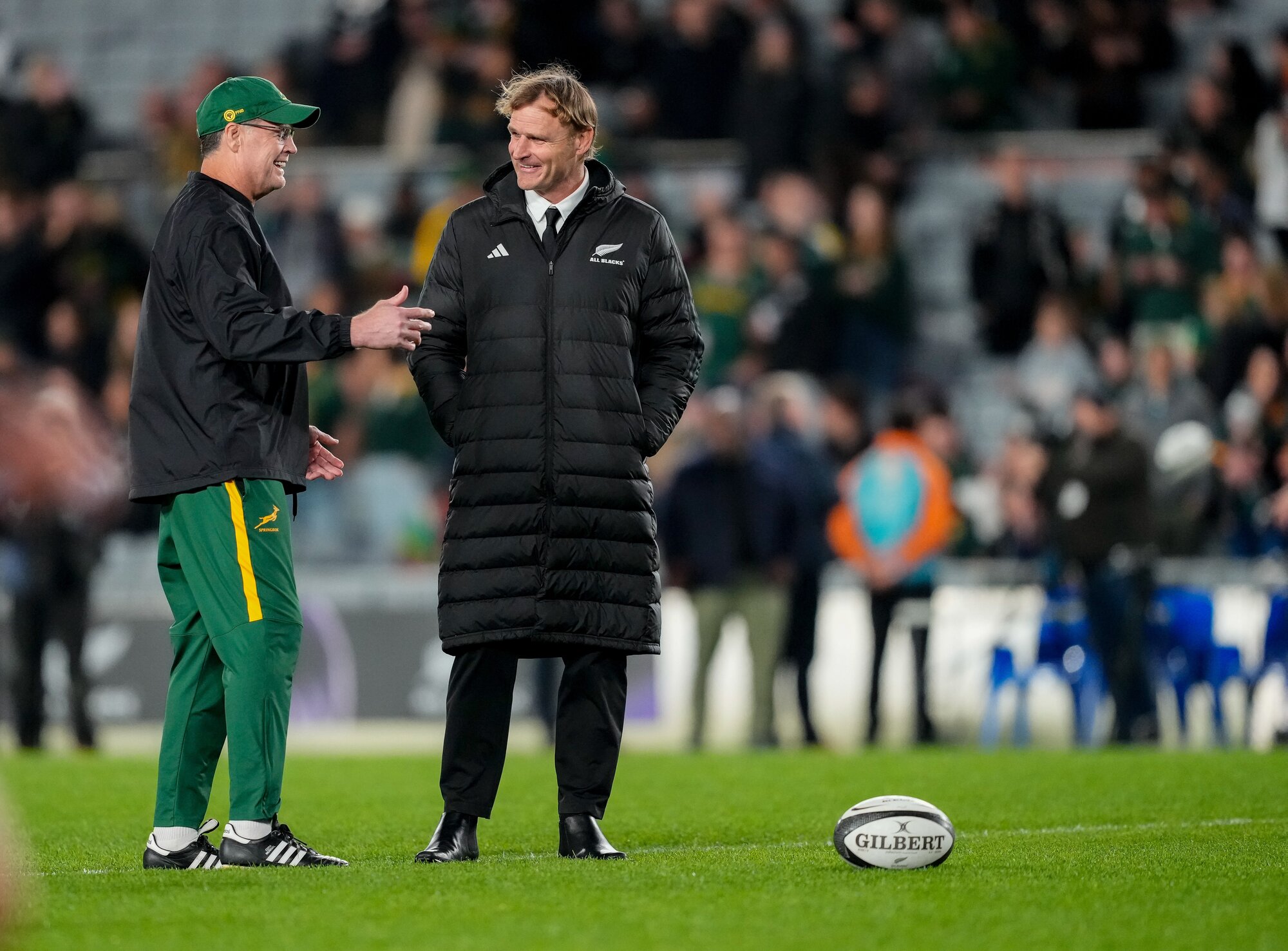
But what’s become just as apparent in recent weeks is how different these two nations are culturally and how their respective public countenance of player and team performance sits at opposite ends of the spectrum.
The All Blacks pride themselves on their ruthless, high-performance culture where standards are mercilessly protected and non-compliance is not tolerated.
But we have to take their word for that, because publicly there is only limited evidence of the ruthless streak that they say pervades their camp.

The language of the All Blacks is protective – bland, vague and shrouded in euphemisms. It’s also never personal and it is never shaming.
Presumably, the All Blacks are more direct with one another behind closed doors and the coaches more pointed and critical in their feedback, because publicly their messaging is non-committal and difficult to decipher.
Take, as a prime example, the decision to drop Sevu Reece for last week’s test at Eden Park, after the veteran wing battled under the high ball in the previous test in Buenos Aires.
After the test in Argentina, New Zealand coach Scott Robertson would only commit to saying: “Test footy is tough when you get three yellow cards and the aerial game they dominated.
“There’s lots of little areas I could talk about but that’s fundamentally how they got the domination of the game.”
A week later, when he unveiled his team to play South Africa and was asked why Reece had been dropped, the coach said: “Those are private conversations, but he’s a good team man and understands what he can do for this team to prepare for the test match.”
Washing the laundry in-house is the All Blacks’ way – and always has been. The hard words and tough-to-have conversations are all done privately and publicly, reputations are protected, feelings considered and their brand promoted.
There is a tacit agreement that the cache of being an All Black will not be eroded or undermined through metaphoric public executions. Maintaining the underlying respect for players good enough to become All Blacks is a critical pillar in the team’s culture, not just in the security it provides the players, but the lack of insight it gives to opponents.
The closest the All Blacks have come in recent weeks to being overtly critical publicly was forwards coach Jason Ryan’s summation of the scrummaging battle at Eden Park – which the home side lost, conceding four penalties and one memorably bad moment when they were shoved more than five metres back on their own put-in.
“Yeah, we were bit messy, especially on our ball,” Ryan said. “We just want to get it out and play, to be fair, but there’s one where they climbed into us, we lost our footing, tried to get back up and it was just too late.
“So that’ll be a never-again moment. We’ve just got to be a whole lot better with our control, we slipped, Tyrel Lomax’s foot went down, couldn’t get back up, tried to and then yeah, lost our timing completely but I need to have a better look at that.”
While Ryan’s assessment of the All Blacks’ scrummaging may have pushed the boundary in New Zealand, it would hardly have registered in South Africa’s world, where the brutality they show on the field is matched by the way they speak and behave off it.
The Boks don’t spare anyone’s feelings and are blunt, emphatic and often withering in their assessments.
They don’t have an issue naming and shaming, they don’t sugarcoat anything and mistakes are proactively highlighted and critiqued in the same, almost callous way social media users comment on individuals.
Head coach Rassie Erasmus is the chief architect of this transparently tough culture, having no qualms after the 24-17 loss in Auckland about picking on two senior players.
“Fourteen points, two easy tries,” Erasmus said when he was asked to give his thoughts on where the game was won and lost.
“I mean, Malcolm [Marx] played well all over, but he misses that tackle, then I think Willie [Le Roux] will accept, and all of us can accept, that was a weird thing he tried to do with that tackle – I’m not sure what he was trying to do.
“The guy just got up and scored the try. Then you are 14 points down and chasing your own tail.”
A couple of weeks after the Springboks had lost to the Wallabies at Ellis Park, Erasmus said: “This is one of the most embarrassing press conferences I’ve done in a long time.
“Not just because we were awful, but they were very good and credit to them. I can try [to] butter it up and bottle it up to sound cool and respectful, but we were really dogshit ... The effort was maybe there but the accuracy or precision wasn’t.”
At Eden Park, when Erasmus was throwing Marx and Le Roux under the bus, his captain for the night, Jesse Kriel, stared straight ahead and nodded along.
For New Zealand’s playing elite, this sort of ritual, public humiliation would be galling and no doubt scarring, but South Africa’s best players seemingly accept this is the way things have to be to live up to their standards.
They speak as they play – direct and confrontational - and their transparency is as welcome to a rugby media and public looking for insight and honesty as it is jarring.
Erasmus, who was also openly critical of himself and the role he played in the Eden Park defeat, then quite brutally dropped a cohort of senior players for this weekend’s test, including Kriel.
It was cold, clinical and unapologetic – yet there never seems to be an issue with players taking their fate personally or disputing the coaches’ right to call them out publicly and then double down by dropping them.
It’s fascinating to ponder which culture builds the more effective high-performance environment and even what impact their respective different approaches have in shaping perspectives about their brand values.
Results across history suggest that the All Blacks, with their more empathetic and nuanced approach, have the more effective team culture.
A high-performance culture doesn’t necessarily need to have its hard edges exposed to be considered a high-performance culture – the All Blacks’ diplomacy and secrecy shouldn’t be read as softness or pandering to sensibilities.
It’s considered and measured, and it certainly seems, on the basis of results, that having empathy and being conscious of players’ sensibilities is the better long-term formula.
But Erasmsus’ Springboks have shown many times that they react well to the sting of public humiliation, and while protectionism is perhaps the best approach longer term, South Africa may benefit this week from the way their own coach has so mercilessly exposed them.
Gregor Paul is one of New Zealand’s most respected rugby writers and columnists. He has won multiple awards for journalism and written several books about sport.