All Blacks v France: Where Dave Rennie will drive change
All Blacks v France, Saturday, 7.05pm
Listen to live commentary on Newstalk ZB Sport and iHeartRadio
Welcome to the start of another new All Blacks era.
Not so long ago it was unfathomable the All Blacks, the long-touted brand of elite rugby excellence, would appoint their third head coach in four years.
Yet here we are, with Dave Rennie assuming charge from Scott Robertson who seized the reins from Ian Foster.
It’s impossible to escape the irony that Rennie’s era opens in Christchurch. It wasn’t supposed to be this way.
Two years ago, Robertson launched his ultimately underwhelming two-year tenure in his home city by unveiling his first All Blacks squad at a central Christchurch art gallery.
Widespread optimism and goodwill accompanied Razor’s rise following his unprecedented Super Rugby success with the Crusaders. That soon faded to frustration, though, amid a consistent lack of improvement and unworkable internal cultural deterioration.
One kilometre from the art gallery, Rennie’s All Blacks trained at Christ’s College this week as they prepare for their first test in Christchurch in almost four years.
Robertson’s ill-fated national tenure and, indeed, the All Blacks’ last match here – the first, shock 25-18 home loss to the Pumas one week after Foster held off Robertson to be reappointed until the 2023 World Cup – offer stark reminders of the relentless pressure and expectations Rennie now confronts, particularly with NZ Rugby chairman David Kirk demanding vast improvements.
Rennie’s tenure won’t be defined by his first match at the helm but you can be sure a fair few curious, loyal Cantabrians will be waiting to judge the initial impression against France at Te Kaha Stadium.
Successive coaching cleanouts prove leading the All Blacks is, clearly, no easy gig.
With a 17-game calendar year to tackle, Rennie takes charge in the most arduous season of the professional age. Yet he could well be the right man at the right time for the All Blacks.
Experience matters as a head coach.
From the Upper Hutt Colts to provincial and Super Rugby success to the last nine years abroad, Rennie has an inherent understanding of who he is and what he wants from his teams which will deliver unity, clarity and alignment to the All Blacks.
“You don’t plan this sort of thing,” Rennie reflected this week. “My plan was to go back to Manawatū and spend more time watching my grandkids play sport, spend time with my boys, get under the trees, split a bit of firewood and help Manawatū out a bit so this is a little different. We’re going to spend about five months in hotels. I’m really excited by it.
“At no stage when I was coaching there [Upper Hutt] do you ever think about coaching professionally. You get involved in the game because you love it. Sometimes things happen and you get an opportunity. I’ve been lucky. I’ve coached in lots of parts of the world, with lots of great people. It’s pretty cool. You get paid to do something that, historically, I’ve done for nothing and would do for nothing.”
Culture, communication and genuine connection will, crucially, sit at the centrepiece of Rennie’s All Blacks.
Just as important, Rennie is assured in his decisions. This is his team.
He won’t get everything right but he won’t be swayed by public opinion and will follow through with conviction. His first, bold All Blacks squad selections for France – starting Ruben Love, Luke Jacobson and moving Will Jordan to the wing – reflects that notion.
From the outset, Rennie has, largely, also rewarded form.
Having only coached five of the current players – Ardie Savea, Anton Lienert-Brown, Damian McKenzie, Jacobson and Samisoni Taukei’aho – previously allows him to push past established reputations. That is evident in Rieko Ioane’s absence from the 34-man squad, and Beauden Barrett missing selection in the first All Blacks team of the year since 2015.
Rennie boasts emotional intellect but he is also intensely competitive and highly detailed.
The hallmarks of his style include demanding ruthless physicality and breakdown clearance work to pave the way for speed to the base and quick ball.
Repeat efforts and work rate are non-negotiable.
When Savea first arrived at Kobe for his six-month sabbatical in Japan this year, Rennie forced his now All Blacks captain into fitness punishments until he met the required data-driven metrics for getting off the ground quickly and back into position. That’s accountability. No one is above those standards.
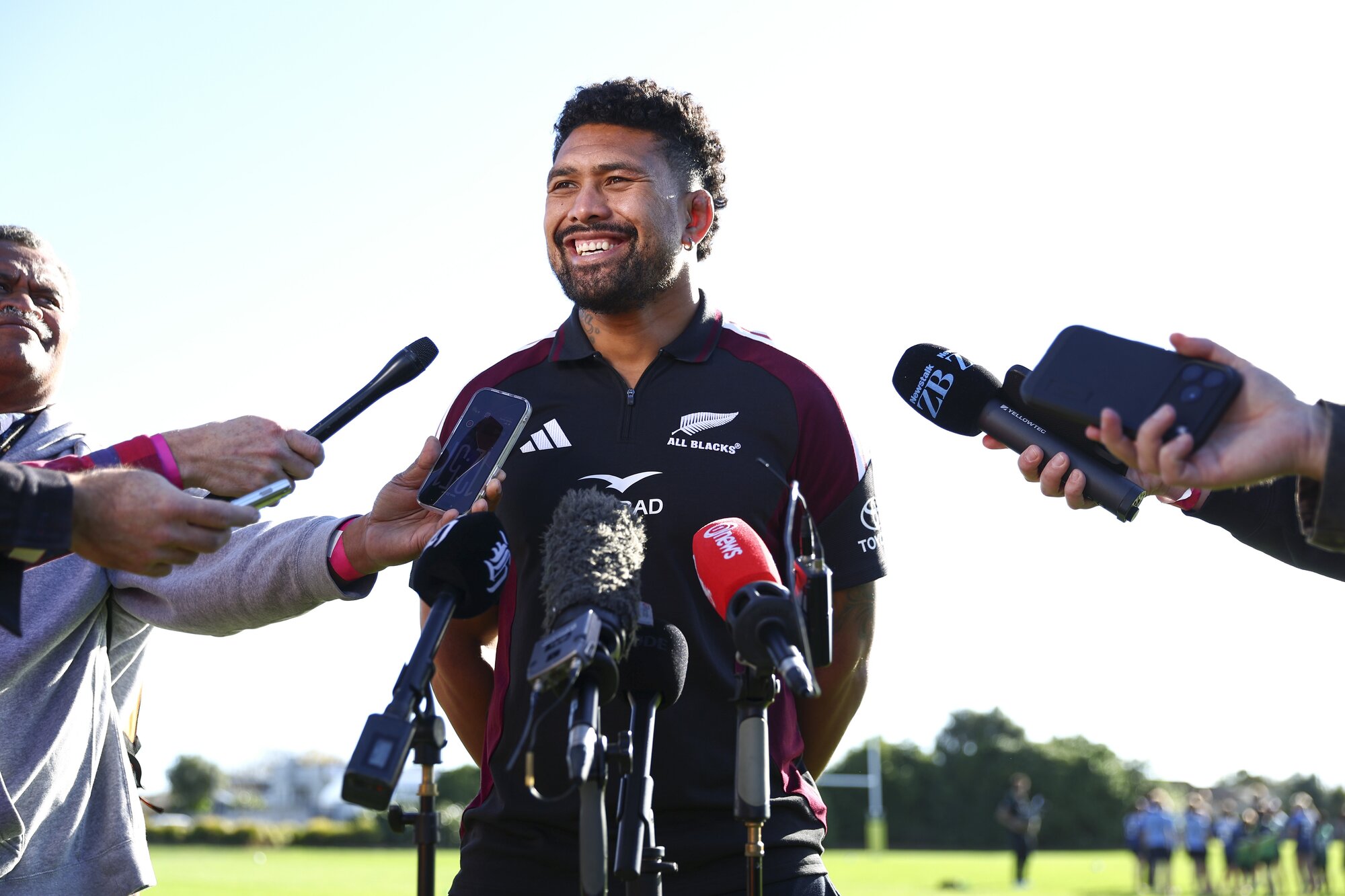
Optimism and ambition with the ball is another trademark.
Rennie will encourage his players to be instinctive, to take opportunities when they are on and to play what they see. Quick taps, quick throws, up-tempo will be the modus operandi.
Such an approach is high risk at times but it suits New Zealand’s approach and, with a plethora of attacking talent to unleash – just look at this weekend’s backline, it can also conjure rapid rewards as the Hurricanes consistently proved this season.
Enhancing basic catch-pass skills – after recruiting former NZ sevens assistant coach Euan Mackintosh, addressing consistent issues under the high ball and flicking the switch between turnovers and counter-attack will be other focal areas.
History tells us that pulling together a new management team, with Jason Ryan the sole survivor from Robertson’s former crew, and coaxing everyone on to the same page in 10 days poses problems.
Starting points by nature are far from the finished product. There will be growing pains, challenges, progressions to come.
With eight European champions from Bordeaux in their starting team, this is a much stronger French side than the All Blacks battled past in their season-opener in Dunedin last year.
Rennie, though, is well placed to navigate the treacherous test scene.
“We’re not going to use the excuse that we haven’t had enough time,” Rennie said, illustrating his immediate expectations. “We know the short turnaround. We’ve been planning for three months and done an enormous amount of work around that. We’re really clear on our game model, the detail within that and the type of athlete we need to play our game.
“There will be a process. We’ll get the boys to a state skill-set and conditioning-wise where it suits us. That may take a bit of time but, as far as being ready to play a test match, we’ll be ready on Saturday.”
Liam Napier is a Senior Sports Journalist and Rugby Correspondent for the New Zealand Herald. He is a co-host of the Rugby Direct podcast.