All Blacks v Italy: Wellington victory sees Dave Rennie’s prove they’ve turned a corner - Gregor Paul
By Gregor Paul in Wellington
Patience and perseverance were two of the new qualities the All Blacks put on show in Wellington, with the third being the previously unachievable ability to problem solve in real time.
After a first half in which the All Blacks couldn’t break down a resilient Italian defence by smashing through the middle or find a way to play round it and get the ball wide, they made some clever adjustments in the second half to create the space and opportunities for the tries to start flowing.
It was never sweeping or majestically relentless, and the fourth quarter was forgettable, but the All Blacks still did enough in Wellington to suggest they are a team on the up, building and growing the foundational qualities they will need to rule the roost.
The third quarter blitz in which the All Blacks were able to run freely and pour through the Italian defence at whatever point they chose, was the 20 minutes that demonstrated the marked difference between Dave Rennie’s All Blacks and his predecessor, Scott Robertson’s.
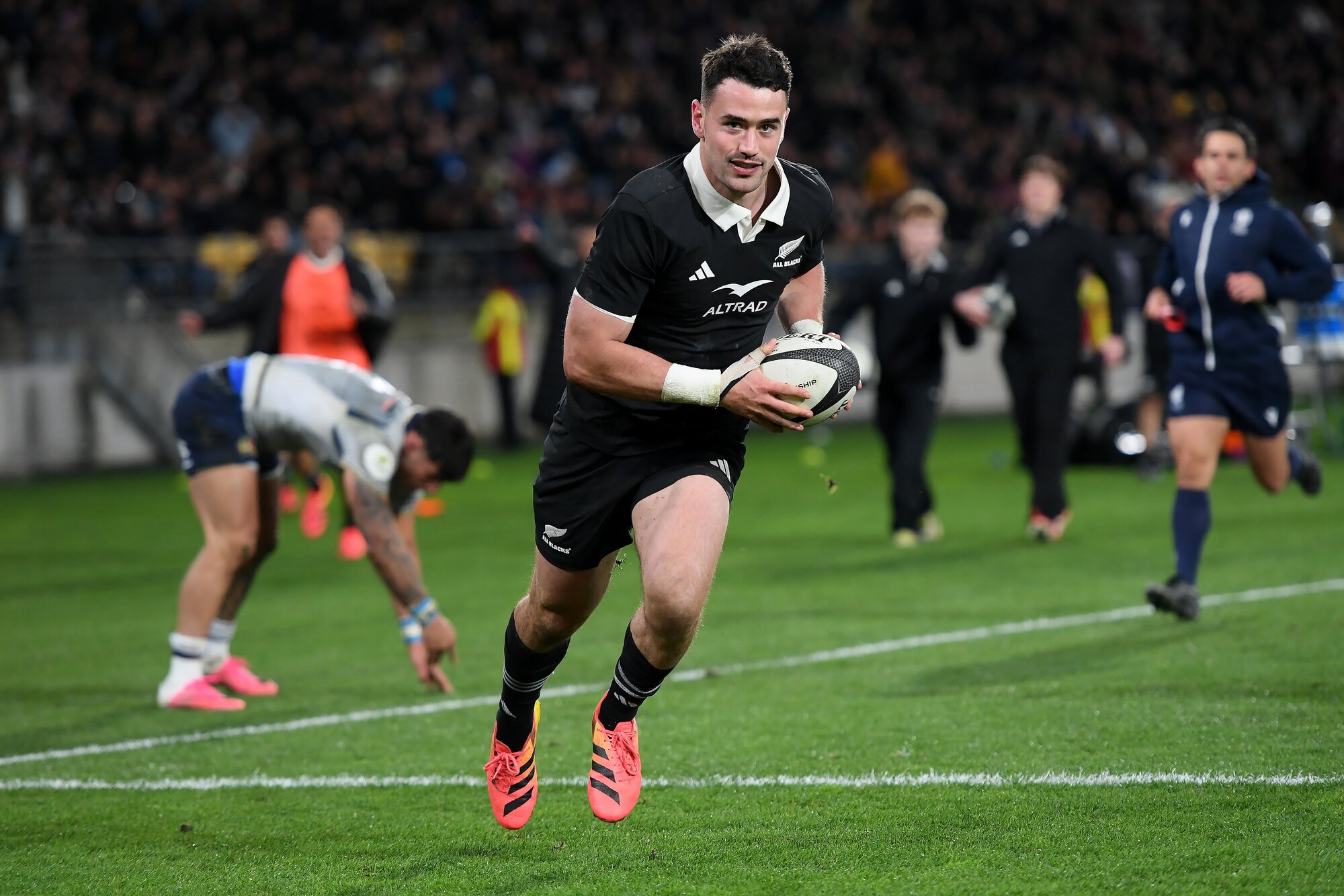
That terrific blast of rugby after the break enabled Will Jordan to scoot over for a hat-trick and become the All Blacks’ highest try scorer in history, but as much as that achievement stands tribute to his remarkable instincts and scorching pace, it was also emblematic of the team’s newfound leadership and ability to regather and adapt at half-time.
Test rugby doesn’t often, if ever, go the way teams expect or want it to, and this seemed to be something the All Blacks never understood last year.
Almost without fail they would fall apart for 20 minutes after half-time, unable to wrestle back momentum or hold themselves together.
But in Wellington, the story was entirely different. The All Blacks were calm, composed, creative and cohesive when they came out after the break – and they brought a few answers with them in how to play through and around the Italians.
They dropped their sweep runners a little deeper, brought the blindside wing into action to create an extra man and varied their strike points with a few more flat passes.
The big ball carriers also used their footwork more, ran harder and noticeably lower to dominate the collisions and cleanout more ruthlessly and the net outcome was that holes started opening everywhere and the Italians fell apart.
There was also a bit more kicking in the repertoire and that turned the Italians and forced them to kick back to create counterattack opportunities against an unstructured defence.
“The response in the second half where the boys held on to the ball and got into the right areas of the field and set early and were able to play the footy we wanted to play helped us surge in the second half,” captain Ardie Savea said when asked what he was happiest with about the performance.
For the first time in an age the All Blacks successfully adapted their gameplan and by doing so, have generated the most compelling evidence yet that they have genuinely turned a corner.
Whether it was the players or the coaches – or a combination of them both – the thing that matters is that they came up with the right answers – hinting that the All Blacks may have rediscovered their Kiwi ingenuity.
That’s a big piece of the puzzle that has been missing and is an attribute they will most certainly need next week against Ireland and is a non-negotiable if they want to win in South Africa.
The specifics in this case were that the Italians, for the first 40 minutes, defended the way the All Blacks wanted to – mostly getting two men into the tackle and not only winning the collision but slowing the release of the ball.
The crazy statistics that the All Blacks generated last week with their speed of recycle had obviously tipped the Italians off about what was coming, and they brilliantly barred up to ensure the numbers were not off the charts.
The All Blacks had a quantity of possession, but not the quality and their attack game didn’t flourish the way they hoped.
The Italian linespeed was also good and they managed to push up quickly in the outside channel to block the All Blacks from getting the ball into the tramlines.
And, a bit like the old days in the 2016-2019 World Cup cycle, the All Blacks didn’t have the tool kit, vision or understanding of how to play through the problem until they regrouped at half-time and worked out what they needed to change.
The disappointment for Rennie was that having Italy at their mercy, the All Blacks didn’t take to them with the scalpel and inflict surgical damage.
They didn’t have the precision or attention to detail that they needed. Their endeavour was good, work-rate high and structure cohesive – but there was a looseness about their passing and ball carrying that irked Rennie.
So too was there a touch of over eagerness in their defending with one too many players shooting off the line and leaving space for Italy to exploit.
“I thought we were excellent after half-time but disappointing in the last 25 minutes where we were just loose,” Rennie said.
“We needed to be a little bit more accurate. Everything that happened we’d expected. We knew first half they would be full of energy and fill the field, and they would be harder to break down.
“But second half, there were a lot of them down, and we were able to play at a tempo that they struggled with, so [it was] disappointing that we didn’t ram home in the last 20 minutes.
“It’s a pass mark but we will need to be better next week.”
Gregor Paul is one of New Zealand’s most respected rugby writers and columnists. He has won multiple awards for journalism and written several books about sport.