All Blacks v Wales: Win flatters Scott Robertson’s men more than it fixes flaws – Gregor Paul

THE FACTS
A gold-standard scoreline from a slow but effective surgical dissection of Wales gave the All Blacks the glossy finish to their season, but it will be a mistake for New Zealanders to believe all is right with the national team.
Wales were plucky. And they were stubborn. They were even quite good at times, certainly when they shifted the ball right to left, but they are No 12 in the world for a reason.
The hosts were always going to succumb to their limitations, the question was when.
The answer turned out to be longer than anyone anticipated and some of that was due to their scrambling defence, and some of it was down to the difficulty the All Blacks had at times in holding their shape, maintaining their patience, and delivering the requisite accuracy.
The dam broke after about 65 minutes and the All Blacks were able to fully let rip as it were and play with zero inhibition.
There were a handful of notable plus points.
The work-rate and determination of Wallace Sititi, who wanted to be involved in everything. The ball-carrying crunch of Samisoni Taukei’aho and the grind of Fabian Holland.
Damian McKenzie relished having time, space, a dry ball and a roof over his head and the veteran midfield pairing of Anton Lienert-Brown and Rieko Ioane offered a bit of direct punch, astute decision-making and steady running lines.
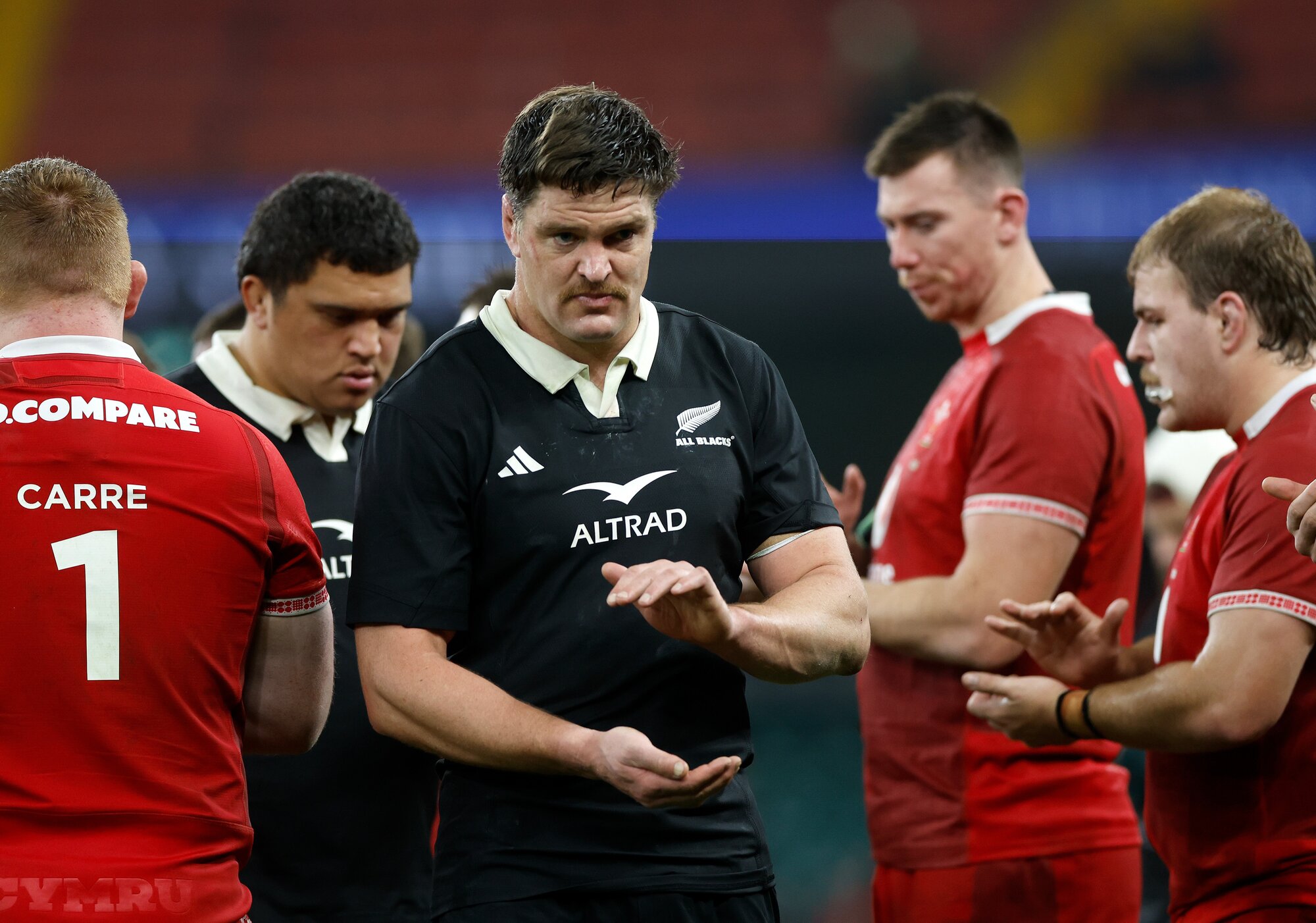
The other major positive was the way the All Blacks adjusted their game plan, binning the initial plan to let Cortez Ratima box kick much of their possession away and instead be bold enough to run out of defence and try to break Wales by making them tackle, tackle, tackle.
Credit to the on-field leaders, they picked quickly that Ratima’s box-kicking was not only being overdone, but it wasn’t going nearly far enough to be effective.
Adjustment was a buzz word for the coaching staff during the week – so to see the players work things out in real time in Cardiff when they weren’t able to do so seven days earlier in London, will have felt like quite the breakthrough moment.
As would have the improvement made in the aerial stakes.
It wasn’t by any means an emphatic win for the All Blacks in the high-ball stakes, but they took more clean catches in the first half alone than they have all season.
But of course, the limits of Wales’ ability have to be taken into account and strict limits placed on exacting what the value of this exercise was.
It was an opportunity for the All Blacks coaches to give a few fringe players the reward of game time at the end of a long tour, and a chance to up Ruben Love’s test experience.
Love made a little bit of a statement by taking his first high-ball cleanly and then scoring a try from nothing when he stepped hard and accelerated.
He had a poorly executed kick charged down, but that aside, it was a productive and promising outing by a young player who is obviously gifted.
Most valuable, however, was that it pushed last week’s loss to England a little down the running order.
No one is going to suddenly forget about what happened at Twickenham last week, but the game against Wales is at least something else to talk about, even if it can’t stand as reason to change the narrative as such.
And the reason a crushing victory against Wales can’t be sold as anything more than a good day out, is that there is no universe where playing the world’s 12th best team down on its luck, bears any resemblance to playing South Africa at Ellis Park, or France in Paris, or England at Twickenham.
It’s a dangerous business to start thinking that the major faultline that was exposed by England has been repaired.
The world of test rugby doesn’t quite like that because the commodities of space and time carry one value in Cardiff and a much higher price everywhere else.
New Zealand have always been able to look a million dollars when they have encountered generous defences and Wales, despite their tireless efforts, just didn’t have the raw power or calibre of personnel to deal with the likes of Caleb Clarke, Sititi, and Taukei’aho.
Their scrum was also barely fit-for-purpose, and so New Zealand could all too easily generate momentum and in a manner that would be all but impossible to do so against the best teams.
By the last 10 minutes, Wales – who ended up scoring their second highest points tally in history against the All Blacks – were dead on their feet and looking every inch the strugglers they were.
It was a bit sad to see a game against a Tier One side descend the way it did, but the All Blacks will feel that while they maybe could have had things under control sooner than they did, they got the job done and can now get on the plane home to begin the process of reviewing 2025.