All Blacks v England: Why Scott Robertson must embrace a 23‑man game like the Springboks – Gregor Paul
THE FACTS
By Gregor Paul in London
An injury to Caleb Clarke has created a vacancy in the All Blacks back three, and Damian McKenzie, having played the house down in Edinburgh, would certainly stack as a viable candidate to slot in at fullback as part of a reshuffle that would result in Will Jordan shifting to the wing.
But to promote McKenzie to the starting team would be to indulge an outdated mindset that continues to prevail in New Zealand rugby circles, while also continuing a selection pattern that has possibly restricted the influence of the All Blacks’ best impact player.
New Zealand’s thinking remains wedded to an old-world view that rugby is a 15-man game, with an eight-man bench and that there should be promotion and relegation between the two separate entities depending on performance.
It remains apparent that players hold aspirations to start and see a bench place as a consolation – a lesser role in a clear hierarchy where starting carries nearly all the prestige.
The modern game doesn’t really subscribe to that view any more, as best evidenced by the world-leading South Africans, who have become the first team to lose any sense of division between bench and starting players.
The Springboks have embraced the idea that rugby is a genuine 23-man operation and that time on the field, and the time within the game that a player enters the field, are not the right ways to measure importance and influence.
In trying to figure out how the Boks have made such a sustained advance in the past decade, this reinvention and repositioning of the bench as an equally valid and important part of the match-day set-up has been critical.
Head coach Rassie Erasmus has sold his players a marketing narrative that has built the bench into being a specific and sought-after job – and eradicated this notion that contributing in minutes 1-40 is somehow more valuable than contributing in minutes 41-80.
It seems the All Blacks are also starting to make a mental shift in how the coaches select the bench and how the players perceive its importance.
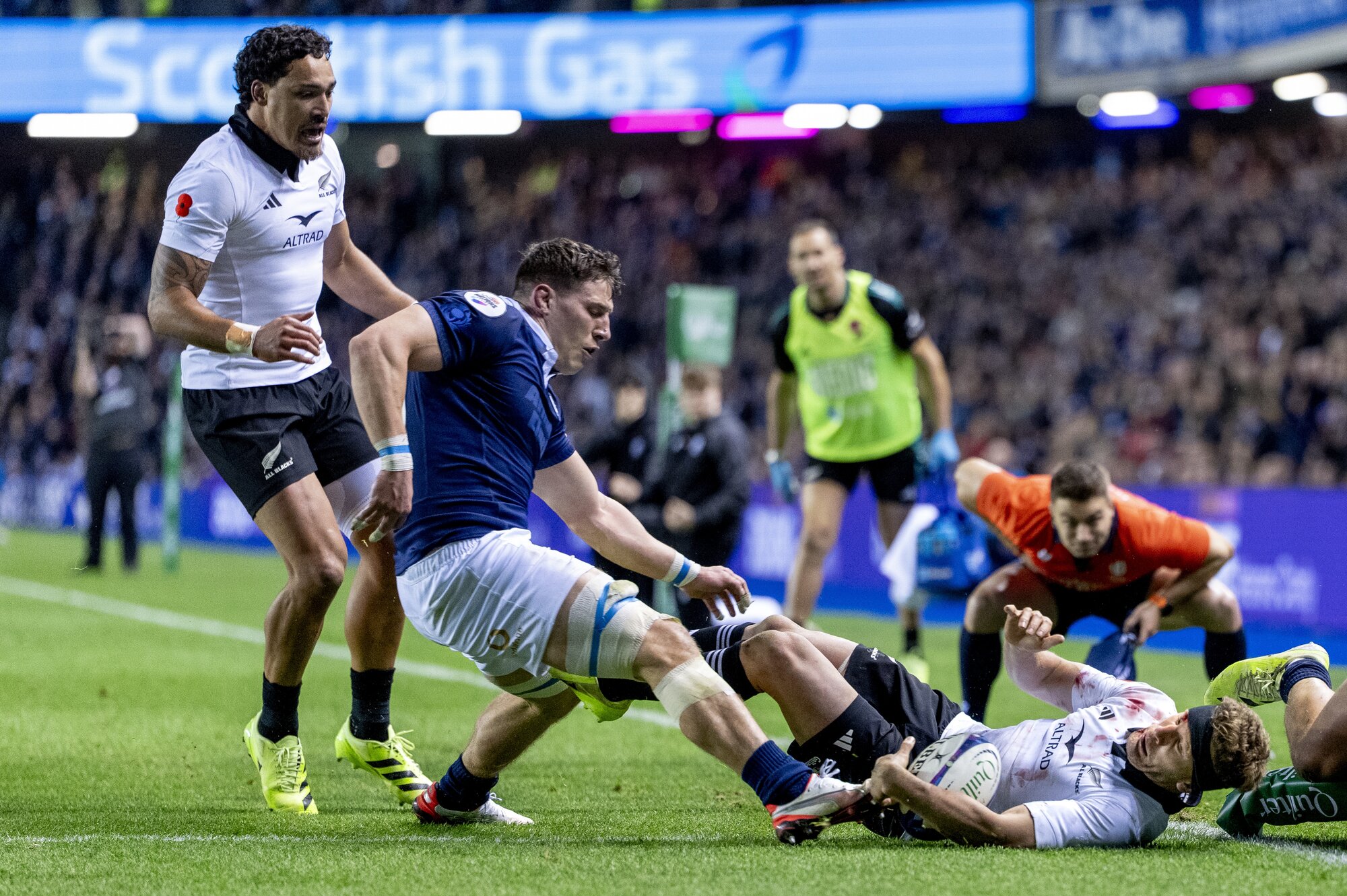
Certainly, in the past two weeks, bench players have had an enormous bearing on the performance, no one more obviously or significantly than McKenzie, whose 35 minutes in Edinburgh were good enough to make him man-of-the-match.
In the past, a performance such as McKenzie’s would lead to calls for him to be rewarded with a start this week against England, but it feels that what should be apparent by now is the best way to use him is off the bench.
He’s been tried as a starting No 10 and never quite shown himself to be right for the role.
McKenzie is someone most comfortable playing off instinct. He’s quick, agile, innovative in his skill-set and a player who prefers to live in the moment rather than deliver to a prescribed plan.
He’s a player with the respective skills required of a 10, but perhaps one without the patience and mental discipline to deliver the full extent of the game plan.
If there are injuries, he can step in, but the idea that he is in a live contest with Beauden Barrett to be the team’s chief playmaker is not right any more.
They were last year, and maybe even earlier this year, but not now – partly because Richie Mo’unga has agreed to come home next year and the battle for the No 10 jersey will be between him and Barrett.
And partly the competition between Barrett and McKenzie has ended because the latter has built his impact value to the point where the coaching panel doesn’t want to lose it.
They could start him at fullback at Twickenham this week with Jordan and Leroy Carter on the wings, but that would feel like a physically vulnerable combination.
The more practical solution would be to shift Leicester Fainga’anuku to the wing to replace Clarke and bring in Billy Proctor at centre.
That gives the back three a power wing and a bit more size to cope with a physically imposing English backline, and most importantly, it keeps McKenzie on the bench where he can again be injected with a brief to operate between the backfield and first receiver as he sees fit.
And that’s clearly the best way to use him – as a free spirit almost, sent on at some stage in the second half when there may be an element of fatigue building in the opposition and when he’s seen how things have been playing out tactically.
He can change the attacking dynamic and make things happen at a time when most tests are starting to become a little less structured and defences have lost some of their earlier line speed and intensity.
Gregor Paul is one of New Zealand’s most respected rugby writers and columnists. He has won multiple awards for journalism and written several books about sport.