Paul Lewis: All Blacks loose forward pecking order reshaped by Du’Plessis Kirifi and Devan Flanders
THE FACTS
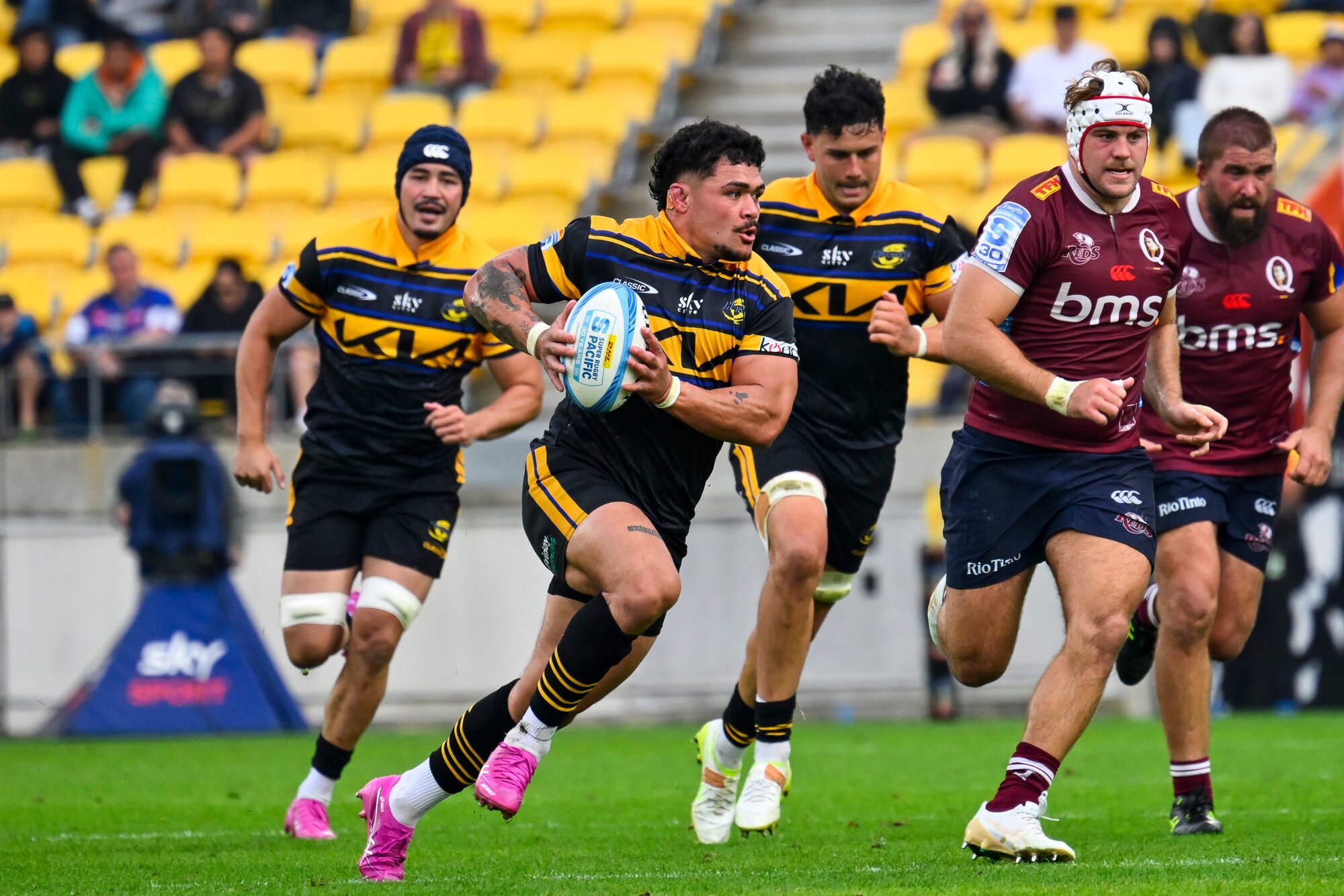
Du’Plessis Kirifi’s fine form for the Hurricanes as they dismantled the Reds 52-14 was timely as the identity of the next openside flanker behind Ardie Savea has been, well, a bit blurred up to now.
Unusually for New Zealand, the cupboard of top-class No 7s has been somewhat bare for some time and, with Savea in Japan and Wallace Sititi injured, plus the impending departure of Dalton Papali’i, overall back row depth has looked diluted.
Cue Kirifi’s terrific display against the Reds.
He hadn’t been seen much previously after a calf injury, but All Blacks coach Dave Rennie and his henchmen will have noted not only his game-high tackling – he chopped them down like trees – but also his aggressive running, making 78m in 10 carries (the most in the match except for Fehi Fineanganofo in scoring another hat-trick).
He beat seven defenders and pulled off two clean breaks.
It was impressive stuff against a team, let’s remember, including two top Wallaby loose forwards (Fraser McReight and captain Harry Wilson). McReight is a class act and renowned turnover merchant, but he was completely overshadowed by Kirifi.
The Canes had forward impetus for much of the match, making it much easier for a No 7 to shine but Kirifi did the lot. His 21 tackles (one missed) topped the game count and he burgled a key turnover as well.
It’s relevant because, if you count the number of specialist openside candidates after Savea, you stop at Kirifi, even though teammate Peter Lakai can play there as well.
It’s also relevant because this international season will also be one of the toughest ever for an All Blacks team (if not the toughest), so Rennie will want to manage Savea’s minutes this year.
Last year, for example, Savea started at No 7 in 11 of the All Blacks’ 13 tests (Kirifi in the others) with Sititi at No 8, the latter replaced Lakai for four tests. Sititi returned to play in the unsatisfactory win against Wales in the final match of the last season.
Lakai, like Sititi, can play in all three loose forward positions and is thus an almost guaranteed All Black squad member. However, he seems most effective at No 8 and has a powerful combination with Kirifi.
That was best seen in Fineanganofo’s second try. Kirifi felled big Reds lock Seru Uru with a flying grasscutter tackle, Lakai made the turnover, gaining a penalty. Ruben Love kicked 48m to the corner where they pulled a lineout move, Lakai delivering the scoring pass.
Kirifi wasn’t the only No 7 making a mark.
Luke Jacobson switched there as the misfiring Chiefs battled past a stubborn Force. Jacobson is typically a No 8 or blindside, known principally for the quality of his tackling.
His work with the ball has been less hailed but he turned in a strong performance last weekend, scoring an excellent try on an angled run. His appearance at No 7 is a signal he too has flexibility credentials.
Debut for Devan?
At blindside, has Devan Flanders now done enough to take top contender spot from incumbent All Black Simon Parker? This armchair selector thinks so.
Parker took over from Tupou Vaa’i after the All Blacks rightly abandoned the experiment of playing one of our leading locks there.
Parker had a good start but, by the end of the season, still hadn’t definitively cemented his test place. His Super Rugby form has been similar – good but not a shoo-in for the All Blacks.
Flanders had only an abbreviated spell before a head knock forced him off against the Reds but he was again impressive and deserves top spot now.
In round four, this column had the contenders for blindside ranked: Parker 1, Dominic Gardiner (Crusaders) 2, Flanders 3, Ethan Blackadder 4, Samipeni Finau 5. After round 7, we think the ranking is: Flanders 1, Parker 2, Anton Segner (Blues) 3, Gardiner 4, Blackadder 5, Finau 6.
Segner comes into the picture after his best game so far, taking the role of senior loose forward in a young Blues trio. He responded with a strong lineout and general performance as the Blues, 14-15 down after halftime, played it tight before chalking up two entertaining tries to Payton Spencer and Caleb Clarke to win 40-15.
Gardiner and Blackadder didn’t play this week so will have further chances to press their claims.
Carter at centre
Centre is another position yet to be convincingly claimed. Leroy Carter’s game there for the misfiring Chiefs was inconclusive. He was busy, defended well, and did nothing wrong but didn’t figure strongly either.
For the Hurricanes, Billy Proctor ran and tackled passably well against the Reds, but his ball security let him down occasionally – and he has still to demonstrate he is at home at international level.
A brace of Calebs?
Caleb Tangitau’s two tries against Moana Pasifika will add to the clamour from those who think he should be an All Black this year. There is no doubt his pace and tackle-breaking are sharp offensive weapons and he increased his work rate last weekend. However, his ability under the high ball is not yet compelling.
Carter also struggles there at times. Another Chief, Emoni Narawa, is highly competent under high kicks but looked off the pace last weekend.
Chay Fihaki (Crusaders) is probably the best high ball exponent and can also play fullback, as can Kyren Taumoefolau who had a cameo for the Chiefs, replacing Narawa.
Blues’ wing Cody Vai has been an impressive rookie this season, looking absolutely at home at this level. He looks stringy, like there isn’t much of him – but is surprisingly resilient in contact.