Two US soldiers killed in Iranian missile attack on Jordan base
No comment from Trump over US soldiers killed
Stephen Marr
US President Donald Trump has not commented about Iranian strikes that left two American service personnel dead, one missing and four injured in Jordan.
Posts from the President on his Truth Social platform in the past 24 hours have instead concentrated on "ensuring the integrity of elections" - after his address to the nation on Wednesday - and blaming Canada for poor air quality in the United States.
The American death toll since the Iran conflict began on February 28 has now raised to 16.
In its X post about the Jordan attack, US Central Command (Centcom) said it would not release further details about the fatalities until after the families of the dead had been notified.
Stephen Marr
NY mayor looking into arresting Netanyahu during US visit
Stephen Marr
New York Mayor Zohran Mamdani is in talks over whether to try to arrest Israeli Prime Minister Benjamin Netanyahu during an upcoming UN summit.
Mamdani told The New York Times: "I believe that Prime Minister Netanyahu belongs in The Hague. He's a war criminal who has been charged by the International Criminal Court.
"That is an opinion that is held by many, purely because of what his actions have wrought over these last many years."
Mamdani admitted he was not sure if he has the power to order the New York Police Department to detain a foreign leader but is discussing the matter with the city's legal team.
He added: "Whatever the law allows me to do in New York City, that's what we will do."
The UN General Assembly, a major gathering of world leaders, takes place in September at UN headquarters in New York.
– AFP
Stephen Marr
Stephen Marr
Iran strikes Saudi Arabia for first time in three months
Stephen Marr
Iran attacked Saudi Arabia overnight for the first time in nearly three months.
The strikes triggered early warning alarms in al Kharj, east of the capital Riyadh, and at Yanbu, along the Red Sea coast.
One attack targeted the Prince Sultan Airbase in al Kharj, which hosts US forces.
Saudi state media reported that the early warning alarms had been triggered but did not elaborate on what triggered them.
The IRGC has not yet reported an attack on Saudi Arabia.
– The Telegraph
US bombs key Iranian road tunnels in overnight strikes
Stephen Marr
The US damaged a tunnel in Iran during a wave of overnight strikes, disrupting a critical transport route.
The Shahid Mirzaei Tunnel in Iran’s southern Hormozgan province was closed following the seventh consecutive night of strikes.
American forces struck several bridges in the vicinity in an apparent attempt to cut off the nearby Bandar Abbas, a crucial port city where roughly half the country’s trade arrives.
The region has endured days of back-and-forth attacks in a conflict increasingly focused on control of the Strait of Hormuz. The collapse of an interim ceasefire leaves no clear end in sight for the war that the US and Israel began more than four months ago.
– The Telegraph
Two US soldiers were killed on Friday by an Iranian missile and drone strike on a military base in Jordan.
One other service member is missing and several more were injured, the US Central Command (Centcom) announced on Saturday, after Iran launched its latest barrages across the Gulf in retaliation for consecutive nights of US attacks.
The US military did not release the troops’ identities. It said they were killed defending against the attack – the first American deaths due to direct Iranian fire since the opening days of the war.
It brings the total number of US military deaths to 16 since the war began in late February.
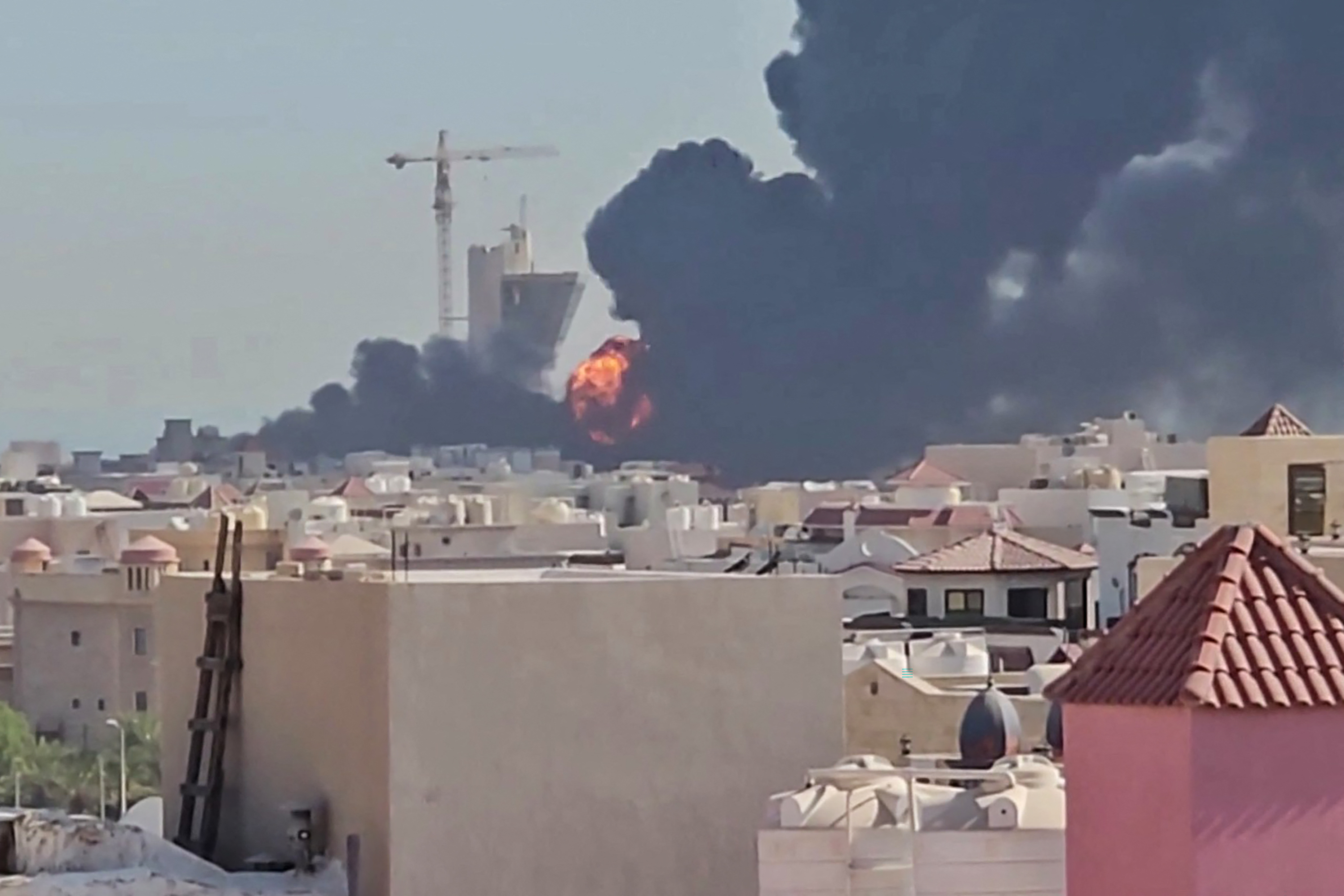
Overnight, Tehran struck Kuwait, Bahrain, Jordan and Saudi Arabia in a fierce bombardment.
The secretary-general of the Gulf Co-operation Council, Jasem Mohamed Albudaiwi, accused Iran of committing “war crimes” with attacks on civilian infrastructure - including water desalination plants.
Tehran characterised the strikes as revenge for the week-long American campaign that has begun to target non-military sites including roads, bridges and – according to the Islamic Republic – one of its own drinking water facilities.
On Saturday night, Iran’s Supreme Leader accused Washington and US President Donald Trump of “repeated violations” of the preliminary memorandum of understanding the two nations signed a month ago.
Mojtaba Khamenei, who has not been seen in public since he was wounded in the February 28 strike that killed his father, said America’s attacks “once again proved to everyone how worthless and unreliable the signature of the US President is”.
He added that Tehran had “unforgettable lessons in store” for the “American enemy”.
Earlier, Kazem Bharibabadi, the Iranian deputy foreign minister, announced that the country had entirely suspended its participation in the peace deal.
Washington is in the process of deploying dozens of refuelling aircraft to bases in Israel in what could be the prelude to an expansion of its military campaign.
On Saturday, Kuwait said Iran had struck a water desalination plant for the second time in two days. The Gulf state relies on such facilities for 90 per cent of the its drinking water.
Flights were suspended at Kuwait International Airport because of the missile and drone attack, which also injured several oil-plant workers according to the state-owned Kuwait Petroleum Corporation.
Tehran said it had targeted US military bases in Kuwait, Bahrain and Jordan as retaliation for US strikes on Friday night.
The Islamic Revolutionary Guard Corps (IRGC) said: “Since there is no international institution to prevent the savagery of the US military, we have no path before us except the Quranic command: ‘Whoever attacks you, attack them in the same manner’.”
In the first attacks on Saudi Arabia for three months, Iran fired at a US military base in the city of Al-Kharaj, east of the capital Riyadh, and the Red Sea port of Yanbu.
The IRGC did not claim the strikes, which triggered early warning alerts, and neither the Saudi government nor state media offered any comment.
On Friday night, the US military struck roads and bridges in southern Iran. The attacks appeared to form part of an attempt to isolate the ports through which Tehran brings vitally needed supplies into the country.
Centcom deployed fighter jets and drones to hit surveillance sites, military logistics infrastructure, underground weapons storage and maritime capabilities in the overnight strikes.
Iranian state television said that the US had also hit a desalination plant in the southern province of Jask, leaving 10,000 people without access to drinking water.
The IRGC said it had carried out strikes on US combat aircraft at Sheikh Isa Air base in Bahrain and destroyed fighter jets in the US base of Al Azraq in Jordan. The Telegraph was not able to verify the claims.
Danny Citrinowicz, a former senior Israeli intelligence official, said that it was not yet impossible to halt the slide towards all-out war.
He said: “Both sides are remarkably managing to escalate but still preserving the rules of the game – neither is escalating in a way that would make returning to negotiation too hard.”
The collapse of the ceasefire deal followed a struggle between Washington and Iran for control of the Strait of Hormuz.
Donald Trump demanded free passage. Tehran believed the agreement’s loose phrasing would allow it to control navigation and potentially extract fees.
- AFP