RNZ-Reid Research poll: Would a new leader save National or Labour?

Most voters remain unconvinced a new leader would help boost National or Labour’s election chances, although support for a switch-up has grown over the past year.
The finding comes in the latest RNZ-Reid Research poll, which showed National slumping to its lowest level of support since Christopher Luxon took charge, while Labour also lost ground.
Luxon endured a flurry of speculation about his future earlier this year before calling and winning a confidence vote from his caucus in April.
Labour’s Chris Hipkins has also periodically faced questions about his leadership, most recently in March when his ex-wife took aim at his character on social media.
Would a new leader make the difference?
About one in three respondents (31.9 percent) said they thought National would be better placed to win the election if it changed its leader.
A larger share, 44.7 percent, disagreed, while 23.4 percent were unsure.
That marks a narrowing of opinion since September. Then, just 24.7 percent thought changing leader would improve National’s chances, while 41.9 percent disagreed and 33.4 percent were undecided.
Overall, the results suggest more voters have become convinced of the merits of a switch-up, though a clear majority remain sceptical or unsure.
Respondents were also asked who they would select from National’s frontbench if the party was to change its leader.
Among those named, Chris Bishop attracted the most support (13.7 percent), followed by Nicola Willis (12.5 percent) and Erica Stanford (11 percent).
But the largest share by far - 42.2 percent - did not have an alternative National MP in mind.
Among National voters, Willis emerged as the preferred successor, with 26 percent support, compared with 14.4 percent for Bishop and 12.6 percent for Stanford. About 28 percent said they did not know.
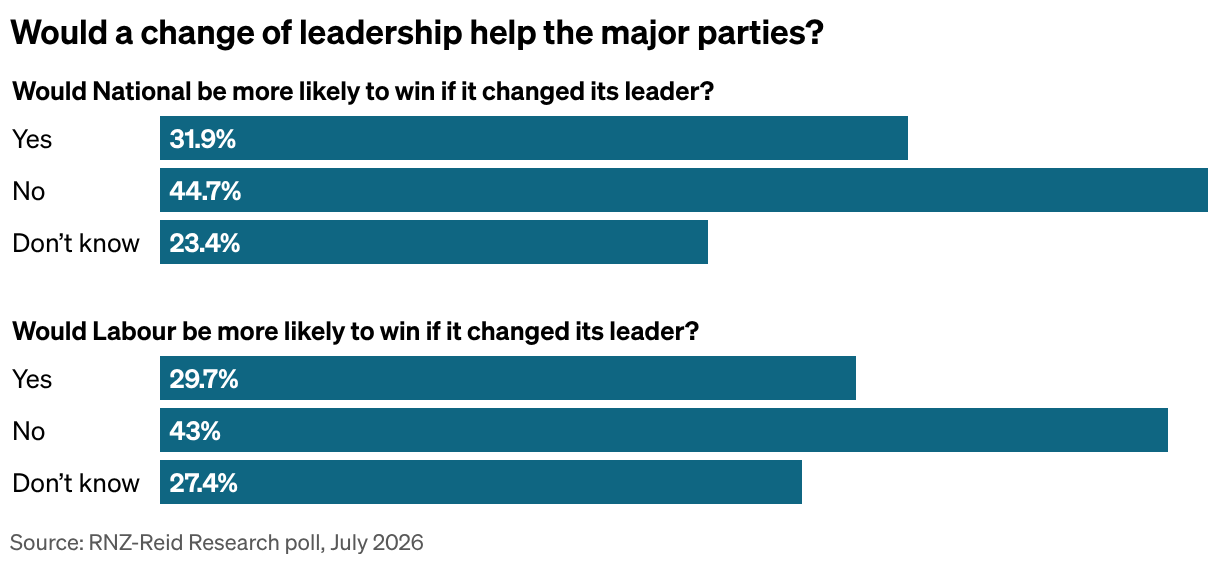
Labour recorded a similar pattern as National, with a clear majority of decided voters saying they thought replacing Hipkins was a bad idea.
Asked whether a leadership change would help Labour’s chances, 29.7 percent of respondents said yes, while 43 percent said no and 27.4 percent were unsure.
However, support for a change had also increased since September.
Then, 24.9 percent thought a new leader would give Labour a boost, against 42.9 percent who said it would not and 32.2 percent who did not know.
Kieran McAnulty was the only member of Labour’s frontbench to receive double-digit support (16.2 percent) as a replacement, with Megan Woods in second (6 percent).
More than half of respondents - 52 percent - said they did not know who should lead Labour instead.
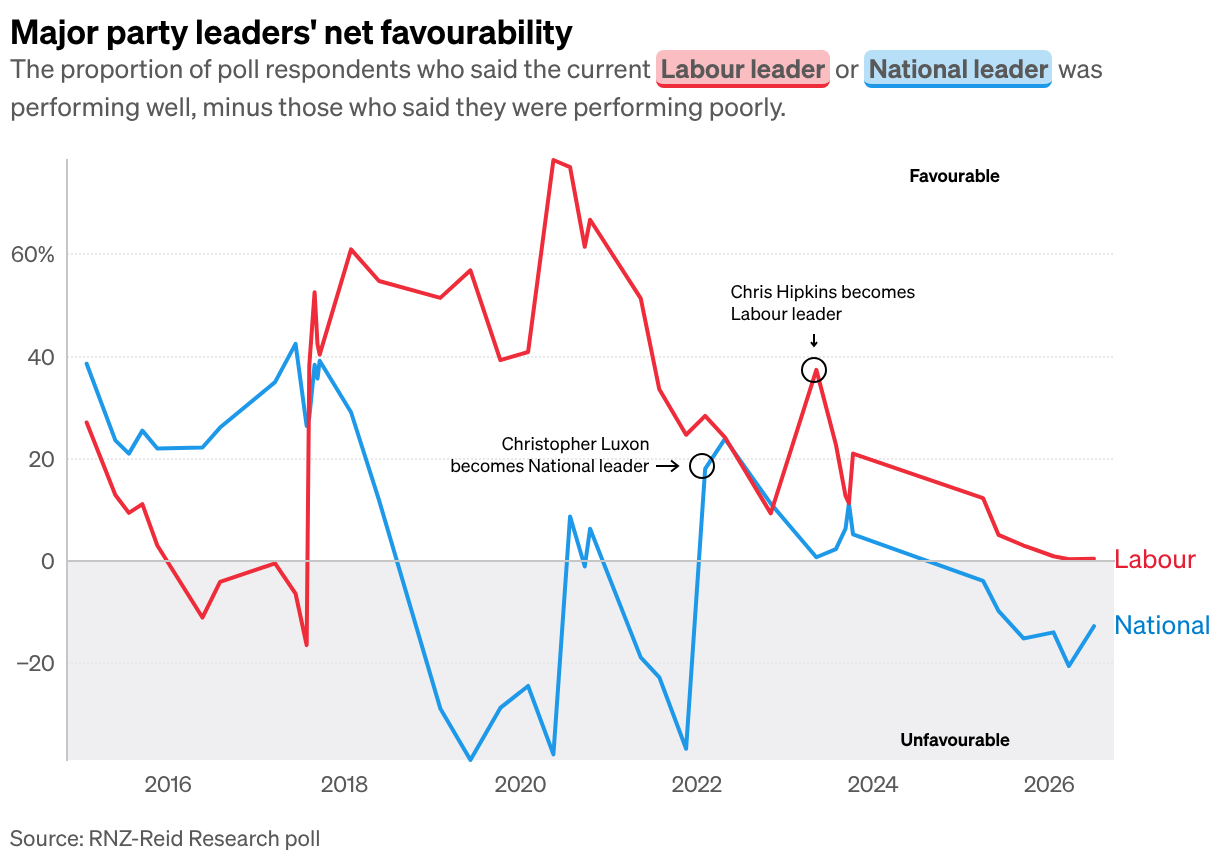
The leadership findings come as both Luxon and Hipkins posted modest improvements in their personal approval ratings after registering record lows in March.
Just over a third of respondents (34.4 percent) said Luxon was performing well as prime minister, up 4.6 points. Nearly half (47.2 percent) said he was performing poorly, down 3.2 points.
That leaves Luxon with a net performance score of -12.8, an improvement of 7.8 points from -20.6 in March.
Hipkins fared better overall, with 37.4 percent approving of his performance as opposition leader, up 1.5 points, and 37 percent disapproving, up 1.4 points.
That gives him a net rating of just 0.4, up 0.1 points.