Can NZ help turn back the Doomsday Clock?
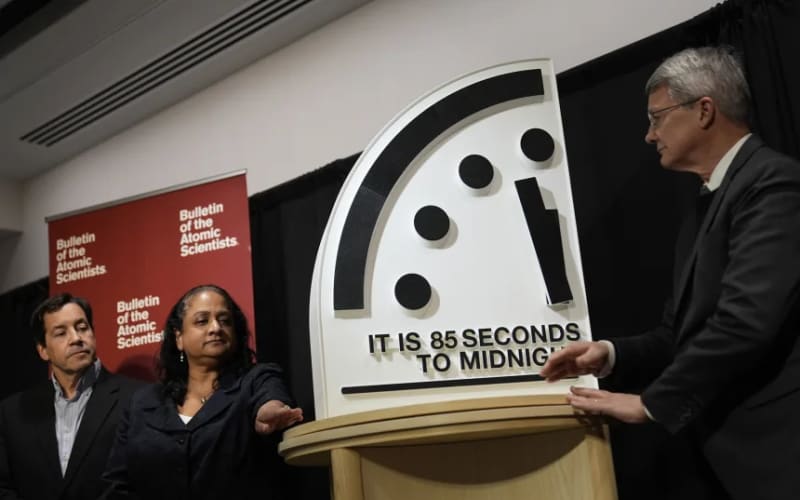
The Doomsday Clock is closer to midnight than ever before - but New Zealand provides a source of hope, if it chooses to stand against the arms race, says a disarmament expert.
The Doomsday Clock is a symbolic representation of how close humanity is to destroying the world, and is currently set at 85 seconds to midnight, or global disaster.
Dr Zia Mian of Princeton University - a key speaker at a conference of the Public Advisory Committee on Disarmament and Arms Control (PACDAC), wrapping up on Wednesday in Wellington - said the clock was at four seconds ahead of a year ago.
He said this was driven by climate change, war and stockpiling for war.
“New Zealand and other countries should ask themselves that if this is the arms race offence-defence dilemma that is unfolding among great powers, what role and relationship should they have to this?” Mian told RNZ.
“Because if you want to be part of that set of processes, then you are getting yourselves wrapped up into making yourself a target.”
The number of nuclear warheads had been dropping, but were now on the rise, while the US is frequently issuing warnings that it faces a multi-headed threat from Russia, China and North Korea.
The last nuclear weapons treaty the US had with Russia recently expired and spending on conventional and new weapons such as drones was surging.
‘A leader of this new global coalition’
But Mian said there was a growing movement coalescing around a key anti-nuclear treaty to outlaw the weapons enacted in 2021, that New Zealand helped create.
“There are now 100 countries in the Treaty on the Prohibition of Nuclear Weapons (TPNW), and New Zealand was key to helping design, develop, and take this treaty forward.
“So it’s been seen as a leader of this new global coalition of countries trying to build a different path forward,” he said.
“And this is where New Zealand really has an opportunity to kind of build on this legacy.”
But the conference also heard that growing global volatility was putting some countries off signing the treaty - and the Trump administration encouraged others to pull out.
‘It’s incoherence’
Van Jackson - an associate professor in international relations at Victoria University - told the conference the US was out to kill arms control of all types so it could be “unencumbered”.
He later told RNZ: “If you’re engaged in militarism, you’re not inhibiting nuclear use, you’re making it more likely.”
But he said New Zealand was encouraging the US militarism in the Pacific, while also working on the TPNW.
“It’s incoherence. There’s one part of the New Zealand government that is obsessed with America-centric language about lethality and remilitarisation and war-fighting,” said Jackson.
“All of that is on the wrong side of the ledger, right? That contributes to the problem of militarism that makes the Pacific less secure. And that’s how we end up in the situation last week where China’s launching an SLBM [submarine-launched ballistic missile].”
The launch of a nuclear-capable missile by Beijing into the Pacific was condemned by New Zealand.
But Jackson said the explanation - that China was responding to US nuclear modernisation - had been missing and must be factored in.
Jackson and Mian insisted there was still power in collective action on disarmament.
“The fact that they’re having this two-day conference on nuclear weapons and international humanitarian law in Wellington, I wish more countries would actually have this,” said Mian.
“I wish we would have these conferences in Washington and in London and in Paris and in Moscow and in Beijing, because it’s only when you start to have these kinds of conversations that you can actually begin to rethink your assumptions.”
The Ministry of Foreign Affairs and Trade hosted the conference and is the secretariat supporting PACDAC.
Ministry speakers at the conference stressed the geopolitical pressures, but also that there was hope as combating nuclear weapons depended on changing people’s minds.
Everyone agreed that one key to that would be a major UN study due out next year on the impacts of a nuclear war on people and nature.
‘Ready to fight tonight’
Meanwhile the Defence Force (NZDF)’s new strategy documents for overhauling its workforce and organisation stress urgency and a warfighting ethos.
The goal is set out in its slogan, “Ready to fight tonight, tomorrow and together”.
“We need to grow, and fast,” they said.
“Being ready for conflict in the near term - by delivering combat capability - is the primary driver for this workforce strategy.”
The documents listed the hurdles ahead including a “hollowness” and “fragility” in key ranks and trades, and a “degraded” training system that could not keep up with new technology.
“The number of our core target demographic (18-24 year olds) who meet the current eligibility criteria for our military workforce is decreasing.
“The tight market for some expert specialist roles” was another constraint.
Nevertheless, NZDF said it had started on key initiatives, such as changing how it recruits. It got $26 million last year to begin on this.
It was cutting back on the use of outside contractors, to build up skills in-house. “If the worst happens and we find ourselves in active conflict, we need to have absolute confidence those support functions will continue to operate as we need them to.”
Its plans include increasing pay and changing how people are promoted, but it faces the real dilemma of needing to lift combat preparedness while taking trained soldiers away from the coalface to train the new recruits, all with the goal of adding 20-30 percent to its ranks by 2040.
Its shorter term two-to-four year push focuses on “improving military preparedness as much and as rapidly as possible”.
It would prioritise combat jobs, although back-office support roles and better administrative and other technology would also be “critical”, according to the documents.
Associate Minister of Foreign Affairs Todd McClay - who is responsible for government functions relating to disarmament, non-proliferation, and arms control - has been approached for comment.