Football: A-League pay talks at impasse as new season looms
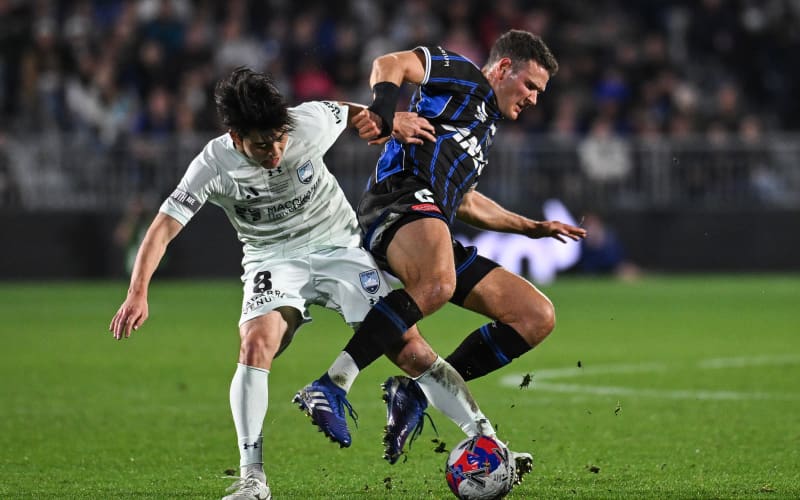
As the A-League prepares to reveal the fixtures for the upcoming season this week, the league and its players are at loggerheads over pay.
The five-year collective bargaining agreements for the A-League Men and A-League Women ended last month and the latest deal is at a stalemate months out from kick off in the 2026-27 season.
The players’ union, Professional Footballers Australia (PFA), rejected the pay deal from the Australian Professional Leagues (APL), who run the A-Leagues, last week.
APL chief executive officer Steve Rosich said in a statement to RNZ the two parties had “collaborative discussions” up until Wednesday’s rejection and have “sought an explanation on the PFA’s position, before further engagement”.
“We have been negotiating in good faith with the PFA for the past eight months to agree a new CBA to ensure the sustainable growth of the A-Leagues for our clubs and players, and are looking to continue to do so.”
Despite the stand-off, Rosich said the draw for the men’s A-League will be released this week and there were “continued positive developments regarding new investors” in the women’s competition.
What the women’s competition would look like for the upcoming season was already uncertain before the CBA hurdle, with Central Coast Mariners women needing to find a new owner before the end of July and Canberra United’s funding also in doubt.
Part of the proposed CBA was the APL wanted to raise the A-League women’s competition salary cap from $A640,000 to $A775,000, boost the minimum wage of female players by 27 per cent to almost $A35,000 per season, and allow clubs to sign two “marquee players” outside the cap.
The offer that was rejected by PFA members included a $A100,000 increase to the $A2.6 million for the men’s salary cap and the limiting of marquee contracts, the value of which sits outside the cap, to just one per club.
The men’s salary cap has been a point of contention between the PFA and APL since new salary cap limits were mooted in 2025.
PFA chief executive Beau Busch told Australian media the proposed CBA did not go far enough.
Busch said players wanted to agree on a one-year deal that was “focused on working with the APL to turn the leagues around”, as reported by news.com.au.
“We believe the A-League Women represents the biggest opportunity in Australian sport and that the A-League Men has the potential to recapture its proven successes, but the negotiation process revealed that the APL lacks belief in the potential of the women’s game and is wedded to a misguided talent-farm strategy for the men’s,” he told the website.
AAP reported Busch wrote in a memo to players that “an overwhelming majority of players elected to reject the APL proposal, believing that it did not advance the players’ and the game’s collective interests.
“The A-Leagues delegates have now formally ratified this position. As such, we have informed APL that their proposal has been rejected and that the CBA negotiation process has been exhausted.”
After the last CBA was locked in in September 2021 the then managing director of APL said: “When APL took control of the leagues, we promised it would herald a new era of investment and this agreement shows the progress that has already been made.
“This is a clear example of what can be achieved when we work together with a common vision to realise the potential of Australian football.”
In 2021 the APL also heralded “players are partners with us in the game and central to its growth …there will be immediate improvements across the men’s and women’s leagues, most notably for women’s football, all of which will flow through into improved experiences for players, and ultimately into growing and improving our game”.
Auckland FC’s inclusion in the women’s competition was delayed until the 2027-28 season after an initial delay but what the league will look like by then could come down to what happens this season.
In August last year, before the 2025-26 season, APL chairman Stephen Conroy said expanding the women’s competition was a “key part” of the strategy but that “challenges unique to our women’s game” had to be considered so “we expand the league at the right pace and with the right investment to ensure long-term sustainable growth.”